
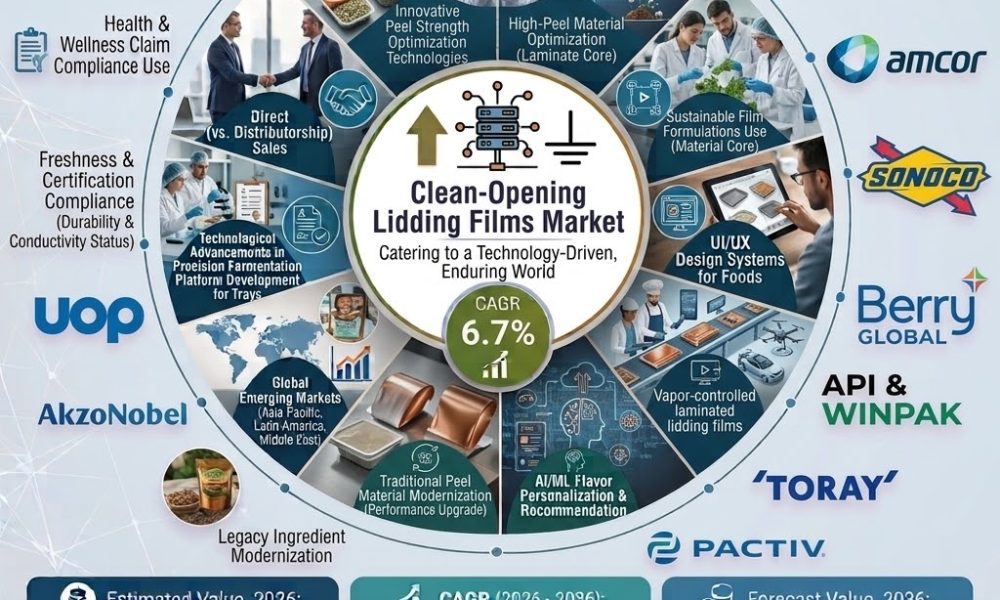
The global clean-opening lidding films market is projected to grow from USD 4.3 billion in 2026 to USD 8.2 billion by 2036, expanding at a 6.7% CAGR during the forecast period. The market was valued at USD 4.0 billion in 2025, creating an absolute opportunity of about USD 3.9 billion through 2036. Demand is being supported by dairy, ready-meal, meat, and cheese packers seeking consistent seal performance and controlled opening behavior.
U.S. food spending reached USD 2.51 trillion in 2025, according to the USDA Economic Research Service in June 2026. This large food market supports recurring use of lidding films across dairy and prepared-food packaging. At the same time, packaging developers are testing film structures against peel force, sealing temperature, dwell time, barrier needs, and recycling requirements.
Get Detailed Market Forecasts, Competitive Benchmarking, and Pricing Trends: https://www.factmr.com/connectus/sample?flag=S&rep_id=16543
Global Segment Leaders
- Peelable sealant — 33.0% share in 2026: Peelable sealants lead the seal-mechanism segment because they help balance package integrity with controlled opening force. Lock-seal/peel hybrids, pressure-assisted peel, retort peel, and low-temperature peel structures serve different processing conditions.
- PET — 34.0% share in 2026: PET leads the base-film segment due to its clarity and stable converting performance. It also provides a suitable base for printing, barrier layers, and heat-seal coatings.
- Clean peel — 37.0% share in 2026: Clean peel is the leading opening-performance category. It addresses residue, stringing, and film tearing while allowing pack makers to specify a more predictable seal interface.
- Dairy cups — 29.0% share in 2026: Dairy cups lead applications because yogurt, desserts, and cultured products are commonly packed in high volumes and require reliable seals with consumer-friendly opening.
Country-Level Performance
- China — 7.5% CAGR: China records the highest projected growth among the profiled markets. The National Bureau of Statistics reported in February 2026 that retail sales of grain, oil, and food by enterprises above the designated size increased 9.3% in 2025. This supports continued demand for sealed dairy cups, prepared meals, and protein trays.
- United States — 7.0% CAGR: U.S. demand is supported by high food consumption and packaged-food production. USDA National Agricultural Statistics Service reported in April 2026 that U.S. milk production reached 232 billion pounds in 2025, supporting recurring lidding requirements for yogurt and other cultured products.
- Japan — 7.0% CAGR: Japan’s outlook is linked to portioned food formats, compact packaging, and recovery considerations. The Statistics Bureau reported in February 2026 that average monthly consumption spending for two-or-more-person households reached 314,001 yen in 2025.
- Germany — 6.8% CAGR: Ready-meal production and recycling requirements shape the German market. Destatis reported in January 2026 that German ready-meal production had increased 25.6% by volume over five years. Germany’s packaging recovery system also keeps recycling compatibility relevant to lid and tray design.
- France — 6.3% CAGR: France closes the displayed country range. INSEE reported on May 29, 2026 that French household spending on food and non-alcoholic beverages reached EUR 192.8 billion in 2025, supporting recurring use of sealed food packaging.
Regional Context
The report covers North America, Latin America, Western Europe, Eastern Europe, East Asia, South Asia & Pacific, and the Middle East & Africa. Country growth spans 1.2 percentage points across the forecast period.
China’s stronger growth reflects expanding packaged-food channels, while the United States and Japan are both projected at 7.0% but have different demand drivers. Germany and France are influenced by ready-meal production, dairy applications, and packaging-recycling requirements. Across regions, pack developers are balancing clean opening with seal security, barrier performance, line compatibility, and material recovery.
Competitive Landscape
Key companies profiled in the clean-opening lidding films market include Amcor, Klöckner Pentaplast, Constantia Flexibles, Coveris, Winpak, and Berry Global. Berry Global’s former film and packaging operations are now represented within Amcor following their combination completed on April 30, 2025.
Constantia Flexibles highlighted an expanded product portfolio in August 2025 that included EcoPeelCover, a thin die-cut aluminum lidding solution for dairy applications. The company stated that the structure reduces aluminum thickness by 25% and coating weight by 50% compared with conventional specifications while maintaining barrier and sealing performance.
Amcor’s combination with Berry Global broadened its film and packaging portfolio. Klöckner Pentaplast provides barrier top-lidding films for rigid trays, while Coveris and Winpak participate across flexible food packaging applications where seal integrity, barrier performance, and production-line compatibility are key requirements.
Analyst Opinion
Shambhu Nath Jha, Principal Consultant at Fact.MR, stated:
“Clean opening is a testing issue as much as a convenience feature. The market is expected to reward films that hold a stable seal window while keeping peel force consistent after filling and cold-chain handling. Firms should combine substrate control with pack testing and clear seal-performance files.”
Key Market Considerations
Film manufacturers and packaging developers are expected to focus on several technical requirements:
- Documenting peel-force ranges across common cup and tray substrates.
- Testing lidding films on production lines because sealing temperature and dwell time can alter peel behavior.
- Evaluating recyclable PE and PP combinations where material structures permit.
- Developing lower-gauge films without losing stable peel performance.
- Checking recycling compatibility when different materials are combined.
- Maintaining a balance between peel force and seal security.
Research Methodology
Fact.MR’s analysis draws on 120+ sources, 35+ company portfolios, 25+ countries, and more than 20 industry interviews. Primary research included manufacturers, service providers, technology developers, distributors, end users, and subject-matter experts. Desk research covered government statistics, regulatory publications, company filings, trade data, technical studies, industry associations, standards, and public policy.
Explore More Related Studies Published by Fact.MR Research:
Hydrophilic Thermoplastic Resins Market
Compressed Air Quality Sensors Market
About Fact.MR
Fact.MR is a leading provider of market research and consulting services, offering syndicated and customized research across industries including Consumer Goods, Healthcare, and Chemicals & Materials.



