
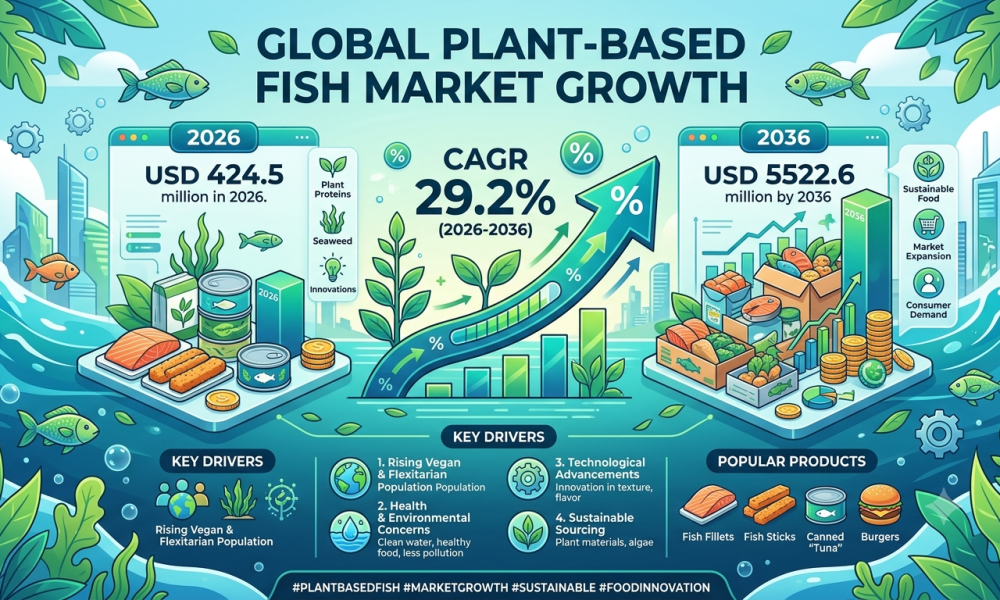
The global plant-based fish market is projected to grow from USD 424.5 million in 2026 to USD 5.52 billion by 2036, registering a 29.2% CAGR during the forecast period. Demand is supported by familiar seafood meal occasions, growing interest in alternative proteins, wider retail availability, and improvements in texture and cooking performance. Suppliers are increasingly focusing on products that replicate the eating experience of conventional seafood while addressing pricing and sensory gaps.
Plant-based fish products are gaining traction across familiar formats such as patties, fillets, tuna alternatives, and prepared seafood applications. Retail remains an important route for category expansion, while refrigerated products continue to dominate due to the texture-sensitive nature of many fish alternatives. However, price premiums and differences in taste and texture remain important factors influencing repeat purchases.
Get detailed market forecasts, competitive benchmarking, and pricing trends: https://www.futuremarketinsights.com/reports/sample/rep-gb-12756
Global Segment Leaders
- Product Type – Burger Patty: 39.6% in 2026. Standardized portions simplify household preparation and commercial menu costing, supporting the adoption of patty formats.
- Nature – Plant-based Fishless Fish: 84.6% in 2026. The category offers a wider range of seafood-style applications beyond tuna, supporting broader product development and meal occasions.
- Merchandising Format – Refrigerated Product: 87.6% in 2026. Chilled placement helps maintain texture and positions plant-based fish alongside familiar refrigerated seafood products.
- Source – Soy-based Protein: 34.6% in 2026. Soy provides established texturization functionality for structured fish alternatives, while pea and wheat proteins are also used for selected formulations.
- Distribution Channel – Retail: 53.1% in 2026. Grocery retail provides a broad platform for household trial, repeat purchasing, pack-price comparison, and shelf-level category expansion.
Country-Level Performance
Spain is projected to grow at the fastest pace, with a 35.9% CAGR through 2036. The outlook is supported by established plant-based grocery purchasing and growing interest in alternative proteins, although price sensitivity remains an important consideration.
The United Kingdom is expected to record a 31.2% CAGR, supported by measurable growth in plant-based seafood. GFI Europe recorded 8.5% unit growth and 13.7% volume growth for UK plant-based seafood during 2025.
The United States is forecast to grow at a 30.4% CAGR. Plant-based fish products compete directly with conventional seafood and other proteins, making taste, texture, pricing, and product positioning important factors for repeat purchasing.
France is projected to expand at a 29.6% CAGR, supported by increasing private-label participation in plant-based proteins. GFI Europe recorded 16.8% plant-based meat volume growth in 2025, with private labels accounting for 22% of category volume.
Poland is expected to grow at a 28.5% CAGR, with growing interest in reducing animal-protein consumption supporting opportunities for alternative seafood products.
Germany is projected to record a 28.1% CAGR. The market faces sensory challenges, with GFI Europe reporting a 29.4% decline in plant-based seafood volume in 2025 and linking the weakness to taste and texture gaps.
Italy is forecast to grow at a 25.8% CAGR. Lower prices and private-label participation are helping reduce trial barriers for plant-based proteins, while fish-style products continue to require convincing texture and convenient preparation.
Japan is expected to record a 22.0% CAGR. National food-technology initiatives and organized testing and commercialization programs are creating routes for non-animal protein products.
Regional Context
Spain, the United Kingdom, and the United States represent the higher-growth country markets profiled in the report, with CAGRs of 35.9%, 31.2%, and 30.4%, respectively. Growth across these markets is supported by established plant-based food exposure, retail testing, and consumer familiarity with alternative proteins.
France, Poland, and Germany are projected to record CAGRs between 29.6% and 28.1%. These markets present opportunities for expansion through private-label development, meat-reduction trends, and wider retail availability, while pricing and sensory performance remain important considerations.
Italy and Japan record CAGRs of 25.8% and 22.0%, respectively. Their markets are supported by affordability initiatives, private-label participation, and structured food-technology commercialization programs.
The full report covers North America, Latin America, Western Europe, Eastern Europe, East Asia, South Asia and Pacific, and the Middle East and Africa, with country-level analysis across the profiled markets.
Competitive Landscape
The competitive landscape includes Revo Foods GmbH, BettaF!sh (Bayou Best Foods), Steakholder Foods Ltd., Schouten Europe B.V., Oshi Inc., New School Foods Inc., Save Da Sea Foods Inc., The Plant Based Seafood Co., Fysh Foods (City Roots Hospitality), and IBIDEN Bussan Co., Ltd. Companies compete across whole-cut fish, tuna alternatives, patties, prepared seafood, and shellfish-style formats. Competition is shaped by sensory performance, production scalability, pricing, retail access, and product format.
Recent developments include Steakholder Foods moving white-fish kebabs and salmon patties into leading vegan specialty stores across Israel in July 2025, following production scale-up with Bondor Foods. Revo Foods returned THE KRAKEN to permanent European sales in July 2025, using its 3D extrusion technology to structure fermented mycoprotein into seafood formats. Schouten Europe introduced plant-based tuna in September 2025, offering chilled professional packs with a minimum three-month shelf life.
Access full Report in PDF Format@ https://www.futuremarketinsights.com/reports/brochure/rep-gb-12756
Analyst Perspective
“Plant-based fish earns repeat space by matching the texture and cooking behavior consumers expect from conventional seafood. Suppliers need consistent production and realistic pricing to expand distribution beyond controlled trials.”
— Nandini Roy Choudhury, Principal Consultant, Future Market Insights
About Future Market Insights (FMI)
Future Market Insights, Inc. (FMI) is an ESOMAR-certified, ISO 9001:2015 market research and consulting organization, trusted by Fortune 500 clients and global enterprises. With operations in the U.S., UK, India, and Dubai, FMI provides data-backed insights and strategic intelligence across 30+ industries and 1200 markets worldwide.



