
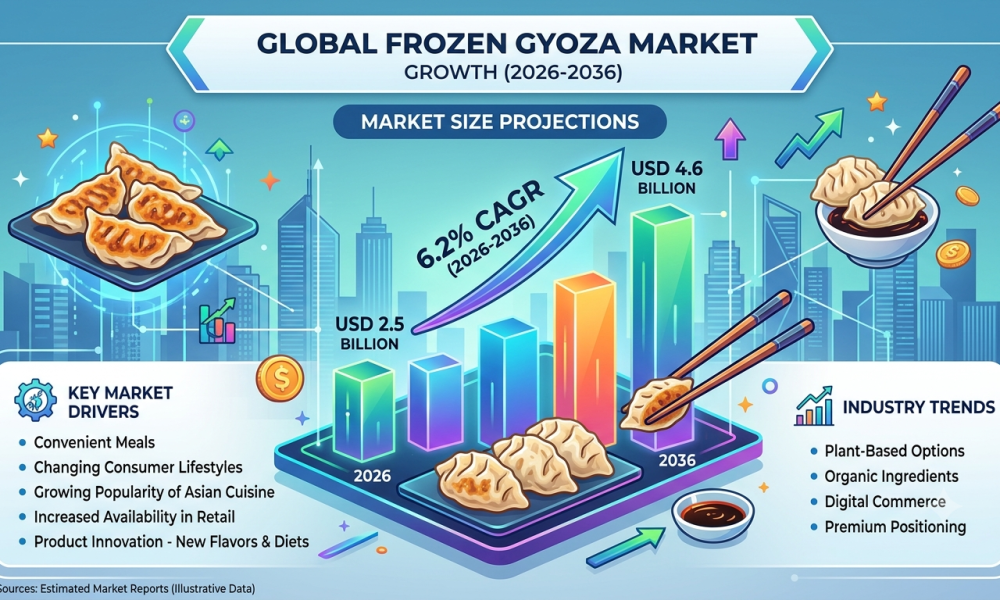
The global frozen gyoza market is projected to grow from USD 2.5 billion in 2026 to USD 4.6 billion by 2036, registering a 6.2% CAGR during the forecast period. The market was valued at USD 2.4 billion in 2025. Growth is supported by rising household demand for convenient frozen meals, expanding Asian-food retail distribution, product innovation, and simplified cooking formats. Japan remains a key reference market, with the Japan Frozen Food Association reporting 109.5 thousand tonnes of frozen gyoza production in 2025, up 13.0% year on year.
Convenience is becoming an increasingly important factor in frozen gyoza purchasing. Manufacturers are developing products that reduce cooking steps, including oil-free, water-free, lid-free skillet formats and microwave-ready options. Air-fryer preparation, larger meal-style dumplings, plant-based fillings, and foodservice bulk packs are also creating opportunities to expand consumption occasions. Overseas markets are gaining access through supermarkets, warehouse clubs, Asian grocery stores, online grocery platforms, and foodservice distribution.
Get detailed market forecasts, competitive benchmarking, and industry insights: https://www.futuremarketinsights.com/reports/sample/rep-gb-35507
Global Segment Leaders
- Filling Type – Pork & Vegetable: 34.0% in 2026. The segment leads as pork provides familiar flavor and moisture, while vegetables such as cabbage, chive, leek, and onion add texture and support established gyoza taste profiles.
- Wrapper Profile – Thin Wheat Wrapper: 63.0% in 2026. Thin wheat wrappers support the crisp-base and tender-top texture expected from pan-fried gyoza while providing a delicate eating experience.
- Cooking Method – Pan-Fry / Skillet: 52.0% in 2026. Skillet preparation remains central to the category because it delivers the browned base, steamed upper wrapper, and heated filling associated with gyoza.
- Pack Format – Multi-serve Bags: 57.0% in 2026. Multi-serve formats allow households to adjust portion sizes and return unused products to the freezer, supporting both family and smaller-household consumption.
- Sales Channel – Supermarkets & Hypermarkets: 43.0% in 2026. Mainstream supermarkets provide established freezer infrastructure and frequent household shopping traffic, helping frozen gyoza reach consumers beyond specialty Asian stores.
Country-Level Performance
Australia is projected to record the fastest growth among the profiled countries, expanding at a 7.6% CAGR through 2036. Growth is supported by multicultural consumer demand and broader supermarket access. CJ Foods expanded frozen dumpling availability through IGA stores nationwide in January 2025, strengthening mainstream retail exposure.
The United Kingdom is expected to grow at a 7.4% CAGR, supported by expanding Asian-food retail exposure and established distribution networks. The 2021 Census recorded 5.5 million people identifying within the Asian, Asian British, or Asian Welsh category, providing a substantial consumer base for Asian food products.
The United States is forecast to expand at a 7.1% CAGR. The market benefits from a large Asian consumer base, established frozen-food infrastructure, and the availability of gyoza across grocery, warehouse club, and foodservice channels.
Canada is projected to grow at a 6.9% CAGR, supported by established Asian communities and developed North American frozen-food supply routes. The country also provides access to established Asian-food retail and distribution networks.
Germany is expected to record a 6.8% CAGR, supported by European frozen-food distribution and expanding regional dumpling manufacturing. Investments in European production capacity are helping suppliers strengthen regional supply routes.
Japan is projected to grow at a 5.4% CAGR. As a mature frozen gyoza market, growth is increasingly linked to product renewal, microwave formats, convenience improvements, and continued household penetration.
South Korea is forecast to expand at a 5.0% CAGR. The market already has an established frozen-dumpling category, making product innovation, convenience formats, and premiumization important avenues for further expansion.
Regional Context
Australia, the United Kingdom, the United States, Canada, and Germany represent the faster-growing group of profiled countries, with CAGRs ranging from 7.6% to 6.8%. These markets benefit from expanding Asian-food exposure, multicultural consumer bases, mainstream supermarket distribution, and established frozen-food infrastructure.
Japan and South Korea represent more mature markets, with CAGRs of 5.4% and 5.0%, respectively. Their growth is increasingly driven by format innovation, household penetration, product renewal, and convenient preparation methods rather than initial category development.
The full report covers North America, Latin America, Western Europe, Eastern Europe, East Asia, South Asia & Pacific, and the Middle East & Africa, with Australia, the United Kingdom, the United States, Canada, Germany, Japan, and South Korea profiled individually.
Competitive Landscape
The competitive landscape includes Ajinomoto Frozen Foods Co., Inc., Eat&Foods Co., Ltd. / Osaka Ohsho, CJ Foods / bibigo, Ajinomoto Foods North America, Inc., Day-Lee Foods, Inc., Wei-Chuan U.S.A., Inc., Wismettac Asian Foods, Inc., and Pulmuone Foods USA. Competition is shaped by filling variety, wrapper performance, cooking convenience, pack formats, retail distribution, foodservice reach, and regional manufacturing capacity.
Recent developments are focused heavily on convenience and local production. In February 2026, Ajinomoto Frozen Foods began rolling out renewed core Gyoza products designed to achieve even browning on induction cooktops without requiring oil, added water, or a lid. The company also expanded microwave and larger-size formats.
In July 2026, Eat&Foods announced its 2026 autumn-winter frozen-food range for September rollout, including new and renewed Osaka Ohsho gyoza products with expanded filling, pack, and flavor options.
In September 2025, CJ Foods opened its Chiba mandu plant in Japan following an investment of approximately KRW 100.0 billion, or USD 73.0 million. The 8,200-square-meter facility provides local production capacity and supports nationwide distribution.
Analyst Perspective
“Gyoza has to brown underneath while the wrapper stays intact and the filling heats through. Failures are immediately visible in the pan: torn skins, sticking or excess water. Manufacturers are addressing those problems through wrapper formulation and simpler cooking methods. Pack sizes and directions also need to suit the cookware and meal portions used in each retail market.”
— Nandini Roy Choudhury, Principal Consultant, Future Market Insights
Explore More Insights from the Food & Beverage Industry Analysis
Gluten-Free Cakes Market: https://www.openpr.com/news/4641970/gluten-free-cakes-market-to-reach-usd-4-22-billion-by-2036
Gluten-Free Sourdough Market: https://www.openpr.com/news/4642101/gluten-free-sourdough-market-to-reach-usd-3-559-7-million
About Future Market Insights (FMI)
Future Market Insights, Inc. (FMI) is an ESOMAR-certified, ISO 9001:2015 market research and consulting organization, trusted by Fortune 500 clients and global enterprises. With operations in the U.S., UK, India, and Dubai, FMI provides data-backed insights and strategic intelligence across 30+ industries and 1200 markets worldwide.



