
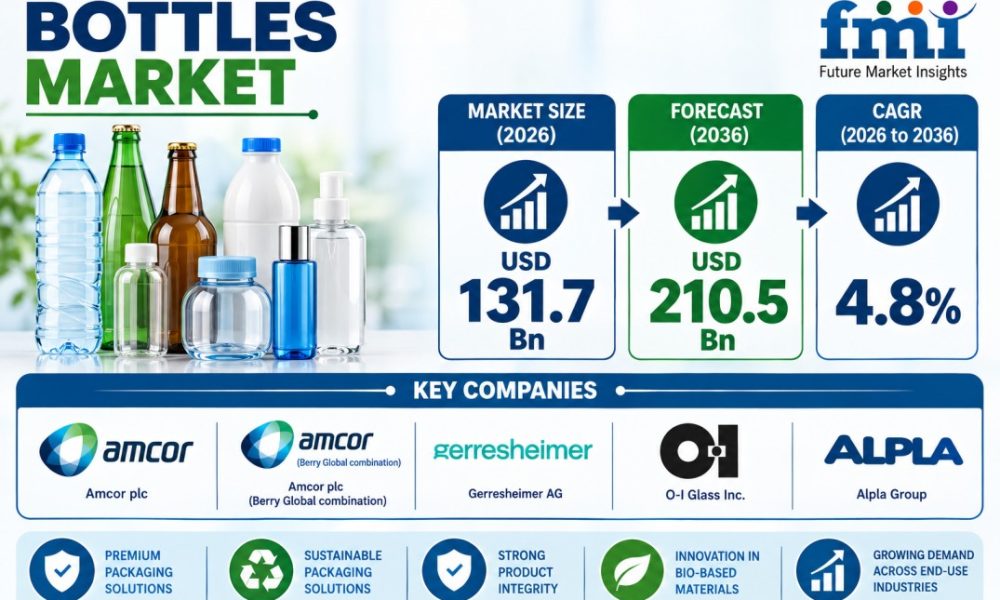
The global Bottles Market is projected to grow from USD 131.7 billion in 2026 to USD 210.5 billion by 2036, registering a 4.8% CAGR during the forecast period, according to Future Market Insights (FMI).
The market was valued at USD 125.7 billion in 2025, creating an absolute dollar opportunity of USD 78.8 billion between 2026 and 2036.
Bottles remain fundamental to beverage, pharmaceutical, personal care, food, and homecare packaging. Demand is increasingly being shaped by beverage consumption, pharmaceutical packaging requirements, recycled-content regulations, lightweighting initiatives, and premium packaging trends.
>> Get Detailed Market Forecasts, Competitive Benchmarking, and Pricing Trends: https://www.futuremarketinsights.com/reports/sample/rep-gb-14353
Plastic Bottles Lead Product Demand
Plastic bottles are expected to account for 51.0% of the product segment in 2026.
PET bottles are widely used in beverages because of their lightweight construction, transparency, shatter resistance, and compatibility with high-speed filling.
HDPE bottles are important in household chemicals, personal care, and pharmaceutical applications where chemical resistance and barrier performance are required.
The growth of recycled-content requirements is also changing the plastic bottle supply chain. Brand owners are increasing their focus on rPET availability, collection systems, sorting capacity, and bottle-to-bottle recycling infrastructure.
Beverages Remain the Largest End Use
The beverages segment accounts for 34.0% of end-use demand in 2026.
Bottled water represents a major source of volume, followed by carbonated soft drinks, juices, and functional beverages.
PET remains widely used for high-volume beverage applications because it combines low weight with shatter resistance and efficient filling-line performance.
At the premium end of the market, glass continues to play an important role in spirits, craft beverages, and differentiated beverage products.
Premiumization is encouraging brands to invest in custom shapes, colors, embossing, specialty finishes, and distinctive closures.
Screw Caps Remain the Leading Closure Format
Screw cap bottles account for 58.0% of closure demand in 2026.
Their resealability and compatibility with automated filling and capping systems make them suitable across beverages, personal care, food, and pharmaceutical applications.
Pharmaceutical applications also create demand for specialized closure systems, including child-resistant and tamper-evident configurations.
These requirements increase the importance of bottle-and-closure compatibility during supplier qualification.
Sustainability Is Reshaping Material Selection
Recycled content mandates across Europe and North America are influencing bottle procurement.
European regulations requiring minimum recycled content in plastic bottles are encouraging investment in PET collection, sorting, and recycling infrastructure.
Glass manufacturers also benefit from high cullet recycling rates, which can support recycled-content targets and reduce energy requirements during glass melting.
For brand owners, the material decision increasingly involves more than cost and appearance.
Procurement teams must consider:
- Recycled-content availability
- Material consistency
- Lightweighting
- Recycling infrastructure
- Regulatory requirements
- Supply reliability
According to Nandini Roy Choudhury, Principal Consultant at Future Market Insights:
“Companies that combine material science capability with scale production across both plastic and glass formats are positioned to serve the evolving needs of beverage and pharmaceutical customers through the forecast period.”
South Korea Leads Country Growth
South Korea is projected to record the fastest country growth at 5.1% CAGR through 2036.
Premium cosmetics and K-beauty are contributing to demand for differentiated glass and specialty plastic bottles, while sustainability-focused material development is creating opportunities for recyclable formats.
The USA is projected to grow at 5.0% CAGR, supported by beverage consumption, pharmaceutical packaging requirements, and retailer sustainability mandates.
Japan is forecast at 4.9%, the EU at 4.8%, and the UK at 4.6%.
>> Exclusive Discounts on Full Report: https://www.futuremarketinsights.com/reports/brochure/rep-gb-14353
Capacity and Distribution Shape Procurement
The 501–1,000 ml capacity range accounts for 31.0% of demand in 2026.
This range serves common beverage sizes as well as household and personal care applications.
Direct sales account for 61.0% of distribution, reflecting long-term supply agreements and contract manufacturing relationships between bottle producers and brand owners.
Online channels are becoming more relevant for smaller brands and businesses requiring lower-volume packaging purchases.
Competition Combines Scale With Material Expertise
The competitive landscape includes companies with significant manufacturing capacity across plastic and glass formats.
Key companies profiled by FMI include Amcor plc, Amcor plc (Berry Global combination), Gerresheimer AG, O-I Glass Inc., Alpla Group, Crown Holdings, Tetra Pak, Ardagh Group, and Berlin Packaging.
Amcor is identified as a major player in PET bottle manufacturing and recycled-content solutions. O-I Glass maintains a strong position in glass bottles, while Gerresheimer serves specialty pharmaceutical packaging requirements.
Competitive differentiation increasingly depends on manufacturing scale, recycled-content capabilities, geographic reach, material expertise, and application-specific packaging solutions.
About the Bottles Market Report
The Future Market Insights study analyzes the bottles market by product, material, capacity, closure type, application, end use, and distribution channel.
Products covered include glass, plastic, metal, and paper bottles. End-use categories include food, beverages, pharmaceuticals, personal care and cosmetics, homecare, and chemicals.
The report covers the 2026–2036 forecast period across North America, Latin America, Western Europe, Eastern Europe, East Asia, South Asia and Pacific, and the Middle East and Africa.
To explore how FMI Custom Research can support your strategic priorities, connect with our team at – [email protected]
About Future Market Insights (FMI)
Future Market Insights, Inc. is an ESOMAR-certified, ISO 9001:2015 market research and consulting organization trusted by Fortune 500 companies. With a global presence across the U.S., UK, India, and Dubai, FMI delivers data-driven insights across 30+ industries and 1200 markets worldwide.



