
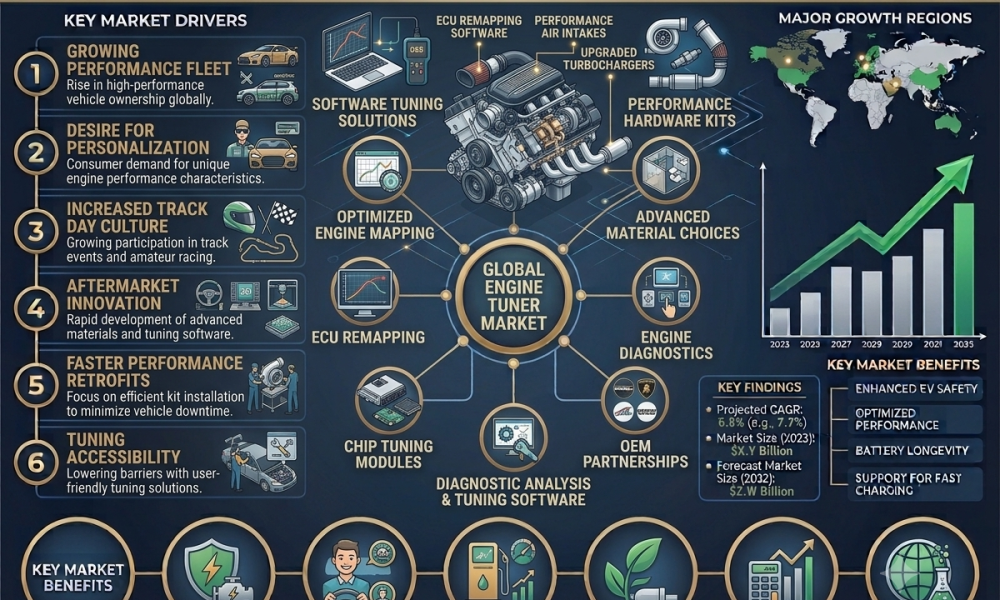
The global engine tuner market is projected to expand from USD 4.2 billion in 2025 to USD 7.1 billion by 2036, advancing at a 5.0% CAGR from 2026 to 2036. The market is expected to reach USD 4.4 billion by 2026-end, supported by growing automotive enthusiast culture, increasing electronic engine management adoption, and demand for aftermarket solutions that improve vehicle performance, fuel efficiency, and emissions control.
A key demand factor is the increasing integration of electronic engine management systems across modern vehicles. Hardware and software tuning solutions allow vehicle owners, performance shops, and motorsport operators to modify engine parameters such as fuel injection, ignition timing, boost pressure, and transmission shift points. Growing motorsport participation and track-day activity are also supporting demand for higher-stage tuning products and professional calibration services.
Global Segment Leaders
- Hardware Engine Tuners — 45.0% share: Hardware engine tuners lead the product segment, including plug-in performance modules, standalone ECU systems, piggyback controllers, and handheld programmers that modify engine operating parameters.
- Performance Enhancement — 40.0% share: Performance enhancement represents the leading application segment as vehicle owners seek higher power output, improved torque, and sharper throttle response through engine calibration.
- Passenger Vehicles — 65.0% share: Passenger vehicles account for the leading vehicle-type share, reflecting widespread tuning activity across sedans, SUVs, trucks, sports cars, and other personal vehicle platforms.
- Aftermarket — Leading sales channel: Specialty performance retailers, online platforms, and vehicle-specific tuning shops remain important distribution channels for engine tuner products and calibration solutions.
- Stage 1 Tuning — Leading tuning stage: Software-only ECU remapping represents the largest volume category, while Stage 2 and Stage 3 tuning increasingly target dedicated enthusiasts and competition vehicles requiring additional hardware modifications.
Get detailed market forecasts, competitive benchmarking, and pricing trends:
https://www.futuremarketinsights.com/reports/sample/rep-gb-14124
Country-Level Performance
The United States is projected to record the highest growth among the profiled markets, expanding at a 5.3% CAGR through 2036. Demand is supported by a strong automotive enthusiast culture, an established aftermarket distribution network, and continued interest in performance and efficiency tuning across truck, SUV, sports car, and other passenger vehicle segments.
South Korea follows with a 5.2% CAGR, supported by domestic automotive manufacturing, an active tuning culture around Hyundai and Kia platforms, and growing motorsport participation. The country’s established vehicle production ecosystem also provides a broad platform base for vehicle-specific tuning solutions.
The European Union is expected to expand at a 5.0% CAGR, reflecting continued demand for vehicle personalization and performance optimization alongside growing interest in software-based ECU calibration. Emissions requirements and vehicle software regulations remain important considerations for aftermarket tuning providers operating across European markets.
The United Kingdom is projected to record a 4.8% CAGR. Demand is supported by established performance retailers, specialist tuning workshops, motorsport participation, and a mature automotive enthusiast community. Regulatory requirements surrounding emissions and road-legal modifications influence the range of tuning solutions available to consumers.
Japan is projected to record a 4.7% CAGR, the lowest among the profiled markets. The market benefits from a long-established performance vehicle culture, motorsport participation, and demand for tuning solutions compatible with Japanese vehicle platforms. Vehicle software integration and regulatory considerations remain important factors shaping product development.
Overall, the report identifies the USA, South Korea, EU, UK, and Japan as key growth markets for engine tuning solutions.
Regional Context
The United States and South Korea form the faster-growing country group, with CAGRs of 5.3% and 5.2%, respectively. The United States benefits from its large automotive aftermarket, strong enthusiast culture, and demand for performance and towing optimization across trucks and sports cars. South Korea is supported by domestic vehicle manufacturing, active tuning communities, and motorsport participation.
The European Union follows at 5.0%, with demand shaped by vehicle personalization, software-based engine calibration, and the installed base of electronically managed gasoline and diesel vehicles. Regulatory requirements around emissions compliance remain an important consideration for tuning companies.
The United Kingdom and Japan record slower growth at 4.8% and 4.7%, respectively. Both markets maintain established enthusiast and performance communities, while emissions regulations, vehicle software security, and platform-specific requirements influence aftermarket tuning adoption.
The full report covers five key country markets, including the United States, South Korea, European Union, United Kingdom, and Japan.
Drive Your Business Growth Strategy: Checkout the Report for Key Insights!
https://www.futuremarketinsights.com/checkout/14124
Competitive Landscape
The competitive landscape includes Bosch Motorsport, Cobb Tuning, Dimsport Srl, Superchips Ltd., RaceChip Chiptuning GmbH, and other tuning providers. Market participants compete through vehicle-platform compatibility, calibration capabilities, tuning stages, plug-and-play installation formats, diagnostic functions, and aftermarket distribution relationships.
Hardware-focused providers offer plug-in modules, handheld programmers, piggyback controllers, and standalone ECU systems, while software-oriented companies increasingly provide customizable calibration maps and digital tuning platforms. Data logging and diagnostic capabilities are becoming important differentiators as modern vehicles rely more extensively on electronically controlled powertrains.
FMI Principal Consultant Nikhil Kaitwade observes, “Tuning companies that can deliver emissions-compliant performance solutions compatible with modern OBDII and EOBD vehicle diagnostics systems are likely to expand their addressable market over the forecast period.”
What Is Driving Demand for Engine Tuners?
Automotive enthusiast culture and vehicle personalization remain major demand drivers. Vehicle owners increasingly use engine tuning to modify power delivery, throttle response, torque characteristics, and overall driving performance. This trend is particularly relevant across sports cars, performance vehicles, trucks, SUVs, and other enthusiast-oriented platforms.
The growing electronic content of modern vehicles is also changing the engine tuner market. Software-based tuning platforms can modify ECU calibration parameters without requiring extensive mechanical modifications. Handheld programmers connected through vehicle OBD ports can store multiple calibration maps, while data-logging capabilities allow users and professional tuners to monitor engine parameters during operation.
Hardware engine tuners account for 45.0% of product share, reflecting continued demand for plug-in performance modules, piggyback controllers, standalone ECUs, and handheld programming devices. These systems can modify parameters associated with fuel injection, ignition timing, turbocharger boost pressure, and transmission shift behavior.
Performance enhancement represents 40.0% of application share. Vehicle owners primarily seek higher horsepower, torque, and throttle response through calibration adjustments. Stage 1 tuning typically focuses on software-only ECU remapping, while Stage 2 and Stage 3 applications may require supporting hardware and professional dyno calibration.
Diesel tuning represents another demand opportunity. Commercial vehicle operators and individual diesel vehicle owners use calibration optimization to target fuel efficiency, torque, and towing performance. Fleet applications can therefore extend the engine tuner market beyond enthusiast-focused performance upgrades.
At the same time, emissions regulation and vehicle software security create constraints. Alterations to factory emissions-control systems can face legal restrictions, while increasing vehicle cybersecurity requirements can limit access to engine-control parameters. Tuning providers therefore face growing pressure to develop solutions that remain compatible with OBDII and EOBD diagnostic architectures while meeting applicable emissions requirements.
The transition toward electric vehicles represents a longer-term structural challenge for the engine tuner market because EVs do not use conventional internal-combustion engine calibration. However, the large installed base of gasoline and diesel vehicles continues to provide a substantial addressable market for engine tuning products through the forecast period.
Technology adoption is also moving the market from standalone hardware toward integrated hardware-software platforms. Customizable tuning maps, remote calibration capabilities, data logging, and diagnostic functions are creating more connected tuning ecosystems for vehicle owners, performance shops, and motorsport operators.
How Is the Engine Tuner Market Segmented?
The engine tuner market is segmented by product, application, vehicle type, fuel type, tuning stage, component, and end use.
- Hardware Engine Tuners — 45.0% share: Physical ECU interface devices, plug-in modules, piggyback controllers, standalone ECUs, and handheld programmers account for the leading product segment.
- Performance Enhancement — 40.0% share: Power output and throttle response improvements represent the largest application category.
- Passenger Vehicles — 65.0% share: Passenger vehicles lead demand, encompassing sedans, SUVs, trucks, sports cars, and other personal vehicles.
- Gasoline and Diesel Engines: Tuning solutions address both gasoline and diesel powertrains, with diesel applications supporting fuel-efficiency and towing optimization.
- Stage 1, Stage 2, and Stage 3: Stage 1 focuses primarily on software calibration, while higher-stage tuning incorporates additional supporting hardware and professional calibration.
- Aftermarket, OEM, and Motorsports: Aftermarket applications represent the principal distribution environment, while motorsports creates demand for advanced tuning and dyno-calibrated systems.
The market excludes diagnostic-only tools without tuning capability, separately sold exhaust and intake hardware, and factory-installed engine management systems.
About Future Market Insights
Future Market Insights (FMI) is a leading provider of market research and consulting services, offering syndicated and customized research across industries including automotive, mobility, and industrial technology. FMI provides actionable insights into emerging market trends, competitive landscapes, demand patterns, and technology adoption to support strategic business decisions.



