
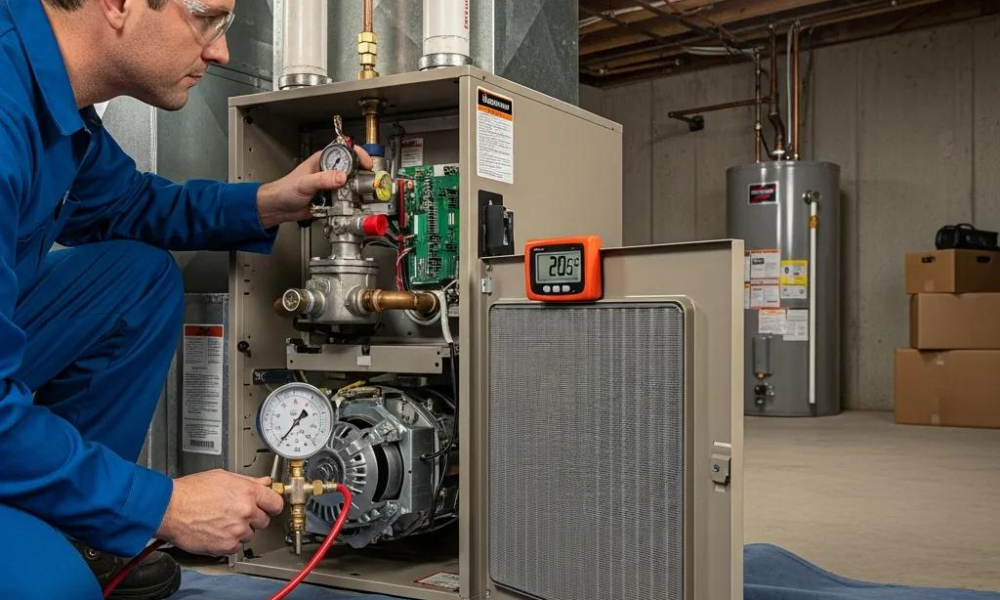
Heating services Richmond homeowners depend on become most critical right when the season shifts — that first week when temperatures drop overnight and the furnace runs constantly for the first time in months. That’s when problems that were easy to ignore in fall become impossible to overlook, and when the cost of not having dealt with them earlier becomes painfully clear. Knowing what to watch for before things get urgent is the difference between a quick service call and an emergency repair in the middle of January.
Uneven Temperatures Across the House
Walk through your home on a cold day and pay attention to whether certain rooms feel noticeably colder than others. A bedroom that’s consistently cooler than the rest of the house, or a living room that takes much longer to reach the thermostat setting, is a sign that something in the heating system isn’t working uniformly.
The causes range from simple — a closed or blocked vent, a dirty filter restricting airflow — to more involved, like a failing zone control system or a furnace losing capacity. Either way, the pattern tends to worsen rather than resolve on its own. Scheduling a heating services Richmond inspection early is significantly cheaper than waiting until the system degrades further.
Noises That Weren’t There Before
A properly functioning heating system runs quietly. If your furnace or heat pump has started making sounds it didn’t make last winter — banging when it kicks on, rattling while it runs, squealing that comes and goes — those sounds are worth taking seriously. Banging typically points to delayed ignition in a gas furnace. Rattling usually means something has come loose inside the unit. Squealing suggests a motor bearing or belt issue.
None of these problems fix themselves, and most get worse the longer the system keeps running. Scheduling a heater furnace repair inspection before the noise becomes a failure is almost always the lower-cost path.
Energy Bills Climbing Without Explanation
If your heating costs have gone up meaningfully compared to the same period last year — and you haven’t changed your thermostat habits or added square footage — the system is working harder than it should to maintain the same temperature. That extra effort shows up directly in your utility bills before it ever shows up as a visible breakdown.
Reduced efficiency usually traces back to one of a few things: a dirty filter reducing airflow, a blower motor that’s struggling, or ductwork leaks bleeding conditioned air before it reaches the living spaces. Professional HVAC services can identify exactly where the efficiency loss is happening and what it would take to correct it.
Short Cycling
Short cycling — when the heating system turns on, runs briefly, shuts off, and then repeats that cycle frequently — is hard on equipment and easy to miss if you’re not paying close attention. A system that’s short cycling is failing to complete full heating cycles, which means it’s not reaching temperature efficiently and is putting extra stress on components every time it starts up.
Common culprits include a dirty air filter, an oversized unit, or a malfunctioning thermostat. All of them warrant professional diagnosis rather than guesswork.
Age and What It Means for Your Heating System
Most furnaces and heat pumps are rated for 15 to 20 years of useful life under normal operating conditions. A heating system past the 15-year mark isn’t necessarily due for replacement, but it does need closer attention. Component failures become more frequent as systems age, parts become harder to source for older models, and efficiency tends to decline even in units that appear to be running normally.
Consistent HVAC maintenance service is the most effective strategy for extending useful life — catching small problems before they become expensive ones and keeping efficiency as high as possible for as long as the system makes sense to maintain.
The Yellow Flame Warning
For homes with gas furnaces, the color of the burner flame is worth checking periodically. A healthy gas flame burns blue and steady. A yellow or orange flame, or one that flickers inconsistently, can indicate incomplete combustion — which in some cases means the system is producing carbon monoxide rather than safely venting it. This is one heating services Richmond warning sign that warrants immediate attention rather than a scheduled appointment.
When to Schedule
The best window for scheduling a heating check in Richmond is early fall, before the cold arrives and before demand peaks. Getting ahead of the season means better appointment availability, more time to address anything that turns up, and the peace of mind of knowing your air conditioner and heating system are both ready before they’re needed most.




