
Market Overview
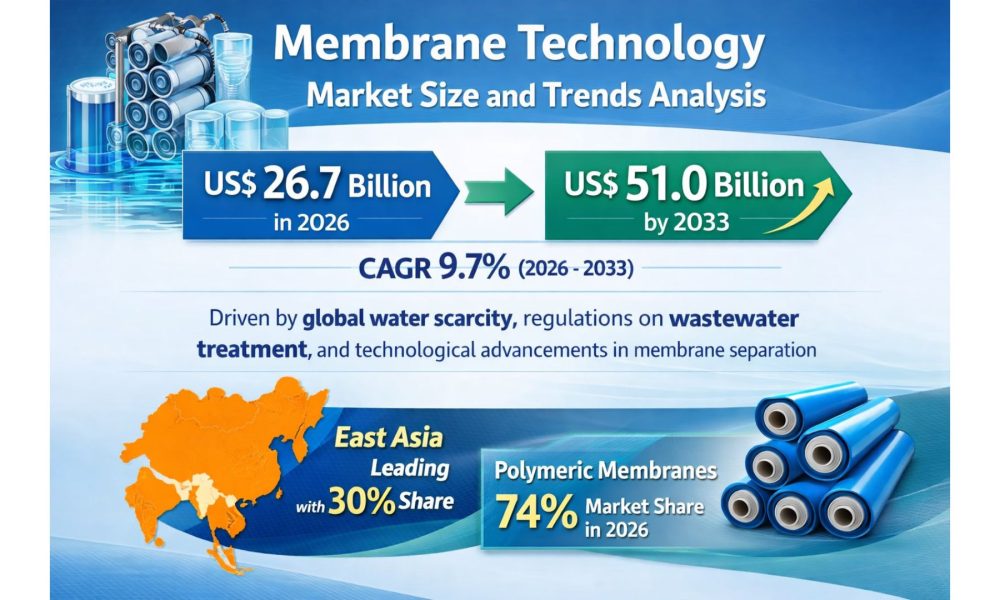
According to insights from Persistence Market Research, the global membrane technology market is projected to be valued at US$ 26.7 billion in 2026 and is expected to reach US$ 51.0 billion by 2033, expanding at a CAGR of 9.7% during 2026–2033.
Membrane technology refers to advanced separation processes using semi-permeable membranes to filter, purify, and separate substances. These technologies are widely used in water and wastewater treatment, desalination, industrial processing, food & beverage, and pharmaceutical applications. The market is experiencing rapid growth due to increasing environmental concerns, water scarcity, and the need for efficient filtration solutions.
Get Your FREE Sample Report Instantly – Click Now: https://www.persistencemarketresearch.com/samples/3024
Key Market Drivers
Rising Global Water Scarcity
One of the most significant drivers of the membrane technology market is the growing global water crisis. A large portion of the global population lacks access to clean drinking water and proper sanitation infrastructure, which is accelerating demand for advanced water purification technologies.
Membrane systems such as reverse osmosis (RO) and ultrafiltration are widely deployed to treat contaminated water, making them essential in achieving global sustainability goals such as clean water and sanitation initiatives.
Increasing Wastewater Treatment Regulations
Governments worldwide are implementing stringent regulations for wastewater treatment and industrial discharge. Industries are increasingly adopting membrane-based filtration systems to comply with environmental standards. This trend is particularly strong in developed regions, where regulatory frameworks are well established.
Technology Insights
The membrane technology market is segmented into reverse osmosis (RO), ultrafiltration (UF), microfiltration (MF), and nanofiltration (NF).
- Reverse osmosis (RO) dominates the market, accounting for around 38% share in 2026, driven by its extensive use in desalination and water purification projects.
- Ultrafiltration and microfiltration are widely used in municipal water treatment and industrial applications.
- Nanofiltration is gaining traction in specialized applications such as chemical processing and pharmaceutical filtration.
These technologies are critical for improving water quality, reducing contaminants, and enabling water reuse.
Membrane Type Analysis
The market is categorized into polymeric membranes, ceramic membranes, and others.
- Polymeric membranes dominate the market with approximately 74% share, owing to their cost-effectiveness and wide applicability across industries.
- Ceramic membranes are the fastest-growing segment due to their superior durability, high temperature resistance, and longer operational lifespan.
The shift toward advanced materials is enabling improved efficiency and performance in harsh industrial environments.
Application Insights
Membrane technology finds applications across multiple industries:
- Water & Wastewater Treatment: The largest segment, driven by increasing demand for clean water and reuse systems.
- Desalination: Rapidly growing due to water scarcity in regions such as the Middle East and South Asia.
- Industrial Processing: Used in chemicals, power plants, and oil & gas industries.
- Food & Beverage & Pharmaceuticals: Ensures product purity and quality through advanced filtration.
The versatility of membrane systems continues to expand their adoption across both traditional and emerging sectors.
Regional Analysis
East Asia Leading the Market
East Asia holds the largest market share, accounting for around 30%, driven by strong industrialization, government investments in water infrastructure, and technological advancements in countries like China, Japan, and South Korea.
North America and Europe
North America accounts for approximately 22% share, supported by strict environmental regulations and high adoption of advanced water treatment technologies. Europe also demonstrates significant growth due to climate change concerns and investments in sustainable water management systems.
Emerging Regions
Regions such as the Middle East and South Asia are witnessing rapid growth due to large-scale desalination projects and increasing water demand. Countries like India and Saudi Arabia are investing heavily in membrane-based water treatment infrastructure.
Market Trends
Advancements in Membrane Materials
Technological innovations, such as conductive membranes and high-performance polymers, are enhancing efficiency and reducing fouling issues. These advancements are improving water output and operational performance.
Expansion into Carbon Capture and Resource Recovery
Membrane technologies are increasingly being explored for carbon capture, lithium extraction, and resource recovery, opening new revenue streams beyond traditional water treatment applications.
Growth of Sustainable Infrastructure
Sustainability initiatives and climate change mitigation efforts are driving investments in energy-efficient membrane systems for water reuse and desalination.
Market Challenges
Despite strong growth prospects, the market faces several challenges:
- Membrane fouling and performance degradation, leading to higher maintenance costs
- High initial investment for advanced membrane systems
- Competition from alternative filtration technologies
Addressing these challenges requires continuous innovation and cost optimization.
Get a Customized Market View in One Click: https://www.persistencemarketresearch.com/request-customization/3024
Competitive Landscape and Key Players
The membrane technology market is moderately consolidated, with major global players dominating key segments. Leading companies focus on product innovation, partnerships, and capacity expansion to strengthen their market position.
Key players include:
- DuPont Water Solutions
- Toray Industries, Inc.
- Veolia Water Technologies & Solutions
- Nitto Denko Corporation (Hydranautics)
- Pall Corporation
- MANN+HUMMEL Water & Membrane Solutions
- Pentair
- Asahi Kasei Corporation
- Merck KGaA
- 3M
- Alfa Laval
These companies are actively investing in advanced membrane technologies and expanding their global footprint.
Conclusion
The global membrane technology market is set for robust growth through 2033, driven by rising water scarcity, stringent environmental regulations, and technological advancements. With increasing adoption across water treatment, desalination, and industrial applications, membrane technologies are becoming indispensable in modern infrastructure.
While challenges such as fouling and high costs persist, continuous innovation and expanding application areas—such as carbon capture and resource recovery—are expected to unlock significant growth opportunities in the coming years.
About Persistence Market Research:
Persistence Market Research delivers strategic research solutions that drive business growth. Founded in 2012 and registered in England and Wales in 2023 as Persistence Research & Consultancy Services Ltd., we have completed 3,600+ custom and syndicated studies and supported 2,700+ projects for leading research firms. Combining traditional methodologies with modern tools, we provide actionable insights to multinational corporations, consultants, investors, and government bodies, earning strong trust through long-term client relationships.
Contact Us:
Persistence Market Research
Second Floor, 150 Fleet Street,
London, EC4A 2DQ, United Kingdom
USA Phone: +1 646-878-6329
UK Phone: +44 203-837-5656
Email: [email protected]
Web: https://www.persistencemarketresearch.com




