
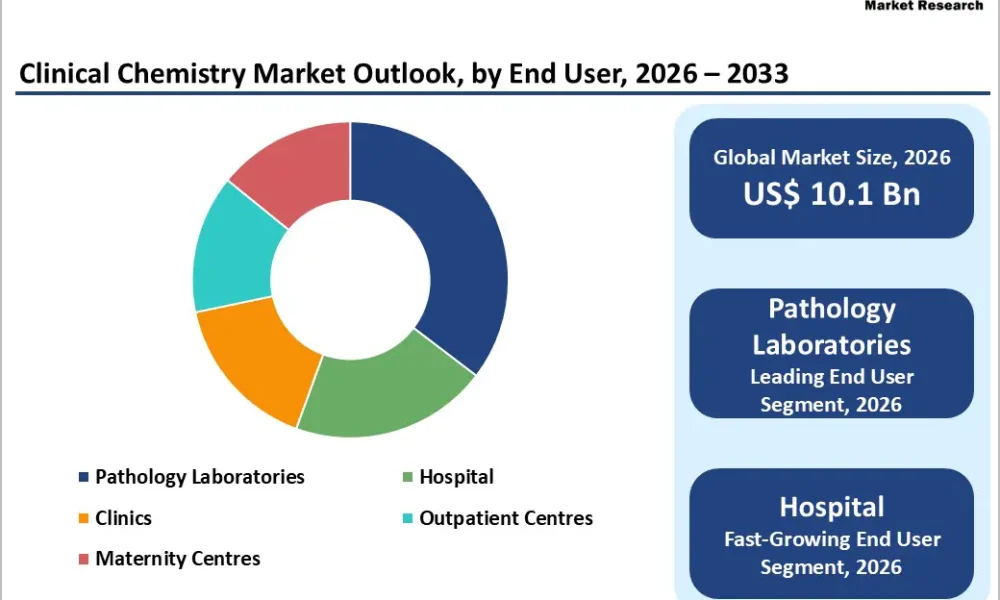
The global clinical chemistry market is poised for substantial growth, with an estimated valuation of US$ 10.1 billion in 2026, projected to reach US$ 13.8 billion by 2033. This expansion corresponds to a compound annual growth rate (CAGR) of 4.6% from 2026 to 2033. A significant driver of this growth is the escalating prevalence of chronic diseases, including diabetes, cardiovascular disorders, and kidney-related conditions. According to the Centers for Disease Control and Prevention (CDC), approximately 129 million adults in the United States suffer from at least one major chronic illness.
Technological advancements, including automated analyzers and point-of-care (POC) testing systems, are enhancing diagnostic efficiency and enabling timely clinical decision-making. Rising healthcare expenditure and government-led early detection initiatives further contribute to market expansion. The World Health Organization (WHO) underscores the global burden of cardiovascular diseases (CVD), emphasizing the need for frequent chemistry panel assessments to monitor and manage patient health effectively.
Download Your Free Sample & Explore Key Insights: https://www.persistencemarketresearch.com/samples/27019
Key Market Highlights
North America dominates the clinical chemistry market, underpinned by advanced laboratory infrastructure, high testing volumes, favorable reimbursement frameworks, and rapid adoption of automation technologies. In contrast, the Asia Pacific region represents the fastest-growing market segment, driven by expanding hospital networks, an increasing burden of chronic diseases, national health screening programs, and rising healthcare investments.
Among product segments, clinical chemistry reagents account for the largest share due to their recurrent usage in routine metabolic, lipid, renal, and electrolyte testing across hospitals, laboratories, and outpatient care settings. High-throughput automated analyzers and digital laboratory systems represent the fastest-growing technology segment, fueled by workforce shortages, laboratory consolidation trends, and the rising demand for operational efficiency.
| Key Insights | Details |
|---|---|
| Clinical Chemistry Market Size (2026E) | US$ 10.1 Bn |
| Market Value Forecast (2033F) | US$ 13.8 Bn |
| Projected Growth (CAGR 2026–2033) | 4.6% |
| Historical Market Growth (CAGR 2020–2025) | 3.9% |
Market Dynamics
Drivers
Increasing Elderly Population and Rising Chronic Disease Incidence
The growing elderly population is a major driver for the clinical chemistry market due to the higher prevalence of age-related disorders such as hypertension, diabetes, cardiovascular diseases, liver disorders, and kidney problems. The increasing incidence of chronic diseases directly elevates the demand for clinical chemistry tests essential for diagnosis, treatment, and monitoring. Furthermore, the emphasis on preventive care supports routine screening, contributing to market growth.
Adoption of Point-of-Care Testing Kits and Analyzers
Point-of-care testing (POCT) enables early detection and monitoring of various analytes, allowing clinicians to initiate timely treatment. The adoption of POCT kits and analyzers is growing rapidly, driven by the need for fast and accurate diagnostic solutions across hospital and outpatient settings. This trend is significantly contributing to the expansion of the clinical chemistry market.
Expansion of Fully Automated Clinical Chemistry Systems
Healthcare institutions worldwide are increasingly implementing fully automated clinical chemistry systems with integrated quality-assurance features. These systems are capable of processing multiple samples simultaneously and performing tasks such as tube sampling, cap piercing, and sample dilution. The adoption of automated analyzers enhances laboratory efficiency, reduces turnaround time, and supports accurate diagnostics, thereby driving market growth.
Restraints
High Capital Investments and Shortage of Skilled Professionals
High capital investment requirements limit the accessibility of advanced clinical chemistry analyzers to large hospitals and laboratories, creating a barrier for smaller laboratories and independent practitioners. Additionally, a global shortage of skilled lab technicians and pathologists hampers market growth. Despite rising demand, the availability of trained professionals remains insufficient, constraining the adoption of advanced diagnostic systems.
Opportunities
Expansion in Hospital Settings
Hospitals represent the fastest-growing end-user segment in the clinical chemistry market, driven by increasing patient admissions related to cardiovascular disease, diabetes, kidney disorders, and age-related illnesses. The demand for rapid diagnostic decision-making in emergency rooms, intensive care units, and inpatient wards is accelerating the adoption of integrated chemistry analyzers and high-throughput testing platforms. Large-scale healthcare infrastructure programs, such as the U.K.’s New Hospital Programme, are expanding laboratory capacity, modernizing facilities, and increasing routine testing volumes.
Hospitals are also adopting automated workflow solutions, track-based systems, and consolidated analyzers to manage growing sample loads efficiently. Integration with electronic medical records and centralized laboratory networks is improving operational efficiency and clinician access to results. These trends create sustained opportunities for manufacturers supplying scalable instruments, reagents, and service contracts tailored to high-volume hospital environments.
Get Custom Insights Designed for Your Businecss: https://www.persistencemarketresearch.com/request-customization/27019
Category-wise Insights
Product Type Analysis
Clinical chemistry reagents continue to dominate the market, accounting for approximately 57% of revenues. Their recurring consumption in routine metabolic, lipid, renal, and electrolyte testing ensures a consistent demand across hospitals and laboratories. Reagents are favored for their reproducibility, reliability, and compatibility with automated analyzers. The global rise in chronic disorders such as diabetes, cardiovascular disease, and kidney dysfunction further increases routine testing volumes, reinforcing reagent dominance. Ongoing innovations in assay stability, shelf life, multiplexing capability, and sensitivity strengthen the segment’s leadership in the market.
End-User Analysis
Pathology laboratories accounted for around 35% of the clinical chemistry market in 2025, reflecting their pivotal role in high-complexity diagnostics and population-scale screening. Equipped with advanced automation, high-throughput analyzers, and stringent quality-control frameworks, these labs provide accurate and reproducible testing across diverse assay panels, including metabolic, cardiac, tumor, and endocrine markers. Hospitals and physician networks increasingly outsource large-volume or specialized testing to pathology labs to optimize capacity while maintaining regulatory compliance. Rising chronic disease screening initiatives, oncology programs, and preventive healthcare strategies continue to shift testing volumes toward centralized laboratory networks, highlighting the ongoing importance of pathology laboratories in sustaining market growth.
Regional Insights
North America Clinical Chemistry Market
North America remains a mature clinical chemistry market due to advanced healthcare infrastructure, high diagnostic test volumes, and rapid adoption of automated laboratory systems. The United States drives regional demand, supported by widespread chronic disease prevalence, preventive screening programs, and established hospital laboratory networks. Laboratories are investing in high-throughput analyzers, integrated tracks, and digital connectivity to improve turnaround times and operational efficiency.
Replacement demand for aging instruments and the expansion of outpatient diagnostic centers maintain market momentum. Regulatory frameworks and reimbursement systems encourage standardized chemistry panels for cardiovascular, renal, and metabolic disorders, ensuring consistent reagent consumption. Laboratory consolidation, precision medicine initiatives, and the growth of home-based testing and centralized laboratory hubs are expected to shape future market trends.
Asia Pacific Clinical Chemistry Market
Asia Pacific represents the fastest-growing regional market, driven by rapid healthcare infrastructure development, increased diagnostic awareness, and improved access to laboratory testing. Countries such as China, India, Japan, and South Korea are investing in hospital construction, laboratory modernization, and national screening programs targeting diabetes, cardiovascular disorders, and kidney disease. Urbanization and aging populations are increasing patient volumes, while public insurance expansion enhances diagnostic affordability.
Manufacturers are developing locally produced analyzers and reagent kits to address regional price sensitivities, enabling wider market penetration beyond metropolitan centers. The growth of private diagnostic chains and reference laboratories is centralizing testing volumes and accelerating automation adoption. Cross-border partnerships, technology transfers, and government-backed initiatives further support sustained market growth in the region.
Checkout Now & Download Complete Market Report: https://www.persistencemarketresearch.com/checkout/27019
Competitive Landscape
Market Structure Analysis
The global clinical chemistry market is moderately consolidated, with multinational corporations holding a substantial share of revenues. Companies pursue mergers, acquisitions, and strategic alliances to expand assay menus, strengthen technology capabilities, and increase geographic reach. Organic strategies, including new product launches, automation upgrades, and digital laboratory solutions, complement inorganic growth initiatives. Portfolio expansion into integrated analyzer systems, high-throughput platforms, and specialized reagents is a primary focus. Collaborations with hospital networks, reference laboratories, and regional distributors enhance market penetration and support long-term growth in both developed and emerging markets.
Key Market Developments
In May 2023, Siemens Healthineers launched two high-volume hematology testing systems, the Atellica HEMA 570 Analyzer and Atellica HEMA 580 Analyzer, reflecting ongoing investment in automation and high-throughput capabilities.
Major Companies in the Clinical Chemistry Market
- Danaher Corporation
- Abbott
- F. Hoffmann-La Roche Ltd
- Siemens AG
- Thermo Fisher Scientific Inc.
- bioMérieux SA
- Bio-Rad Laboratories Inc.
- Cardinal Health, Inc.
- Mindray Medical International Limited
- Hitachi, Ltd.
- Hologic Inc.
These companies compete through product innovation, regional expansion, and partnerships, reinforcing their presence across hospital, laboratory, and point-of-care segments. Continuous investments in automated systems, digital laboratory solutions, and reagent optimization position them to meet increasing global demand for clinical chemistry testing.
Conclusion
The clinical chemistry market is experiencing steady growth, driven by the rising prevalence of chronic diseases, technological advancements in automation and point-of-care testing, and expanding healthcare infrastructure. North America maintains dominance due to established laboratory networks and high testing volumes, while Asia Pacific emerges as the fastest-growing market, supported by healthcare investments and government initiatives. Clinical chemistry reagents lead product demand due to their recurring use, while high-throughput automated analyzers represent the fastest-growing technology segment. The market offers opportunities for expansion in hospital settings and centralized laboratory networks, although high capital costs and workforce shortages pose challenges. Overall, continuous innovation, infrastructure development, and strategic partnerships will remain key factors shaping the global clinical chemistry market over the coming decade.




