
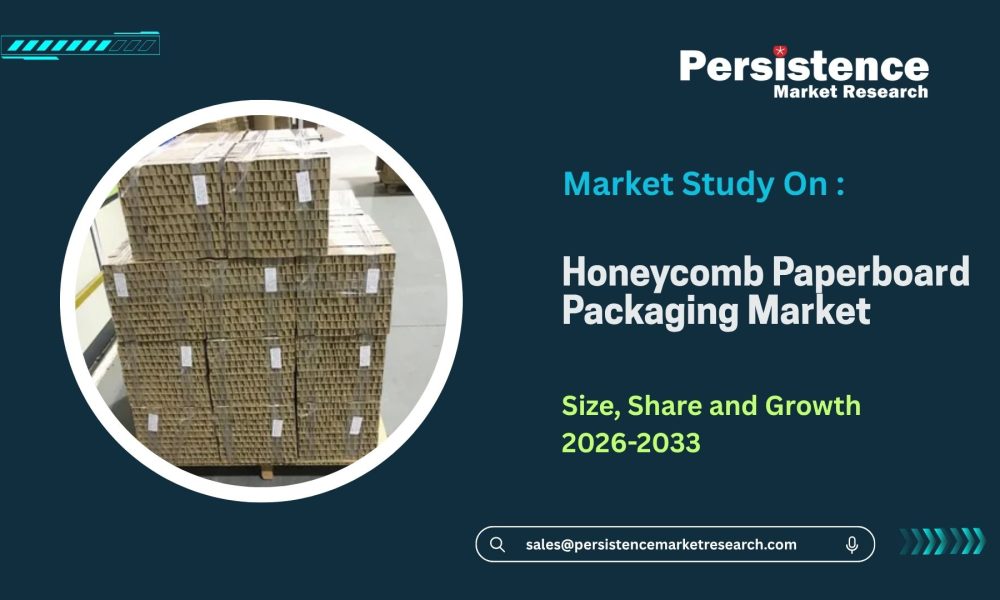
The honeycomb paperboard packaging market is gaining significant traction as industries shift toward sustainable and lightweight packaging solutions. Honeycomb paperboard is widely recognized for its high strength-to-weight ratio, recyclability, and cost efficiency, making it a preferred alternative to plastic and wood-based packaging materials. It is extensively used in protective packaging, pallets, furniture, automotive parts, and industrial goods. With growing environmental concerns and stricter regulations on plastic usage, businesses are increasingly adopting eco-friendly packaging formats such as honeycomb paperboard.
According to Persistence Market Research, the global honeycomb paperboard packaging market size is likely to be valued at US$1.4 billion in 2026 and is expected to reach US$2.2 billion by 2033, growing at a CAGR of 6.7% during the forecast period from 2026 to 2033. This growth is primarily driven by the increasing adoption of sustainable materials across global supply chains. The protective packaging segment is expected to remain dominant due to its widespread use in logistics and transportation, while Asia Pacific leads the market owing to rapid industrialization, expanding manufacturing sectors, and rising export activities.
Download Your Free Sample & Explore Key Insights : https://www.persistencemarketresearch.com/samples/18079
Key Highlights from the Report
➤ The honeycomb paperboard packaging market is projected to grow from US$1.4 billion in 2026 to US$2.2 billion by 2033
➤ Increasing demand for eco-friendly and recyclable packaging materials is a major growth driver
➤ Expansion of global logistics and e-commerce sectors is boosting protective packaging applications
➤ Rising use in automotive, furniture, and electronics industries is strengthening market demand
➤ Asia Pacific remains the leading regional market due to strong manufacturing growth
➤ Continuous innovation in lightweight and high-strength packaging solutions is enhancing adoption
Market Segmentation
The honeycomb paperboard packaging market is segmented based on product type, application, and end-use industry. Product types include interior packaging, exterior packaging, pallets, and cushioning solutions. Among these, protective and cushioning packaging dominates due to its ability to safeguard fragile and high-value goods during transit. The material’s structural strength and shock-absorbing capabilities make it highly suitable for industrial and commercial packaging applications. Manufacturers are also focusing on customized designs to meet specific packaging requirements across industries.
In terms of end-use industries, the market caters to sectors such as automotive, consumer goods, electronics, furniture, and industrial manufacturing. The furniture and automotive sectors are major contributors, as honeycomb paperboard is used for packaging large and heavy components while reducing transportation costs. Additionally, the rapid growth of e-commerce has increased the demand for durable and sustainable packaging materials, further boosting adoption across retail and logistics sectors.
Customize This Report for Your Exact Requirements : https://www.persistencemarketresearch.com/request-customization/18079
Regional Insights
Asia Pacific dominates the honeycomb paperboard packaging market due to rapid industrial development and expanding manufacturing capabilities in countries such as China and India. The region benefits from strong export activities, increasing demand for protective packaging, and supportive government initiatives promoting sustainable materials. The presence of a large number of manufacturing units and cost-effective production capabilities further strengthens the region’s leading position in the global market.
North America and Europe are also key markets, driven by stringent environmental regulations and increasing emphasis on sustainable packaging solutions. Companies in these regions are actively replacing plastic-based packaging with recyclable alternatives such as honeycomb paperboard. The growing demand for eco-friendly logistics solutions and advancements in packaging technologies are supporting market growth in these developed regions.
Market Drivers
One of the primary drivers of the honeycomb paperboard packaging market is the increasing adoption of sustainable packaging materials. Businesses across industries are under pressure to reduce their environmental footprint and comply with regulations limiting plastic use. Honeycomb paperboard, being recyclable and biodegradable, offers an ideal solution for companies aiming to achieve sustainability goals. This shift is particularly evident in industries such as retail, electronics, and automotive, where packaging plays a crucial role in product protection and brand image.
Another significant driver is the growth of global supply chains and logistics networks. With the rise of e-commerce and international trade, there is a growing need for reliable and durable packaging solutions that can protect goods during long-distance transportation. Honeycomb paperboard provides excellent strength and cushioning, making it suitable for heavy-duty packaging. Its lightweight nature also helps reduce shipping costs, further enhancing its appeal among manufacturers and logistics providers.
Market Restraints
Despite its advantages, the honeycomb paperboard packaging market faces certain challenges. One major restraint is the limited awareness and adoption in developing regions, where traditional packaging materials such as plastic and wood are still widely used. The initial cost of transitioning to honeycomb paperboard solutions can also deter small and medium-sized enterprises from adopting this material, slowing market penetration in some areas.
Another constraint is the competition from alternative sustainable packaging materials, including molded pulp and corrugated cardboard. These materials are already well-established in the market and often come with lower costs or easier production processes. Additionally, the performance limitations of honeycomb paperboard in extremely humid conditions can affect its usability in certain environments, posing a challenge for broader adoption.
Market Opportunities
The honeycomb paperboard packaging market presents strong growth opportunities through technological advancements and product innovation. Manufacturers are focusing on enhancing the durability, moisture resistance, and customization capabilities of honeycomb paperboard products. These innovations are expected to expand the material’s applications across various industries, including electronics and heavy machinery packaging.
Another promising opportunity lies in the expansion of sustainable packaging solutions in emerging markets. As awareness of environmental issues grows and governments implement stricter regulations, demand for eco-friendly packaging is expected to increase significantly. Companies that invest in local production facilities and strategic partnerships in emerging economies can capitalize on this growing demand and strengthen their global market presence.
Checkout Now & Download Complete Market Report : https://www.persistencemarketresearch.com/checkout/18079
Company Insights
Key players operating in the honeycomb paperboard packaging market include:
- Smurfit Kappa
- DS Smith
- Packaging Corporation of America
- Axxor
- Sonoco Products Company
- Sealed Air Corporation
- Mondi Group
- Honicel Nederland B.V.
- Eltete TPM
- Dufaylite
- Cascades Inc.
- Tricor Packaging & Logistics
- Nidaplast
- Grigeo
- Lsquare Eco Products
- Greencore Packaging
Recent Developments
- January 2024: DS Smith Plc introduced advanced honeycomb-based packaging solutions focused on reducing plastic usage in industrial applications
- October 2023: Smurfit Kappa Group expanded its sustainable packaging portfolio with innovative honeycomb paperboard products
Future Opportunities and Growth Prospects
The future of the honeycomb paperboard packaging market looks promising as sustainability continues to shape global packaging trends. Increasing regulatory pressure to reduce plastic waste, combined with growing consumer awareness, is expected to drive further adoption of eco-friendly packaging materials. Honeycomb paperboard, with its lightweight structure and high strength, is well-positioned to replace conventional materials across multiple industries.
Moreover, advancements in manufacturing processes and material technology are likely to enhance product performance and broaden application areas. As industries continue to prioritize cost efficiency and environmental responsibility, the demand for honeycomb paperboard packaging is expected to witness consistent growth, creating new opportunities for market players worldwide.




