

Solar Energy Storage Market Overview
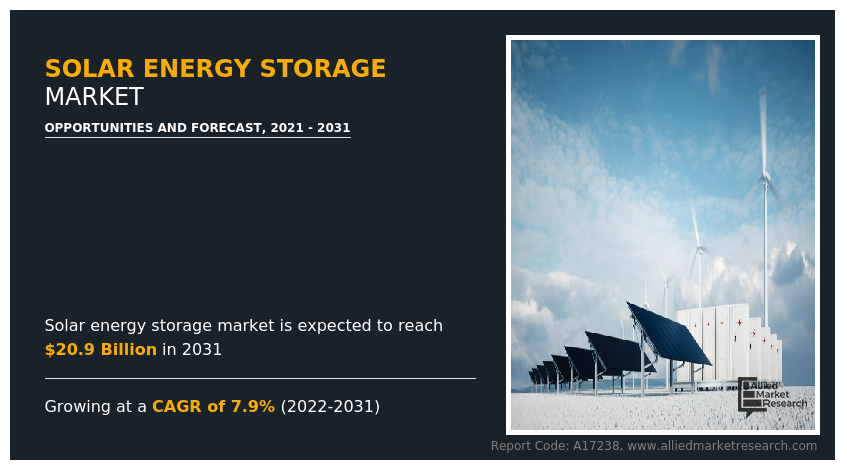
According to a new report published by Allied Market Research, the solar energy storage market size was valued at $9.8 billion in 2021 and is estimated to reach $20.9 billion by 2031, growing at a CAGR of 7.9% from 2022 to 2031. The increasing deployment of renewable energy systems, rising demand for reliable power storage, and supportive government policies promoting clean energy are major factors driving the growth of the solar energy storage market globally.
Download PDF Brochure: https://www.alliedmarketresearch.com/request-sample/A17238
Solar energy storage refers to the process of storing excess solar power in batteries by converting solar energy into chemical energy through a controlled reaction within the battery components. These systems are typically made of lithium-ion, lead-acid, and other advanced battery chemistries and are rechargeable in nature. Solar energy storage solutions are widely used in solar charging stations, off-grid systems, residential solar setups, and large-scale power plant storage installations to ensure a consistent and uninterrupted power supply.
Growing Demand for Sustainable Energy Storage Solutions
The growing demand for sustainable and clean energy storage solutions is one of the primary drivers of the solar energy storage market. Governments across the globe are actively promoting renewable energy adoption to reduce carbon emissions and dependency on fossil fuels. As a result, the demand for solar batteries and advanced solar energy storage systems is expected to witness significant growth during the forecast period.
In addition, the installation of solar energy storage systems helps reduce reliance on coal, oil, and other imported fossil energy resources. This shift toward renewable energy sources not only supports environmental sustainability but also strengthens energy security across both developed and developing economies. The increasing focus on green energy infrastructure is therefore accelerating the adoption of solar energy storage technologies worldwide.
Rising Residential and Commercial Adoption Boosting Market Growth
Rapid population growth, increasing disposable income, and expanding residential construction activities have significantly boosted the demand for solar energy storage systems. Homeowners and businesses are increasingly adopting solar battery systems to store excess energy generated during peak sunlight hours and utilize it during nighttime or power outages.
Moreover, commercial and industrial sectors are investing heavily in solar energy storage solutions to ensure operational continuity and energy cost savings. The deployment of solar energy storage systems in manufacturing units, commercial buildings, and industrial facilities enhances energy efficiency while minimizing electricity costs. This growing adoption across end-use sectors is expected to contribute substantially to the solar energy storage market expansion.
Challenges Associated with Remote Installations
Despite strong growth prospects, the solar energy storage market faces certain challenges, particularly in remote and off-grid locations. Installing solar energy storage systems in remote areas such as islands and rural regions can be difficult due to limited accessibility, infrastructure constraints, and unpredictable renewable energy generation.
Furthermore, these locations often face challenges such as temperature variations, natural calamities, and inconsistent power supply, which can hinder the performance and installation of solar battery systems. Such factors are anticipated to restrain the solar energy storage market growth to some extent during the forecast period.
Market Segmentation by Type
Based on type, the solar energy storage market is segmented into lead-acid, lithium-ion, flow battery, and others. Among these, the lithium-ion segment dominated the global market in 2021, accounting for nearly 44% of the total share. This dominance is attributed to the high energy density, longer lifecycle, and superior efficiency offered by lithium-ion batteries compared to conventional battery technologies.
The increasing industrialization, rapid urbanization, and growing demand for electric vehicles and electronic devices have further strengthened the adoption of lithium-ion-based solar energy storage systems. Additionally, continuous technological advancements in lithium-ion battery manufacturing are expected to enhance system performance and reduce costs, thereby supporting the solar energy storage market growth.
Market Segmentation by Installation
On the basis of installation, the market is categorized into on-grid and off-grid systems. The on-grid installation segment held the largest market share of around 62% in 2021, owing to the rapid urbanization and increasing adoption of grid-connected solar energy systems across developed and developing nations such as the U.S., China, and India.
Technological advancements in solar energy storage infrastructure and the rising number of smart grid projects have significantly contributed to the dominance of on-grid installations. Meanwhile, off-grid solar energy storage systems are gaining traction in rural and remote regions where grid connectivity is limited or unavailable.
Regional Analysis of the Solar Energy Storage Market
Region-wise, the solar energy storage market analysis covers North America, Europe, Asia-Pacific, and LAMEA. Asia-Pacific is projected to grow at the highest CAGR during the forecast period and accounted for around 35% of the solar energy storage market share in 2021. The growth in this region is driven by increasing government initiatives regarding zero-emission targets and the rising deployment of renewable energy projects in countries such as China, India, and South Korea.
Europe also emerged as a significant revenue contributor in 2021, supported by stringent environmental regulations, strong renewable energy policies, and increased investments in battery storage technologies. North America is witnessing steady growth due to rising adoption of residential solar systems and large-scale energy storage projects.
Impact of COVID-19 on the Solar Energy Storage Market
The COVID-19 pandemic had a notable impact on the solar energy storage market, particularly due to reduced consumer spending and disruptions in supply chains. Lockdown restrictions affected both upstream and downstream operations, resulting in increased inventories and delayed project installations. In addition, the heavy dependence on Chinese exports for solar modules, solar cells, and storage components significantly impacted production activities in countries such as India, which imports nearly 80% of its solar products from China.
However, the shift toward remote working and increased reliance on backup power solutions during the pandemic created new growth opportunities for the solar energy storage market. The growing adoption of electric micro-mobility devices and battery-powered systems further supported the demand for lithium-ion-based storage solutions during this period.
Competitive Landscape and Key Market Players
The global solar energy storage market is highly competitive, with key players focusing on technological innovations, strategic partnerships, and capacity expansions to strengthen their market presence. Major companies operating in the market include ADARA POWER, BASF SE, BMW, EnerSys, Evonik Industries AG, KOKAM, Leclanché SA, LG Chem, LG Electronics, Maxwell Technologies, Owens Corning, PPG Industries, Primus Power, Samsung, Siemens AG, Sumitomo Chemical Co., Ltd., and The Lubrizol Corporation.
These companies are investing heavily in research and development activities to improve battery efficiency, enhance storage capacity, and develop cost-effective solar energy storage solutions to meet the growing global demand.
Get a Customized Research Report: https://www.alliedmarketresearch.com/request-for-customization/A17238
Future Outlook of the Solar Energy Storage Market
The future of the solar energy storage market looks highly promising, driven by increasing renewable energy adoption, rising investments in clean energy infrastructure, and growing awareness regarding sustainable power solutions. The integration of advanced battery technologies, expansion of smart grid networks, and favorable government incentives are expected to further accelerate market growth.
Moreover, the growing emphasis on energy independence, reduction in carbon emissions, and increasing installation of solar power systems across residential, commercial, and industrial sectors will continue to fuel the demand for solar energy storage systems. As renewable energy becomes a central component of the global energy mix, the solar energy storage market is poised to witness steady and long-term growth through 2031.
Other Trending Reports:-
About Us
Allied Market Research (AMR) is a full-service market research and business-consulting wing of Allied Analytics LLP based in Portland, Oregon. Allied Market Research provides global enterprises as well as medium and small businesses with unmatched quality of “Market Research Reports” and “Business Intelligence Solutions.” AMR has a targeted view to provide business insights and consulting to assist its clients to make strategic business decisions and achieve sustainable growth in their respective market domain.
Pawan Kumar, the CEO of Allied Market Research, is leading the organization toward providing high-quality data and insights. We are in professional corporate relations with various companies and this helps us in digging out market data that helps us generate accurate research data tables and confirms utmost accuracy in our market forecasting. Each and every data presented in the reports published by us is extracted through primary interviews with top officials from leading companies of domain concerned. Our secondary data procurement methodology includes deep online and offline research and discussion with knowledgeable professionals and analysts in the industry.




