

Thermal Energy Storage Market Overview
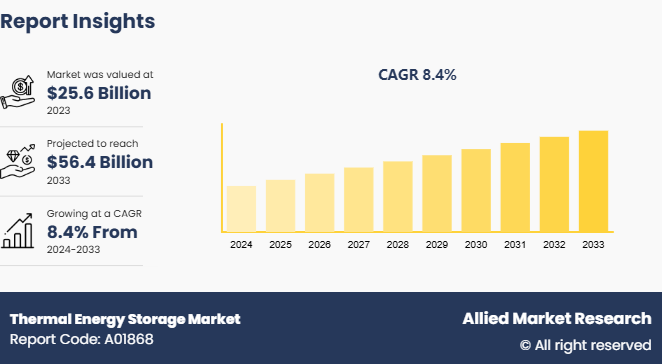
According to a new report published by Allied Market Research, the thermal energy storage market size was valued at $25.6 billion in 2023, and is projected to reach $56.4 billion by 2033, growing at a CAGR of 8.4% from 2024 to 2033.
What is Thermal Energy Storage?
Thermal energy storage (TES) refers to the technology and methods used to store energy in the form of heat. This stored thermal energy is then used later to provide heating, cooling, or to generate electricity. TES systems are designed to balance the supply and demand of energy, improve energy efficiency, and enhance the reliability of energy systems. They are commonly used in various applications such as solar power plants, heating & cooling systems of buildings, and industrial processes.
Download PDF Brochure: https://www.alliedmarketresearch.com/request-sample/2198
Asia-Pacific thermal energy storage market share is rapidly increasing its adoption of renewable energy sources, such as solar and wind power. Thermal energy storage (TES) systems offer a viable solution to this problem by storing excess energy generated during peak production times and releasing it during periods of high demand or low production.
The major players operating in the thermal energy storage industry include Aalborg CSP, Abengoa, Cartesian, Enel Spa, EVAPCO, Inc, Kraftblock GmbH, Lumenion GmbH, Magaldi Green Energy, Man energy solutions, PCM products ltd., Phelas GmbH, Spirax sarco limited., Sunamp Ltd., and Thermofin.
The surge in integration of renewable energy sources significantly drives the demand for thermal energy storage (TES) systems. As the countries shift toward a more sustainable energy landscape, renewable sources such as solar and wind power are increasingly adopted due to their environmental benefits.
These sources are inherently intermittent, producing energy only when the sun is shining or the wind is blowing, which does not always align with peak energy demand.
TES systems address this challenge by storing excess energy produced during periods of high generation and releasing it when demand is higher or when renewable generation is low, thereby enhancing the reliability and stability of the energy supply. All these factors are expected to drive the thermal energy storage market trend during the forecast period.
The surge in renewable energy integration and the increased focus on energy efficiency and sustainability are significantly driving the demand for thermal energy storage (TES).
As renewable sources such as solar and wind become more prevalent, their intermittent nature creates a need for effective storage solutions to balance supply and demand.
Government incentives drive the market demand for TES technologies and incentivize private sector investment. These incentives take various forms such as tax credits, grants, subsidies, and low-interest loans, aimed at reducing the upfront costs and financial barriers associated with deploying TES systems.
By providing financial incentives for energy efficiency improvements and renewable energy integration, governments accelerate the adoption of TES solutions across residential, commercial, industrial, and utility sectors. All these factors are anticipated to offer new growth opportunities in the global thermal energy storage market forecast.
Electrochemical batteries, such as lithium-ion batteries, have emerged as strong competitors to TES in various sectors such as grid-scale energy storage and electric vehicles.
Key Characteristics
- Storage Methods:
- Sensible Heat Storage: Stores heat by raising the temperature of a solid or liquid (e.g., water tanks, concrete).
- Latent Heat Storage: Utilizes phase change materials (PCMs) that absorb or release energy during phase changes (e.g., melting and solidifying).
- Thermochemical Storage: Involves reversible chemical reactions to store energy.
- Materials Used:
- Common materials include water, molten salts, concrete, and specialized phase change materials.
- Integration:
- Can be integrated with renewable energy sources (like solar thermal systems) to store excess energy generated during peak production times.
Batteries offer several advantages such as high energy density, rapid response times, and modularity that makes them well-suited for applications requiring short-duration energy storage and frequent cycling.
In addition, the declining costs of battery technologies have made them increasingly cost-competitive with TES systems, particularly for applications where space constraints or portability are significant considerations.
Procure This Report (420 Pages PDF with Insights, Charts, Tables, and Figures): https://bit.ly/4kaYUOM
On the basis of technology, the market is divided into latent heat storage, sensible heat storage and others.
By storage material, the market is segmented into water, molten salt, phase change material (PCM), and others.
On the basis of application, the market is categorized into power generation, heating, and cooling.
By end user, the market is segmented residential, commercial & industrial, and utilities.
Advantages
- Energy Efficiency: Helps balance supply and demand by storing energy when it is abundant and releasing it during peak usage times.
- Cost Savings: Reduces energy costs by shifting energy use to off-peak times, leading to lower electricity rates.
- Grid Stability: Supports grid reliability by providing backup energy during high-demand periods.
Applications
- Building Heating and Cooling: Stores thermal energy for heating or cooling in residential and commercial buildings.
- Solar Thermal Systems: Stores energy collected from solar panels for use during cloudy days or at night.
- Industrial Processes: Used in industries to manage heat requirements for processes, improving overall efficiency.
Conclusion
Thermal energy storage offers a practical solution for enhancing energy efficiency and supporting the integration of renewable energy. By storing thermal energy for later use, it contributes to sustainability and energy management efforts across various sectors.




