
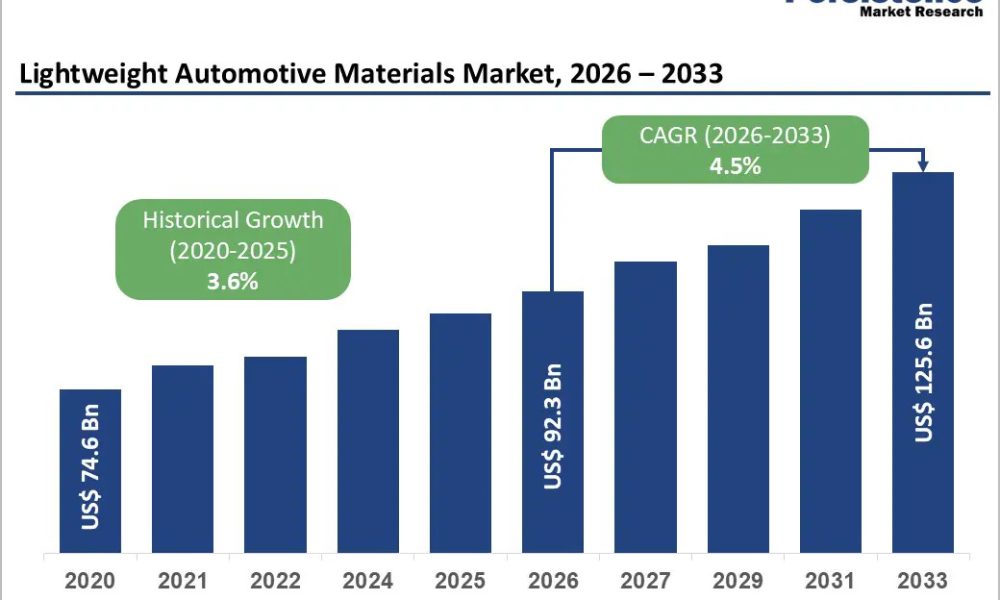
The global lightweight automotive materials market is witnessing steady expansion as automakers intensify their focus on fuel efficiency, emission reduction, and vehicle performance optimization. According to recent insights from leading market research firms, the market is projected to grow from US$ 92.3 billion in 2026 to approximately US$ 125.6 billion by 2033, registering a compound annual growth rate (CAGR) of 4.5% during the forecast period (2026–2033).
This growth trajectory is primarily driven by stringent environmental regulations, rising adoption of electric vehicles (EVs), and increasing consumer demand for high-performance vehicles with improved fuel economy. Lightweight materials such as aluminum, high-strength steel, magnesium alloys, and advanced composites are becoming essential components in modern vehicle manufacturing due to their ability to reduce overall vehicle weight without compromising structural integrity.
Automotive manufacturers are under continuous pressure to meet emission standards set by regulatory authorities across regions such as North America, Europe, and Asia-Pacific. Lightweight materials play a pivotal role in helping OEMs achieve these standards by improving fuel efficiency and extending EV battery range. Additionally, advancements in material science and manufacturing technologies are enabling cost-effective production and wider adoption of lightweight components across vehicle segments.
Get Free Sample Now: https://www.persistencemarketresearch.com/samples/3483
Key Highlights from the Report
➤ The market is expected to grow from US$ 92.3 billion in 2026 to US$ 125.6 billion by 2033, at a CAGR of 4.5%.
➤ Increasing adoption of electric vehicles is accelerating demand for lightweight materials to enhance battery efficiency and driving range.
➤ Aluminum and high-strength steel continue to dominate due to their cost-effectiveness and mechanical properties.
➤ Asia-Pacific remains the leading regional market, driven by strong automotive production in China, Japan, and India.
➤ Advanced composites are expected to witness the fastest growth due to their superior strength-to-weight ratio.
➤ Technological innovations such as AI-driven material design and smart manufacturing processes are reshaping the competitive landscape.
Segmentation Analysis
By Type
The lightweight automotive materials market is segmented into metals, plastics, elastomers, and composites. Among these, metals—particularly aluminum and high-strength steel—continue to dominate the market due to their widespread availability, recyclability, and established manufacturing processes. Aluminum is extensively used in body panels, chassis, and engine components, offering significant weight reduction compared to conventional steel.
High-strength steel remains a preferred choice in structural applications due to its balance of strength, safety, and cost efficiency. However, the composites segment is anticipated to exhibit the fastest growth during the forecast period. Materials such as carbon fiber-reinforced polymers (CFRP) and glass fiber composites are gaining traction in premium and electric vehicles due to their exceptional strength-to-weight ratio and corrosion resistance.
Plastics and elastomers are also witnessing increased adoption, particularly in interior components and under-the-hood applications, owing to their design flexibility and cost advantages.
By Vehicle/Product/Service Type
Based on vehicle type, the market is categorized into passenger vehicles, light commercial vehicles (LCVs), and heavy commercial vehicles (HCVs). Passenger vehicles account for the largest share, driven by high production volumes and increasing consumer preference for fuel-efficient and environmentally friendly vehicles.
The electric vehicle segment within passenger cars is a major growth driver, as automakers strive to reduce vehicle weight to offset the mass of battery systems. Lightweight materials are critical in improving EV performance, range, and energy efficiency.
Light commercial vehicles are also adopting lightweight materials to enhance payload capacity and reduce operational costs. Meanwhile, heavy commercial vehicles are gradually integrating advanced materials, particularly in components such as trailers and cabins, to comply with emission standards and improve fuel efficiency.
By Propulsion/Technology
From a propulsion perspective, the market is segmented into internal combustion engine (ICE) vehicles, electric vehicles (EVs), and hybrid vehicles. While ICE vehicles still hold a significant share, the shift toward electrification is accelerating the adoption of lightweight materials.
Electric vehicles represent the fastest-growing segment, as reducing vehicle weight directly impacts battery performance and driving range. Hybrid vehicles are also contributing to market growth, as manufacturers seek to balance fuel efficiency and performance through material optimization.
Technological advancements such as additive manufacturing (3D printing), AI-driven material simulation, and IoT-enabled production processes are further enhancing the development and deployment of lightweight materials in automotive applications.
Regional Insights
Asia-Pacific dominates the global lightweight automotive materials market, accounting for the largest share due to its robust automotive manufacturing base and increasing vehicle production. Countries such as China, Japan, South Korea, and India are leading contributors, supported by government initiatives promoting fuel efficiency and electric mobility.
China, in particular, is a major market due to its aggressive push toward electric vehicles and strong presence of automotive OEMs. Japan and South Korea are also key players, with advanced technological capabilities and a focus on innovation in material science.
North America represents a significant market, driven by stringent fuel economy standards and growing adoption of electric and hybrid vehicles. The United States is a major contributor, with increasing investments in EV manufacturing and lightweight material technologies.
Europe is another prominent region, characterized by strict emission regulations and a strong emphasis on sustainability. Countries such as Germany, France, and the United Kingdom are at the forefront of adopting lightweight materials, particularly in premium and electric vehicle segments.
Asia-Pacific is expected to remain the fastest-growing region during the forecast period, driven by rising urbanization, increasing disposable income, and expanding automotive production capacities.
Request For Customization: https://www.persistencemarketresearch.com/request-customization/3483
Unique Features and Innovations in the Market
The lightweight automotive materials market is undergoing significant transformation due to technological advancements and innovation. Modern materials are being engineered to offer enhanced strength, durability, and thermal resistance while maintaining minimal weight.
Artificial intelligence is playing a crucial role in material discovery and optimization, enabling manufacturers to design materials with precise properties tailored to specific applications. IoT-enabled manufacturing systems are improving production efficiency and quality control, while reducing waste and costs.
Additive manufacturing is revolutionizing component design, allowing for complex geometries and lightweight structures that were previously unattainable through traditional methods. Additionally, the integration of smart materials with self-healing and adaptive properties is opening new avenues for innovation in the automotive sector.
Key Players and Competitive Landscape
The global lightweight automotive materials market is highly competitive, with several leading companies focusing on innovation, strategic partnerships, and regional expansion to strengthen their market position.
✦ Alcoa Corporation – A leading producer of aluminum, focusing on sustainable and high-performance materials for automotive applications.
✦ Novelis Inc. – Specializes in aluminum rolling and recycling, активно expanding its footprint in automotive lightweighting solutions.
✦ ArcelorMittal S.A. – A global steel giant investing in advanced high-strength steel technologies for automotive applications.
✦ Toray Industries, Inc. – A key player in carbon fiber composites, driving innovation in lightweight materials for electric vehicles.
✦ BASF SE – Provides advanced plastics and chemical solutions, emphasizing sustainability and performance.
✦ Covestro AG – Focuses on high-performance polymers and composites, supporting lightweight automotive design.
✦ Magna International Inc. – Integrates lightweight materials into automotive components through advanced engineering and manufacturing capabilities.
These companies are активно investing in research and development to create innovative materials that meet evolving industry requirements. Strategic collaborations with automotive OEMs and technology providers are also common, enabling faster commercialization of advanced solutions.
Buy Now: https://www.persistencemarketresearch.com/checkout/3483
Recent Developments
- Several leading manufacturers have announced new investments in aluminum and composite production facilities to meet rising demand from electric vehicle manufacturers.
- Strategic partnerships between material suppliers and automotive OEMs have increased, focusing on the development of next-generation lightweight components and sustainable materials.
Future Opportunities and Growth Prospects
The future of the lightweight automotive materials market is closely tied to the evolution of electric mobility and advancements in material science. As governments worldwide continue to enforce stricter emission regulations, the demand for lightweight solutions is expected to rise significantly.
Emerging technologies such as nanomaterials, bio-based composites, and advanced manufacturing techniques are expected to unlock new opportunities for market growth. The integration of digital tools, including AI and machine learning, will further enhance material design and production efficiency.
Sustainability will remain a key focus area, with increasing emphasis on recyclable and environmentally friendly materials. Companies that invest in green technologies and circular economy practices are likely to gain a competitive edge.
In conclusion, the lightweight automotive materials market is poised for steady growth, driven by technological innovation, regulatory support, and the global shift toward sustainable mobility. As the automotive industry continues to evolve, lightweight materials will play a critical role in shaping the future of transportation.




