
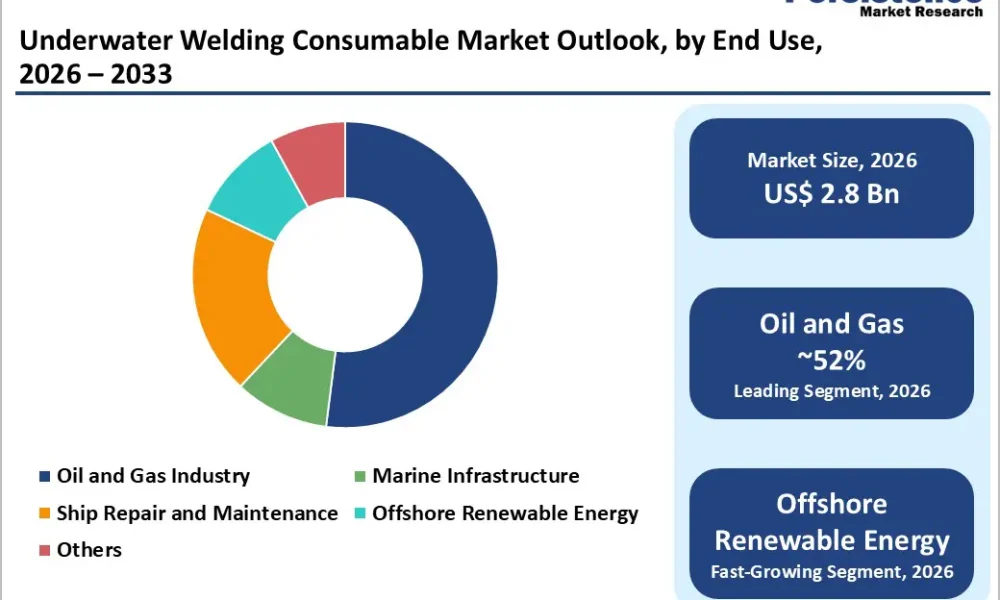
The global underwater welding consumable market is gaining significant momentum as industries increasingly depend on subsea infrastructure for energy production, transportation, and marine operations. The market is valued at US$ 2.8 billion in 2026 and is projected to reach US$ 4.3 billion by 2033, expanding at a CAGR of 6.5% between 2026 and 2033. Underwater welding consumables—such as electrodes, flux-cored wires, and specialty alloys—are essential for performing welding operations in submerged environments, ensuring structural integrity and longevity of offshore installations. These consumables are specifically designed to perform under high pressure, low visibility, and challenging environmental conditions, making them indispensable in offshore maintenance and repair operations.
The growth of the market is largely driven by accelerating investments in offshore energy infrastructure, including oil & gas platforms, offshore wind farms, and subsea pipeline networks. Additionally, a growing maintenance backlog of aging marine structures is fueling demand for underwater welding solutions. Regulatory mandates from global bodies such as the International Maritime Organization (IMO) and the American Bureau of Shipping (ABS) require strict compliance with structural safety standards, further driving the need for regular underwater inspections and welding operations. Among product types, underwater welding electrodes dominate the market due to their wide application and cost-effectiveness. Geographically, North America leads the market, supported by extensive offshore oil & gas operations and strong regulatory frameworks, while Europe is emerging as a key region due to the rapid expansion of offshore wind energy projects.
Key Highlights from the Report
• The market is projected to reach US$ 4.3 billion by 2033 at a CAGR of 6.5%.
• Offshore energy investments are a major driver of market growth.
• Underwater welding electrodes dominate due to widespread usage.
• Aging marine infrastructure is increasing maintenance demand globally.
• North America leads the market due to strong offshore oil & gas presence.
• Regulatory compliance is sustaining steady demand for consumables.
𝐆𝐞𝐭 𝐚 𝐒𝐧𝐞𝐚𝐤 𝐏𝐞𝐞𝐤, 𝐒𝐚𝐦𝐩𝐥𝐞 𝐏𝐃𝐅 𝐈𝐧𝐬𝐢𝐝𝐞: https://www.persistencemarketresearch.com/samples/35032
Market Segmentation
The underwater welding consumable market is segmented based on product type, welding technique, and end-user industries. By product type, the market includes electrodes, flux-cored wires, solid wires, and other specialized consumables. Electrodes account for the largest share due to their versatility and effectiveness in wet welding applications. Flux-cored wires are gaining popularity in dry and hyperbaric welding environments due to their ability to provide stable arcs and high-quality welds. Solid wires are typically used in controlled environments where precision and consistency are critical.
Based on welding techniques, the market is divided into wet welding and dry (hyperbaric) welding. Wet welding is more commonly used due to its cost-effectiveness and operational flexibility, particularly for emergency repairs. However, dry welding is gaining traction for critical applications requiring higher precision and stronger weld integrity. In terms of end-users, the market serves industries such as oil & gas, marine construction, offshore wind energy, and defense. The oil & gas sector dominates the market, driven by extensive subsea infrastructure and continuous maintenance requirements, while offshore wind energy is emerging as a fast-growing segment.
Regional Insights
North America holds a dominant position in the underwater welding consumable market, primarily due to its extensive offshore oil & gas operations in regions such as the Gulf of Mexico. The presence of well-established energy companies and strict regulatory standards ensures consistent demand for underwater welding consumables. Additionally, ongoing investments in subsea infrastructure maintenance further support market growth in the region.
Europe is another significant market, driven by the rapid expansion of offshore wind energy projects in countries such as the United Kingdom, Germany, and Norway. The region’s focus on renewable energy and sustainability is creating new opportunities for underwater welding applications. Meanwhile, the Asia-Pacific region is emerging as a high-growth market due to increasing offshore exploration activities, rising energy demand, and expanding shipbuilding industries in countries like China, India, and South Korea. The Middle East and Africa are also witnessing steady growth due to ongoing investments in oil & gas infrastructure and subsea pipeline networks.
𝐆𝐞𝐭 𝐚 𝐂𝐮𝐬𝐭𝐨𝐦𝐢𝐳𝐞𝐝 𝐌𝐚𝐫𝐤𝐞𝐭 𝐕𝐢𝐞𝐰 𝐢𝐧 𝐎𝐧𝐞 𝐂𝐥𝐢𝐜𝐤 : https://www.persistencemarketresearch.com/request-customization/35032
Market Drivers
The primary driver of the underwater welding consumable market is the rapid expansion of offshore energy infrastructure. As countries invest in oil & gas exploration and offshore wind energy projects, the need for reliable underwater welding solutions continues to grow. Additionally, the increasing number of aging marine structures requiring maintenance and repair is driving demand for consumables. Regulatory requirements mandating regular inspections and maintenance further reinforce market growth. Technological advancements in welding consumables, such as improved coatings and enhanced arc stability, are also contributing to increased adoption.
Market Restraints
Despite its growth potential, the market faces several challenges that may hinder its expansion. High operational costs associated with underwater welding, including specialized equipment and skilled labor, can be a significant barrier. Additionally, the complexity and risks involved in underwater welding operations require highly trained professionals, which can limit workforce availability. Environmental concerns and strict regulations related to marine ecosystems may also restrict certain activities. Furthermore, fluctuations in oil & gas prices can impact investments in offshore projects, indirectly affecting market demand.
Market Opportunities
The underwater welding consumable market presents significant opportunities, particularly with the growth of offshore renewable energy projects. The increasing adoption of offshore wind farms is expected to create new demand for underwater welding solutions. Advances in welding technology, including automation and robotics, are opening new avenues for innovation and efficiency. Emerging markets in Asia-Pacific, Latin America, and Africa offer substantial growth potential due to increasing investments in infrastructure and energy projects. Additionally, the development of eco-friendly consumables and sustainable welding practices is likely to attract new customers and drive market expansion.
𝐂𝐥𝐢𝐜𝐤 𝐭𝐨 𝐏𝐮𝐫𝐜𝐡𝐚𝐬𝐞 𝐭𝐡𝐞 𝐅𝐮𝐥𝐥 𝐑𝐞𝐩𝐨𝐫𝐭 & 𝐒𝐭𝐚𝐫𝐭 𝐄𝐱𝐩𝐥𝐨𝐫𝐢𝐧𝐠 : https://www.persistencemarketresearch.com/checkout/35032
Company Insights
• Lincoln Electric Holdings, Inc.
• ESAB Corporation
• Voestalpine Böhler Welding
• Kobe Steel, Ltd.
• Hyundai Welding Co., Ltd.
• Tianjin Golden Bridge Welding Materials Group Co., Ltd.
• Ador Welding Ltd.
• Fronius International GmbH
Recent developments in the market highlight a strong focus on innovation and sustainability. Leading companies are investing in the development of advanced welding consumables with improved performance in extreme underwater conditions. Additionally, strategic collaborations and partnerships are being formed to expand product portfolios and strengthen global market presence, particularly in emerging regions with growing offshore infrastructure.
Conclusion
The underwater welding consumable market is poised for steady growth, driven by increasing investments in offshore energy infrastructure and the need for maintaining aging marine structures. With stringent regulatory requirements and a growing emphasis on safety and efficiency, the demand for high-quality welding consumables is expected to remain strong. While challenges such as high costs and operational complexities persist, advancements in technology and expanding opportunities in renewable energy sectors are likely to drive future growth. As industries continue to explore and utilize underwater resources, underwater welding consumables will remain a critical component in ensuring the durability and reliability of subsea infrastructure.




