
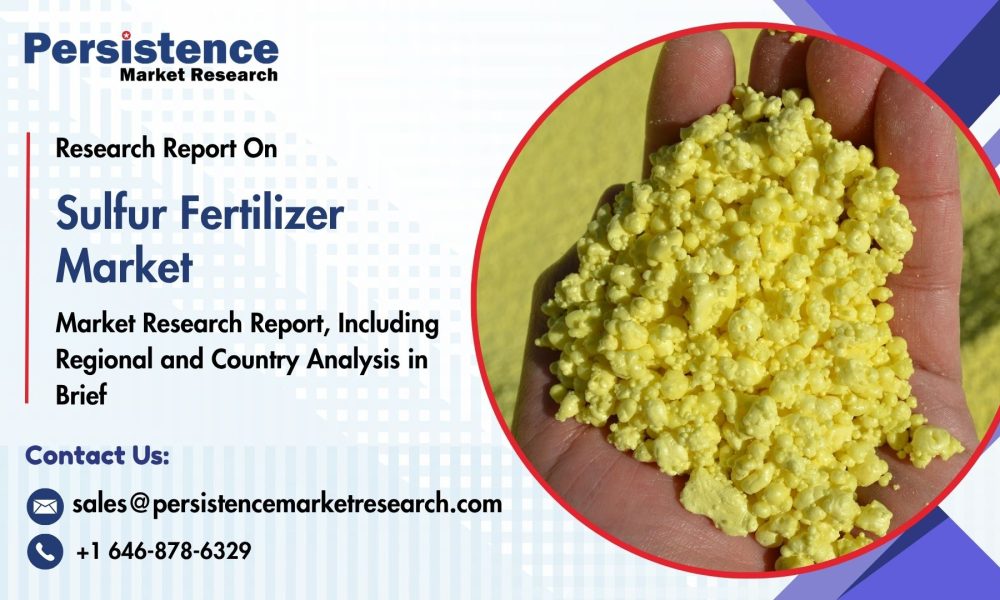
The global sulfur fertilizer market plays a vital role in modern agriculture by supplying sulfur, an essential macronutrient required for plant growth, protein synthesis, and enzyme activity. Sulfur fertilizers help improve crop yield, enhance nutrient absorption, and increase the quality of agricultural produce. In recent years, increasing soil sulfur deficiencies and rising demand for high-yield crops have driven the adoption of sulfur-based fertilizers across global farming systems.
According to market analysis, the global sulfur fertilizer market is expected to reach US$ 4.9 billion in 2026 and is projected to expand to US$ 5.7 billion by 2033, growing at a CAGR of 2.2% between 2026 and 2033. The growth of the market is largely attributed to the increasing depletion of sulfur in agricultural soils and the need for balanced fertilization practices worldwide.
Get Your FREE Sample Report Instantly – Click Now: https://www.persistencemarketresearch.com/samples/34802
Market Overview
Sulfur fertilizers are widely used to supply sulfur nutrients to crops that require adequate sulfur levels for proper metabolic functions. Sulfur is essential for chlorophyll formation, protein synthesis, and enzyme activation, making it a critical component for improving crop productivity and quality.
In the past, sulfur naturally entered agricultural soils through atmospheric deposition caused by industrial emissions. However, strict environmental regulations aimed at reducing sulfur dioxide emissions have significantly decreased atmospheric sulfur levels. As a result, agricultural soils across many regions are experiencing sulfur deficiencies, which has increased the reliance on sulfur-based fertilizers.
Farmers are increasingly incorporating sulfur fertilizers into nutrient management programs to maintain soil fertility and maximize crop yield. These fertilizers are commonly applied in crops such as cereals, oilseeds, fruits, vegetables, and pulses.
Key Market Drivers
Rising Soil Sulfur Deficiency in Agricultural Lands
One of the most important factors driving the sulfur fertilizer market is the growing deficiency of sulfur in agricultural soils. Over the past few decades, improvements in air quality regulations have reduced industrial sulfur emissions, which previously contributed sulfur deposits to farmland.
As atmospheric sulfur levels declined, soil nutrient levels also dropped, creating deficiencies that directly affect crop growth and productivity. Studies have shown that sulfur fertilization can significantly increase crop yields and improve plant nutrient absorption.
This trend is particularly evident in major agricultural regions in North America, Europe, and Asia where intensive farming practices have depleted soil nutrients. Farmers are increasingly adopting sulfur fertilizers to address these nutrient gaps and maintain optimal crop performance.
Growing Global Demand for Food Production
Another major factor supporting market growth is the increasing global demand for food. The rising world population is creating pressure on agricultural systems to produce more food from limited farmland.
To meet this demand, farmers are adopting high-yield crop varieties and advanced agricultural practices. These modern farming methods require balanced nutrient management, including sulfur supplementation, to ensure optimal plant growth.
Sulfur fertilizers help improve nitrogen efficiency, enhance protein content in crops, and increase yield potential. As agricultural productivity becomes a global priority, the demand for sulfur-based fertilizers is expected to continue growing.
Expansion of Oilseed and Biofuel Crops
Oilseed crops such as soybean, rapeseed, and sunflower require higher sulfur levels compared to other crops. The increasing cultivation of oilseed crops for vegetable oil and biofuel production is therefore contributing to the growth of the sulfur fertilizer market.
Sulfur plays a crucial role in oil synthesis within plants. Adequate sulfur nutrition helps improve oil content and crop quality, making sulfur fertilization particularly important for oilseed cultivation.
With global biofuel production expected to increase in the coming years, the cultivation of sulfur-intensive crops will expand, creating new growth opportunities for sulfur fertilizer manufacturers.
Market Restraints
Fluctuating Raw Material Prices
Despite its positive growth outlook, the sulfur fertilizer market faces several challenges. One of the key restraints is the volatility in sulfur prices and raw material supply.
Sulfur is largely obtained as a byproduct of petroleum refining and natural gas processing. Changes in crude oil production, geopolitical tensions, and supply chain disruptions can significantly affect sulfur availability and pricing.
For example, fluctuations in global sulfur supply have led to sudden price increases, impacting fertilizer manufacturing costs and market stability. Such volatility can slow adoption in price-sensitive agricultural markets.
Product Type Insights
Sulfur fertilizers are available in several forms, including sulfates, elemental sulfur, and liquid sulfur fertilizers.
Among these, sulfate fertilizers dominate the market, accounting for approximately 45% of total product consumption. Sulfates are widely used because they provide sulfur in a form that plants can immediately absorb, unlike elemental sulfur, which requires microbial conversion in soil before it becomes available to plants.
Common sulfate fertilizers include:
- Ammonium sulfate
- Potassium sulfate
- Single superphosphate
These fertilizers are widely used in different crop types due to their effectiveness, availability, and compatibility with various agricultural practices.
Form Insights
Sulfur fertilizers are primarily available in two forms:
- Dry fertilizers
- Liquid fertilizers
Dry fertilizers dominate the market due to their lower handling costs, longer shelf life, and suitability for large-scale agricultural applications. They account for nearly 68% of the total market share.
However, liquid sulfur fertilizers are gaining popularity, particularly in precision farming systems. These formulations provide rapid nutrient absorption and are compatible with modern irrigation methods such as drip irrigation and fertigation.
Crop Type Insights
Sulfur fertilizers are used across various crop categories, including cereals, grains, oilseeds, fruits, vegetables, and pulses.
Among these, cereals and grains represent the largest crop segment, accounting for approximately 49% of global sulfur fertilizer demand. Major cereal crops such as wheat, rice, and corn require adequate sulfur levels for protein formation and optimal growth.
The increasing demand for staple foods globally continues to support the use of sulfur fertilizers in cereal production systems.
Application Method Insights
Sulfur fertilizers can be applied using several methods, including soil treatment, foliar spraying, and fertigation.
Soil treatment remains the most widely used application method, accounting for nearly 59% of the market share. This approach provides sustained nutrient release and improves long-term soil fertility.
Other application techniques such as foliar spraying and fertigation are gaining traction, especially in high-value crops where precise nutrient management is required.
Regional Analysis
Asia Pacific
Asia Pacific is the largest regional market for sulfur fertilizers, accounting for nearly 48% of global market share. Countries such as China and India have extensive agricultural sectors and large farming populations.
Government initiatives promoting balanced fertilization, soil health improvement programs, and increasing crop productivity are driving demand for sulfur fertilizers in the region.
North America
North America represents a significant market due to large-scale cereal and oilseed cultivation. Sulfur fertilizer adoption has increased in regions such as the U.S. Corn Belt and Canada, where declining atmospheric sulfur deposition has created nutrient deficiencies in soil.
Farmers in these regions are increasingly using sulfur fertilizers to enhance crop yield and quality.
Latin America
Latin America is emerging as one of the fastest-growing markets for sulfur fertilizers. Countries such as Brazil and Argentina have large soybean and corn production systems that require sulfur supplementation.
The expansion of oilseed cultivation and government support for agricultural development are key factors contributing to market growth in the region.
Competitive Landscape
The sulfur fertilizer market is moderately consolidated, with several global and regional players competing through product innovation and capacity expansion.
Key Market Players
Major companies operating in the market include:
- Yara International
- Nutrien Inc.
- The Mosaic Company
- ICL Group
- Koch Industries
- Shell Sulfur Solutions
- CF Industries Holdings
- Sulphur Mills Ltd.
- Nufarm Limited
- K+S AG
These companies focus on strategic partnerships, technological advancements, and product development to strengthen their global market presence.
Get a Customized Market View in One Click: https://www.persistencemarketresearch.com/request-customization/33649
Future Market Opportunities
The sulfur fertilizer market is expected to benefit from several emerging trends. One of the most promising opportunities is the integration of sulfur fertilization with precision agriculture technologies.
Advanced farming techniques such as soil sensors, satellite imaging, and digital agriculture platforms allow farmers to apply fertilizers more efficiently. This targeted approach helps improve nutrient utilization and reduce environmental impact.
Additionally, the growing adoption of sustainable farming practices and organic agriculture is expected to increase demand for sulfur-based fertilizers, which are considered environmentally compatible nutrient sources.
Conclusion
The sulfur fertilizer market is poised for steady growth in the coming years, driven by rising soil sulfur deficiencies, increasing demand for high-yield crops, and expanding oilseed cultivation. Sulfur plays a critical role in plant nutrition, making sulfur fertilizers essential for improving agricultural productivity and food security.
Although challenges such as price volatility and supply chain disruptions remain, innovations in fertilizer technology and the adoption of precision farming are expected to create new growth opportunities. As global agriculture continues to evolve, sulfur fertilizers will remain an important component of balanced nutrient management strategies.
About Persistence Market Research:
Persistence Market Research delivers strategic research solutions that drive business growth. Founded in 2012 and registered in England and Wales in 2023 as Persistence Research & Consultancy Services Ltd., we have completed 3,600+ custom and syndicated studies and supported 2,700+ projects for leading research firms. Combining traditional methodologies with modern tools, we provide actionable insights to multinational corporations, consultants, investors, and government bodies, earning strong trust through long-term client relationships.
Contact Us:
Persistence Market Research
Second Floor, 150 Fleet Street,
London, EC4A 2DQ, United Kingdom
USA Phone: +1 646-878-6329
UK Phone: +44 203-837-5656
Email: [email protected]
Web: https://www.persistencemarketresearch.com




