
The Smart Faucets Market is witnessing significant growth as smart home technologies continue to reshape modern kitchens and bathrooms. Smart faucets integrate advanced features such as motion sensors, voice activation, and automated water flow control, enabling hands-free operation and improved efficiency. These faucets are designed to enhance convenience, hygiene, and water conservation in residential as well as commercial environments. With increasing consumer awareness about sanitation and the growing adoption of smart home infrastructure, smart faucets are rapidly becoming an essential component of modern plumbing systems.
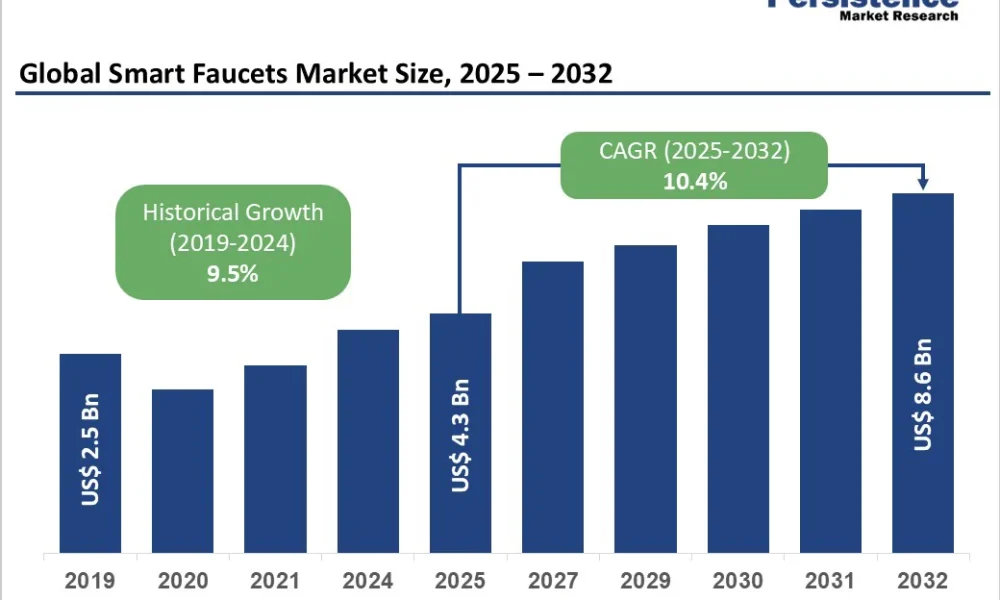
The global smart faucets market size is likely to be valued at US$4.3 Billion in 2025 and is estimated to reach US$8.6 Billion in 2032, growing at a CAGR of 10.4% during the forecast period 2025 – 2032, according to Persistence Market Research. The expansion of the market is largely driven by the increasing preference for touchless technologies that enhance hygiene and reduce germ transmission. Touchless operation allows users to turn water on and off without physical contact, improving cleanliness in kitchens and bathrooms. The residential sector is expected to remain the leading segment due to increasing smart home adoption, while North America is anticipated to lead geographically owing to strong consumer demand for smart home solutions and higher technology adoption.
Download Your Free Sample & Explore Key Insights : https://www.persistencemarketresearch.com/samples/35759
Key Highlights from the Report
➤ The smart faucets market is projected to reach US$8.6 Billion by 2032, expanding steadily during the forecast period.
➤ Growing adoption of touchless and sensor-based plumbing solutions is accelerating demand across residential and commercial sectors.
➤ Increasing consumer focus on hygiene, sanitation, and germ prevention is driving market growth globally.
➤ Integration of smart home ecosystems and voice-controlled devices is strengthening the market expansion.
➤ The residential segment is expected to dominate due to rapid adoption of connected home technologies.
➤ North America is projected to lead the market owing to high technological penetration and strong consumer purchasing power.
Market Segmentation
The smart faucets market can be segmented based on product type and application. Product-wise, the market includes touchless faucets, voice-activated faucets, and digitally controlled smart faucets. Among these, touchless faucets are expected to lead the market due to their widespread use in both residential and commercial environments. These faucets use motion sensors to detect hand movements and automatically regulate water flow, which reduces physical contact and enhances hygiene. The demand for these products has surged particularly in healthcare facilities, restaurants, and public spaces where maintaining cleanliness is essential.
Based on end users, the market is segmented into residential and commercial sectors. The residential segment is anticipated to dominate the market due to the rising popularity of smart homes and connected kitchen appliances. Consumers are increasingly investing in modern kitchen fixtures that combine design, convenience, and efficiency. Meanwhile, the commercial segment is also growing steadily, particularly in hotels, restaurants, and office buildings where touchless faucets improve operational efficiency and support hygiene compliance.
Get Personalized Data – Request Customization Today : https://www.persistencemarketresearch.com/request-customization/35759
Regional Insights
North America is expected to dominate the smart faucets market due to the strong adoption of smart home technologies and advanced plumbing solutions. The region has a well-established infrastructure for connected devices and a high level of consumer awareness regarding hygienic products. In addition, the presence of leading manufacturers and strong investments in home automation technologies are further supporting market growth across the United States and Canada.
Asia Pacific is also emerging as a rapidly growing region for smart faucets. Increasing urbanization, expanding residential construction, and rising disposable incomes are encouraging consumers to adopt advanced home fixtures. Countries such as China, Japan, and South Korea are witnessing a surge in smart home adoption, which is creating favorable opportunities for manufacturers offering innovative faucet technologies.
Market Drivers
One of the primary drivers of the smart faucets market is the growing emphasis on hygiene and cleanliness. The ability to operate faucets without physical contact significantly reduces the risk of germ transmission, making them ideal for kitchens, bathrooms, hospitals, and public facilities. As consumers become more conscious about sanitation, especially in high-traffic areas, the demand for touchless technologies continues to grow. Smart faucets not only enhance hygiene but also improve convenience by allowing users to activate water flow through simple gestures or voice commands.
Another important driver is the increasing adoption of smart home ecosystems. Modern consumers are integrating multiple connected devices such as smart lighting, thermostats, and kitchen appliances into centralized systems. Smart faucets are becoming a part of this ecosystem by offering compatibility with voice assistants and home automation platforms. The ability to control water flow, temperature, and usage digitally is appealing to tech-savvy homeowners who prioritize efficiency and convenience in daily routines.
Market Restraints
Despite strong growth prospects, the smart faucets market faces certain challenges that could limit its expansion. One major restraint is the relatively high cost of installation and product purchase compared to traditional faucets. Smart faucets incorporate sensors, electronic components, and connectivity features, which increase their manufacturing cost. As a result, price-sensitive consumers in developing regions may hesitate to adopt these advanced fixtures.
Another limitation is the complexity associated with installation and maintenance. Smart faucets require electrical connections and specialized plumbing setups, which can make installation more complicated than conventional faucets. In addition, technical issues such as sensor malfunction or connectivity disruptions may require professional servicing. These factors can discourage some consumers from adopting smart faucets, particularly in regions where technical support infrastructure is limited.
Market Opportunities
The growing demand for water conservation technologies presents a major opportunity for the smart faucets market. Smart faucets can regulate water flow automatically and reduce unnecessary water wastage, making them an environmentally responsible solution. As governments and environmental organizations emphasize sustainable water usage, manufacturers have the opportunity to develop advanced faucets that integrate smart sensors and efficient flow control systems.
Another promising opportunity lies in expanding applications across commercial sectors. Hotels, airports, healthcare facilities, and shopping centers are increasingly adopting touchless plumbing solutions to enhance hygiene standards and operational efficiency. The integration of smart faucets in large-scale infrastructure projects and modern commercial buildings is expected to create significant growth opportunities for market players over the coming years.
Unlock Complete Insights – Buy the Full Report : https://www.persistencemarketresearch.com/checkout/35759
Company Insights
Key players operating in the smart faucets market include:
- American Standard Brands
- Kraus USA
- Kohler Co.
- Grohe America Inc.
- Delta Faucet Company
- Pfister
- Danze Inc.
- Moen Incorporated
- Masco Corporation
- Aqua Source Faucet
Recent Developments
January 2024 – Kohler Co. introduced advanced touchless kitchen faucet models integrated with improved sensor technology and smart home compatibility.
October 2023 – Moen Incorporated expanded its portfolio of voice-enabled smart faucets designed to integrate with smart home systems.
Future Opportunities and Growth Prospects
The future of the smart faucets market looks promising as smart home technologies continue to evolve and become more affordable. Increasing consumer interest in automated living environments, combined with a strong focus on hygiene and sustainability, is expected to drive steady demand. Manufacturers are likely to focus on integrating artificial intelligence, improved sensor accuracy, and enhanced connectivity to provide a more seamless user experience.
In the coming years, innovation in design and functionality will play a key role in shaping the market. As smart faucets become more compatible with broader home automation systems and energy-efficient solutions, their adoption is expected to expand across both residential and commercial sectors. With ongoing technological advancements and growing awareness about hygiene and water conservation, the smart faucets market is set to experience sustained growth through the forecast period.




