
The digital world is expanding rapidly, but so are cyber threats. As organizations adopt cloud computing, digital platforms, and connected technologies, the risk of malicious software infiltrating systems has grown significantly. Malware attacks have evolved from simple viruses to complex, highly sophisticated threats capable of bypassing traditional security systems. This shift has driven enterprises and governments to invest heavily in advanced malware detection and analysis tools.
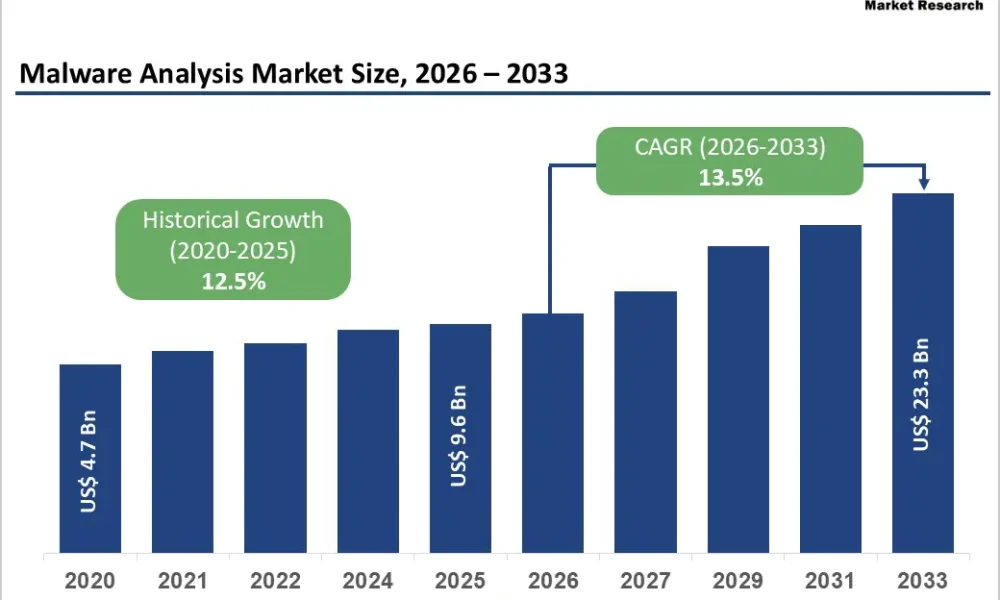
The malware analysis market is therefore experiencing strong momentum worldwide. According to recent industry estimates, the global malware analysis market is expected to reach US$ 9.6 billion in 2026 and grow to approximately US$ 23.3 billion by 2033, registering a compound annual growth rate (CAGR) of 13.5% during the forecast period. This rapid expansion is driven by the increasing frequency of ransomware attacks, growing adoption of artificial intelligence in cybersecurity, and rising demand for proactive threat detection solutions.
With cybercriminals continuously developing new techniques to evade detection, organizations are shifting toward advanced malware analysis systems capable of identifying zero-day exploits, advanced persistent threats (APTs), and complex malware variants. This blog explores the key trends, drivers, challenges, and opportunities shaping the malware analysis market in the coming years.
Rising Cyber Threats Driving Demand for Malware Analysis
One of the most significant factors driving the malware analysis market is the exponential rise in cyberattacks across industries. Organizations today face a variety of threats, including ransomware, phishing attacks, trojans, spyware, and polymorphic malware that constantly changes its code to avoid detection.
The global cybersecurity landscape has witnessed a sharp surge in attacks in recent years. In India alone, more than 3,000 cyberattacks occur weekly, highlighting the urgent need for advanced security infrastructure. Similarly, ransomware incidents have increased dramatically worldwide, with attacks growing 36% year-over-year through 2025.
Modern ransomware campaigns are becoming increasingly organized and sophisticated. Cybercriminal groups now deploy advanced attack toolkits capable of targeting multiple operating systems simultaneously. Healthcare organizations, financial institutions, and government agencies have become prime targets due to the sensitive data they manage.
For example, healthcare organizations experienced a 30% increase in ransomware attacks in 2025, with average ransom demands reaching US$514,000 per incident. These attacks resulted in the exposure of millions of patient records, causing severe financial and reputational damage.
As cyber threats become more complex, traditional antivirus solutions relying on signature-based detection are no longer sufficient. This has led to growing adoption of advanced malware analysis platforms capable of identifying previously unknown threats through behavioral monitoring and automated threat intelligence.
The Role of Artificial Intelligence in Malware Detection
Artificial intelligence (AI) and machine learning (ML) are transforming the malware analysis landscape. Modern malware detection platforms rely on advanced algorithms capable of analyzing millions of malware samples and identifying suspicious patterns.
AI-powered malware analysis tools can detect threats that traditional security systems fail to identify. By analyzing behavioral patterns rather than static code signatures, these solutions can detect zero-day attacks and polymorphic malware variants that frequently change their structure.
Machine learning models trained on large malware datasets allow security teams to analyze files, network traffic, and system behavior in real time. This capability significantly improves threat detection accuracy and reduces response times.
Organizations implementing AI-driven malware analysis systems have reported 63% improvements in attack detection accuracy. These solutions can automatically classify malware, identify attack patterns, and provide actionable intelligence for security teams.
Several cybersecurity vendors are investing heavily in AI-powered malware detection platforms. Cloud-based sandboxing solutions are also integrating machine learning capabilities to analyze suspicious files in isolated environments. This enables organizations to detect malicious activities without exposing their networks to risk.
AI-powered malware analysis also reduces the number of false positives, a common challenge in cybersecurity operations. By automating threat classification and integrating with security orchestration systems, organizations can significantly improve their security operations center (SOC) efficiency.
Growing Popularity of Cloud-Based Malware Analysis
Cloud deployment has become a major trend in the malware analysis market. Many organizations prefer cloud-based security platforms due to their scalability, flexibility, and lower infrastructure costs.
Cloud-based malware analysis platforms allow organizations to analyze suspicious files in remote environments without affecting their internal systems. These solutions also provide instant access to global threat intelligence feeds, enabling faster detection of emerging cyber threats.
In 2025, cloud-based deployment accounted for approximately 58% of the malware analysis market, and it is expected to continue growing rapidly in the coming years. Subscription-based cloud services allow organizations to access advanced malware detection capabilities without significant upfront investment.
Another advantage of cloud deployment is the ability to process large volumes of data quickly. Cloud platforms provide unlimited computing power, enabling real-time malware detection and analysis across distributed networks.
As organizations adopt hybrid and multi-cloud environments, cloud-native malware analysis solutions are becoming essential for maintaining security across complex infrastructures.
Elevate your business strategy with comprehensive market data. Request a sample report now: https://www.persistencemarketresearch.com/samples/33083
Solutions Segment Dominates the Market
The malware analysis market can be segmented into solutions and services. Among these, solutions dominate the market, accounting for approximately 68% of the market share in 2025.
Organizations are increasingly investing in advanced malware analysis tools that combine static analysis, dynamic analysis, and hybrid detection techniques. Static analysis examines the code structure of suspicious files, while dynamic analysis observes their behavior during execution.
Hybrid analysis combines both approaches to provide comprehensive threat detection. These systems can identify malicious code even if it is hidden within encrypted files or disguised using obfuscation techniques.
Behavior-based detection systems have also gained popularity because they focus on identifying suspicious activities rather than specific malware signatures. This approach is particularly effective in detecting previously unknown malware variants.
Many organizations are consolidating their cybersecurity tools to improve efficiency. Integrated malware analysis platforms that combine threat intelligence, endpoint protection, and automated response capabilities are becoming the preferred choice for enterprises.
Large Enterprises Lead the Adoption of Malware Analysis
Large enterprises represent the largest customer segment in the malware analysis market. These organizations maintain extensive digital infrastructures with millions of endpoints, making them attractive targets for cybercriminals.
Large enterprises accounted for approximately 68% of the market share in 2025, reflecting their higher cybersecurity budgets and greater exposure to cyber threats. Enterprises operating across multiple regions often require advanced malware detection capabilities to protect distributed networks and sensitive data.
Regulatory compliance requirements also drive malware analysis adoption among large organizations. Industries such as healthcare, finance, and telecommunications must comply with strict cybersecurity regulations that mandate advanced threat detection and incident response capabilities.
Many large enterprises operate security operations centers (SOCs) that rely heavily on malware analysis tools for threat investigation and forensic analysis. These tools help security teams identify attack origins, analyze malicious files, and prevent future incidents.
BFSI Sector Emerges as the Largest Industry Vertical
The Banking, Financial Services, and Insurance (BFSI) sector holds the largest share in the malware analysis market, accounting for approximately 31% of the global market in 2025.
Financial institutions manage large volumes of sensitive customer data, making them prime targets for cybercriminals. Fraudulent transactions, data breaches, and ransomware attacks pose significant risks to banks and financial service providers.
Cyberattacks targeting the BFSI sector have increased significantly in recent years. Reports indicate that ransomware attacks on financial institutions increased 13 times in 2023, highlighting the need for advanced cybersecurity measures.
Financial organizations also face strict regulatory requirements, including data protection standards and cybersecurity compliance frameworks. Malware analysis solutions play a critical role in ensuring compliance and protecting customer data from cyber threats.
Government and Defense Sector Creating New Opportunities
While BFSI remains the largest segment, the government and defense sector is expected to be the fastest-growing vertical in the malware analysis market. This segment is projected to grow at a CAGR of around 18.5% through 2032.
Government agencies and defense organizations frequently face sophisticated cyberattacks from nation-state threat groups. These attacks often involve advanced persistent threats (APTs) designed to infiltrate networks and steal sensitive information.
Cybersecurity agencies worldwide are investing heavily in advanced malware analysis capabilities to detect and mitigate such threats. Governments are also adopting Zero Trust security frameworks, which require continuous monitoring and advanced threat detection systems.
Collaboration between governments and cybersecurity vendors is further driving innovation in malware analysis technologies. Many countries are establishing national threat intelligence platforms that integrate malware analysis capabilities to enhance cyber defense.
Regional Outlook of the Malware Analysis Market
North America
North America currently leads the global malware analysis market, accounting for approximately 42% of the market share. The region benefits from strong cybersecurity infrastructure, high IT spending, and the presence of major cybersecurity companies.
Enterprises in North America are early adopters of advanced security technologies, including AI-driven malware detection and cloud-based threat analysis platforms. Strict regulatory requirements in sectors such as healthcare and finance also contribute to strong market growth.
Europe
Europe represents the second-largest market for malware analysis solutions. Stringent data protection regulations and cybersecurity policies have encouraged organizations to invest heavily in advanced security tools.
Countries such as Germany, the United Kingdom, and France are leading cybersecurity innovation in the region. Growing concerns about data privacy and cyber espionage have also increased demand for malware analysis platforms.
Asia Pacific
The Asia Pacific region is the fastest-growing market, expected to expand at a CAGR of 16.8% through 2032. Rapid digitalization, increasing internet penetration, and expanding cloud adoption are driving the demand for cybersecurity solutions.
Countries such as India, China, Japan, and South Korea are experiencing a surge in cyber threats as their digital economies grow. Organizations in these countries are investing heavily in malware analysis solutions to strengthen their cybersecurity frameworks.
Competitive Landscape of the Malware Analysis Market
The malware analysis market is moderately concentrated, with several global cybersecurity vendors dominating the industry. Leading companies are focusing on innovation, strategic acquisitions, and integration of AI technologies to strengthen their market position.
Major players in the market include:
- FireEye Inc.
- Cisco Systems Inc.
- Palo Alto Networks
- Sophos Ltd
- Symantec Corporation
- Kaspersky Lab
- Fortinet Inc.
- Check Point Software Technologies
- Qualys Inc.
- McAfee LLC
- Broadcom Inc.
- Juniper Networks Inc.
- Trend Micro Incorporated
- CrowdStrike Holdings Inc.
- Microsoft Corporation
- Proofpoint Inc.
- Intezer Labs
- VMRay
- Joe Security
- Malwarebytes
Many companies are also forming strategic partnerships with cloud providers and managed security service providers to expand their market reach. Innovation in behavioral analytics, AI-based threat detection, and cloud-native security platforms is expected to intensify competition in the coming years.
Future Outlook of the Malware Analysis Market
The malware analysis market is expected to remain one of the fastest-growing segments within the cybersecurity industry. The increasing complexity of cyber threats, rapid digital transformation, and widespread adoption of cloud computing are likely to drive continued demand for advanced malware detection solutions.
Artificial intelligence, automation, and threat intelligence integration will play a crucial role in shaping the future of malware analysis technologies. Organizations will increasingly rely on automated systems capable of detecting and responding to cyber threats in real time.
Additionally, the expansion of the Internet of Things (IoT), 5G networks, and connected devices will further increase the attack surface for cybercriminals. This will create new opportunities for cybersecurity vendors to develop innovative malware analysis solutions.
Conclusion
The global malware analysis market is undergoing rapid transformation as organizations confront increasingly sophisticated cyber threats. With ransomware attacks, zero-day exploits, and advanced persistent threats becoming more common, traditional security tools are no longer sufficient.
Advanced malware analysis platforms powered by artificial intelligence, behavioral analytics, and cloud computing are becoming essential components of modern cybersecurity strategies. As a result, the market is projected to grow significantly, reaching US$ 23.3 billion by 2033.
Industries such as BFSI, healthcare, government, and defense will continue to drive demand for advanced threat detection solutions. Meanwhile, small and medium-sized enterprises are increasingly adopting cloud-based malware analysis services to strengthen their cybersecurity posture.
With cybersecurity remaining a top priority for organizations worldwide, the malware analysis market is poised for sustained growth in the years ahead.
Related Reports:




