
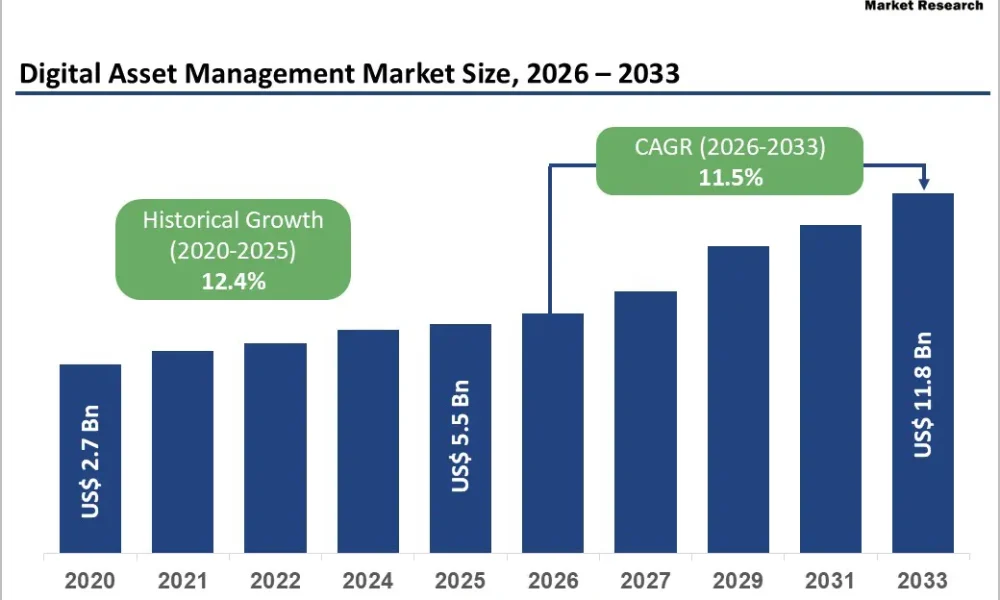
The global Digital Asset Management (DAM) market is undergoing sustained expansion as enterprises confront exponential growth in digital content across marketing, e-commerce, media, and corporate communications. The market is projected to be valued at US$ 5.5 billion in 2026 and is expected to reach US$ 11.8 billion by 2033, expanding at a robust 11.5% CAGR during the forecast period.
This growth reflects a structural transformation in how organizations manage digital content. DAM platforms are no longer optional marketing tools — they are becoming mission-critical infrastructure for brand governance, workflow automation, regulatory compliance, and omnichannel engagement.
Market Overview: From Content Storage to Strategic Infrastructure
Enterprises today generate massive volumes of digital assets including:
- Product images
- Marketing videos
- Campaign creatives
- Social media content
- Technical documentation
- Brand assets
Manual file-sharing systems and decentralized storage methods are no longer sustainable. As businesses expand across geographies and digital channels, centralized repositories powered by cloud-based DAM solutions are becoming essential for:
- Accelerated campaign launches
- Asset reuse and cost reduction
- Brand consistency enforcement
- Compliance and audit trail documentation
Historically, between 2020 and 2025, the DAM market grew at 12.4% CAGR. Although growth moderates slightly to 11.5% through 2033, adoption continues to accelerate across new verticals and emerging markets.
Key Industry Highlights
- Leading Region: North America (36% market share in 2026)
- Fastest Growing Region: Asia Pacific (~19% CAGR)
- Dominant Deployment Model: Cloud-based (66% share)
- Fastest Growing Vertical: Media & Entertainment (18%+ CAGR)
- Key Opportunity: AI-powered metadata tagging and intelligent search
Market Dynamics
Driver 1: Explosive Growth in Digital Content and Omnichannel Distribution
Organizations are experiencing unprecedented digital asset expansion due to:
- E-commerce growth
- Social media marketing
- Influencer collaborations
- Direct-to-consumer (DTC) models
- Streaming and video consumption
Each new campaign, product launch, or market expansion multiplies asset requirements. Without structured asset governance, teams encounter duplication, lost files, brand inconsistencies, and workflow delays.
Enterprises implementing DAM solutions report:
- Faster time-to-market
- Reduced duplicate asset creation
- Improved brand compliance
- Higher marketing productivity
The direct correlation between content volume growth and DAM adoption has become increasingly evident across industries.
Driver 2: Accelerating Shift to Cloud-Based SaaS Models
Cloud deployment commands approximately 66% of total DAM market revenue, reflecting strong enterprise preference for SaaS models.
Benefits include:
- Elimination of hardware infrastructure costs
- Seamless global collaboration
- Automatic security updates
- Rapid scalability
- Reduced IT maintenance burden
Hyperscale providers such as Amazon Web Services, Microsoft Azure, and Google Cloud continue expanding global data centers, enabling scalable DAM deployments across regions.
This cloud democratization has significantly expanded access for SMEs that previously could not afford enterprise-grade on-premise DAM systems.
Restraint 1: Integration Complexity with Legacy Systems
Despite strong demand, organizations face integration challenges when connecting DAM platforms with:
- Enterprise Resource Planning (ERP) systems
- Customer Relationship Management (CRM) platforms
- Content Management Systems (CMS)
- Product Information Management (PIM) systems
Legacy infrastructure operating on outdated data formats creates API compatibility issues, increasing:
- Implementation timelines
- Data migration costs
- Metadata standardization efforts
Mid-sized enterprises often struggle with these complexities due to limited internal IT resources.
Restraint 2: Data Security and Regulatory Compliance Concerns
Organizations in regulated industries such as BFSI, healthcare, and government must address:
- Data residency requirements
- Encryption mandates
- Access control protocols
- Intellectual property protection
The absence of universally standardized DAM security frameworks requires exhaustive vendor evaluation. Concerns around data breaches and unauthorized access continue to delay adoption for some enterprises.
Major Market Opportunity: AI-Driven Digital Asset Management
Artificial Intelligence is transforming DAM platforms from static repositories into intelligent content orchestration engines.
AI-enabled capabilities include:
- Automated metadata tagging
- Image and facial recognition
- Speech-to-text transcription
- Smart content recommendations
- Visual similarity search
For example, Bynder integrates AI-powered search and image similarity features that significantly reduce asset discovery time. Organizations leveraging AI-driven DAM report:
- Faster asset retrieval
- Increased content reuse
- Lower content production costs
- Enhanced marketing agility
AI-powered DAM systems can generate multi-million-dollar operational savings by eliminating redundant content purchases and accelerating campaign workflows.
Vertical Opportunity: Retail & E-Commerce Expansion
Retail & eCommerce represent approximately 35% of the global DAM market share.
Explosive online retail growth has intensified the need to manage:
- Massive product catalogs
- Regionalized content
- Dynamic pricing visuals
- Omnichannel promotional materials
Platforms such as Alibaba Group, JD.com, and Amazon rely heavily on structured asset management for personalized recommendations and seamless product publishing.
Retail organizations implementing DAM systems report:
- Faster product launch cycles
- Improved product data accuracy
- Enhanced customer engagement
- Reduced legacy system costs
Meanwhile, the Media & Entertainment vertical is expanding at over 18% annually, driven by streaming proliferation and global content licensing complexity.
Elevate your business strategy with comprehensive market data. Request a sample report now: https://www.persistencemarketresearch.com/samples/33052
Category-Wise Analysis
Component Insights
The Solution segment dominates with approximately 65% of market value. Core DAM software platforms provide:
- Asset organization
- Workflow automation
- Governance controls
- Distribution capabilities
Services including integration, customization, and support generate recurring revenue streams and deepen client relationships.
Deployment Insights
Cloud-based DAM leads with 66% market share. On-premise models persist in:
- Government agencies
- Defense organizations
- Enterprises with strict data sovereignty mandates
However, long-term growth momentum clearly favors cloud-native deployments.
Application Insights
Sales & Marketing is the largest application area.
Marketing teams depend on DAM platforms to:
- Manage brand libraries
- Coordinate global campaigns
- Localize creative assets
- Track content performance
Clear ROI metrics, including reduced time-to-market and increased asset reuse, drive continued investment in this segment.
Vertical Insights
- Retail & eCommerce: 35% market share
- Media & Entertainment: Fastest-growing (18%+ CAGR)
Media companies use DAM to manage:
- High-volume multimedia assets
- Licensing agreements
- Rights management workflows
- Cross-platform distribution
Organizations report improved content monetization and streamlined production processes after DAM implementation.
Regional Analysis
North America: Market Leader (36% Share)
North America dominates the DAM market due to:
- Mature cloud infrastructure
- Strong enterprise IT budgets
- Advanced marketing automation ecosystems
Leading providers such as Adobe, IBM, and Oracle have established comprehensive service ecosystems supporting enterprise deployments.
Significant annual investments in cloud infrastructure reinforce scalable DAM adoption across industries.
Europe: Compliance-Driven Adoption
Europe demonstrates strong growth driven by GDPR compliance requirements and omnichannel marketing evolution.
Industrial leaders in Germany invest in DAM to support Industry 4.0 initiatives, while the UK and France focus on retail digitization and personalized customer experiences.
Regulatory compliance capabilities remain a decisive vendor selection factor across the region.
Asia Pacific: Fastest Growing (19% CAGR)
Asia Pacific is the fastest-expanding regional market, driven by:
- Explosive e-commerce growth
- Rapid urbanization
- Government digital transformation mandates
- Expanding internet penetration
India’s retail sector, supported by platforms such as Flipkart, is driving strong demand for scalable DAM infrastructure.
China’s digital economy leadership and Southeast Asia’s emerging digital hubs further accelerate adoption across the region.
Competitive Landscape
The DAM market is moderately consolidated, featuring a mix of global enterprise software providers and specialized vendors.
Key companies include:
- Adobe
- Bynder
- Canto
- IBM
- OpenText
- Oracle
- Cloudinary
- Acquia
Competitive differentiation centers on:
- AI-driven automation
- Workflow orchestration sophistication
- Integration depth
- Scalability for high-volume environments
- Implementation and support services
Recent Market Developments
- October 2024:
Adobe introduced AEM Assets Prime and Ultimate cloud editions, emphasizing API-first architecture and advanced automation. - November 2024:
Bynder expanded AI-powered image similarity and visual search capabilities, enabling significant asset reuse savings. - October 2025:
IBM launched IBM Digital Asset Haven with blockchain custody and compliance support for institutional asset governance.
Future Outlook: From Storage to Intelligent Content Ecosystems
Digital Asset Management is evolving from file storage to intelligent content ecosystems enabling:
- Real-time asset orchestration
- AI-driven discovery
- Rights management automation
- Omnichannel content activation
As enterprises confront escalating content complexity, DAM platforms will increasingly serve as strategic infrastructure supporting brand governance, regulatory compliance, and revenue growth.
With the market projected to reach US$ 11.8 billion by 2033, Digital Asset Management is positioned to become a foundational pillar of enterprise digital transformation strategies worldwide.
Related Reports:
Artificial Intelligence as a Service Market




