
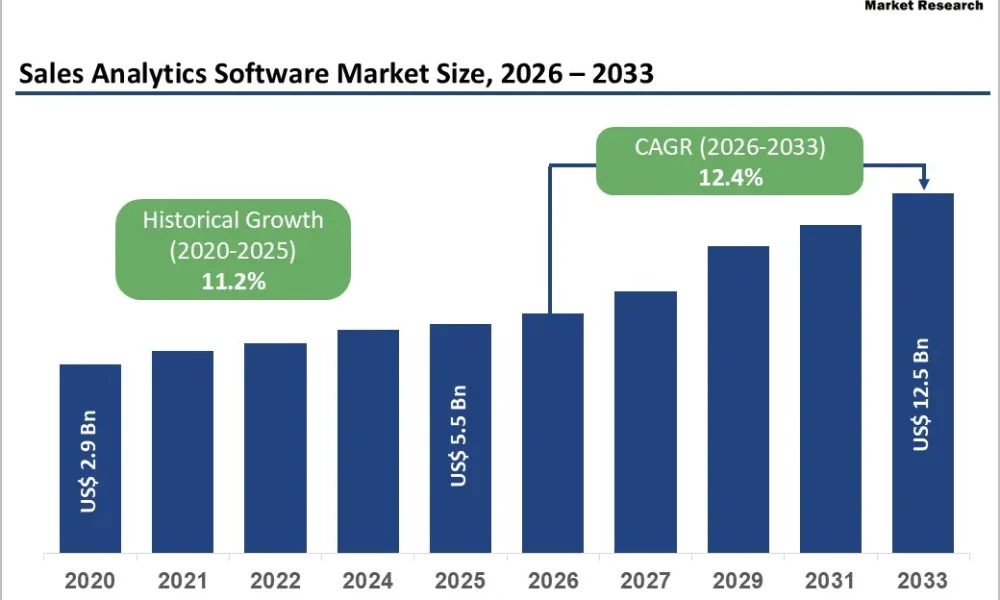
The global sales analytics software market is entering a high-growth phase, fueled by AI-driven forecasting, cloud-based subscription adoption, and enterprise-wide digital transformation initiatives. Valued at US$ 5.5 billion in 2026, the market is projected to reach US$ 12.5 billion by 2033, expanding at a robust 12.4% CAGR between 2026 and 2033.
Organizations are no longer relying on spreadsheet-based forecasting or siloed CRM dashboards. Instead, enterprises are adopting intelligent revenue platforms that integrate predictive analytics, machine learning (ML), and real-time pipeline visibility to drive measurable improvements in win rates, quota attainment, and sales productivity.
Market Overview: AI and Cloud Transforming Revenue Operations
Sales analytics software has evolved from basic reporting tools into AI-powered revenue intelligence platforms. Three structural catalysts are accelerating market expansion:
- AI and ML Integration delivering 25–30% improvements in forecasting accuracy.
- Cloud-based subscription models reducing upfront capital expenditure by 40–60%.
- Digital transformation initiatives requiring real-time revenue intelligence across distributed sales teams.
Between 2020 and 2025, the market expanded at 11.2% CAGR. Moving forward, increased adoption of AI-native sales platforms and SalesOps transformation initiatives are expected to sustain double-digit growth.
Key Industry Highlights
- Leading Region: North America (40% market share in 2025)
- Fastest-Growing Region: Asia Pacific (17.2% CAGR)
- Dominant Segment: Revenue Intelligence & Deal Intelligence (38% share)
- Fastest-Growing Segment: Lead Scoring & Customer Segmentation (16% CAGR)
- Major Opportunity: AI-powered Sales Performance Management (15% CAGR)
Market Dynamics
Driver 1: Digital Transformation and Cloud-Based Adoption
Enterprise IT investments are projected to grow steadily through 2030, creating strong demand for SaaS-based analytics platforms. Organizations are migrating from on-premise systems to cloud-native solutions that offer:
- Subscription-based pricing
- Faster deployment cycles
- Scalable user licensing
- Continuous AI updates
Cloud CRM platforms such as Salesforce, Microsoft, and SAP are embedding predictive analytics directly into their ecosystems, reducing integration friction.
SMEs are adopting subscription-based analytics at a 27% CAGR between 2025 and 2030, recognizing ROI within 12–18 months of deployment.
Driver 2: AI and Machine Learning Delivering Quantifiable Gains
Artificial intelligence has fundamentally reshaped forecasting accuracy.
- Traditional statistical forecasting: ~70% accuracy
- AI-driven predictive models: Up to 95% accuracy
Companies leveraging AI-powered revenue intelligence report:
- 25% improvement in pipeline visibility
- 30% reduction in sales cycle time
- 35% higher win rates
- 25% increase in deal closure rates
Advanced analytics platforms are increasingly embedded in enterprise solutions such as Salesforce Einstein, Microsoft Dynamics 365 Copilot, and SAP Analytics Cloud.
This embedded AI model removes the need for in-house data science teams, democratizing advanced analytics adoption.
Restraint 1: Complex Implementation and High Total Cost of Ownership
Despite compelling ROI metrics, implementation challenges remain significant:
- ERP, CRM, and finance system integration complexity
- Data migration and cleansing requirements
- External consulting fees
- 6–12 month deployment timelines
For SMEs, upfront integration costs can rival annual subscription fees, extending payback cycles to 18–36 months.
Additionally, ongoing system optimization requires IT resources many mid-sized firms lack.
Restraint 2: Data Privacy, Compliance, and Cybersecurity Risks
Regulatory frameworks such as:
- GDPR (Europe)
- CCPA (California)
- Emerging global cybersecurity standards
have increased compliance complexity for cloud-based analytics platforms.
Organizations must address:
- Data residency requirements
- Encryption standards
- Audit trail documentation
- Cybersecurity vulnerability mitigation
An estimated 40–50% of potential adopters delay implementation due to compliance and security concerns.
Market Opportunity: AI-Powered Sales Performance Management (SPM)
Sales Performance Management represents the strongest growth opportunity, projected to expand at 15% CAGR through 2033.
AI-powered SPM platforms enable:
- Real-time quota modeling
- Dynamic compensation calculation
- Automated commission tracking
- Predictive revenue capacity planning
Companies such as Clari, Salesloft, and Outreach are attracting strong venture capital interest for AI-native revenue orchestration solutions.
Elevate your business strategy with comprehensive market data. Request a sample report now: https://www.persistencemarketresearch.com/samples/33096
Category-Wise Analysis
Application Insights
Revenue Intelligence & Deal Intelligence (38% Share)
This dominant segment provides:
- Real-time pipeline health monitoring
- Behavioral anomaly detection
- Conversational intelligence (call analysis)
- Deal risk scoring
Organizations adopting revenue intelligence platforms report 25–30% improvement in forecast precision, strengthening financial planning confidence.
Organization Size Insights
Large Enterprises (62–68% Share)
Multinational corporations dominate adoption due to:
- Complex global sales structures
- Large distributed teams
- Multi-region forecasting requirements
Automation initiatives reduce manual reporting workloads by up to 70%, supporting scalable governance frameworks.
Industry Insights
BFSI Leads (32% Market Share)
Banking and financial institutions prioritize:
- Compliance-ready reporting
- Customer lifetime value analytics
- Lead prioritization
- Transparent sales documentation
AI-driven sales analytics deliver up to 30% improvement in operational sales efficiency within BFSI environments.
Pricing Model Insights
Subscription-based SaaS dominates with 72% share in 2025 and is projected to grow at 16.5% CAGR.
Benefits include:
- Predictable budgeting
- Continuous feature updates
- Lower infrastructure dependence
- Faster time-to-value
This model aligns with enterprise digital transformation strategies emphasizing agility and scalability.
Regional Insights
North America: Market Leader (40% Share)
North America remains the largest market, driven by:
- Mature cloud adoption
- Strong venture capital ecosystem
- Advanced SalesOps frameworks
The United States benefits from integrated AI ecosystems anchored by companies such as Salesforce, Microsoft, and Oracle.
E-commerce surpassing US$1 trillion has intensified demand for real-time sales forecasting and automated pipeline management.
The region is projected to grow at 10.5% CAGR through 2033.
Europe: Compliance-Driven Modernization
Europe holds approximately 24% market share.
GDPR compliance significantly influences vendor selection, with enterprises preferring privacy-by-design platforms.
Germany leads adoption across manufacturing and automotive sectors, while the UK drives demand for AI-driven forecasting tools to maintain competitiveness in a digitally mature market.
Projected CAGR: 11.8% through 2033.
Asia Pacific: Fastest Growth (17.2% CAGR)
Asia Pacific is the fastest-growing region, driven by:
- Rapid industrialization
- Expanding digital infrastructure
- Government-backed AI initiatives
China remains the largest growth engine, while India is experiencing 35%+ analytics adoption growth across BFSI, telecom, and IT services.
Japan and South Korea are integrating AI-driven revenue platforms to support global supply chains and advanced manufacturing ecosystems.
Competitive Landscape
The market demonstrates moderate consolidation, with integrated enterprise software vendors dominating through ecosystem lock-in strategies.
Key players include:
- Salesforce
- Microsoft
- SAP
- Oracle
- IBM
- HubSpot
- Zoho Corporation
- Qlik
- Gong
Vendors are competing through:
- Embedded AI capabilities
- Cross-suite integration
- Unified revenue cloud platforms
- Conversational intelligence automation
- M&A-driven ecosystem expansion
Key Market Developments
- April 2024:
Salesforce expanded Einstein Copilot integration within Sales Cloud, enabling AI-driven forecast automation and opportunity scoring. - February 2024:
Microsoft launched Copilot for Sales within Dynamics 365 and Outlook, embedding generative AI directly into daily sales workflows. - March 2025:
SoftwareOne opened new Digital Sales Hubs in Latin America in collaboration with Microsoft, extending AI-driven sales capabilities to SMEs.
Future Outlook: From CRM Reporting to AI-Driven Revenue Orchestration
The sales analytics software market is evolving beyond static dashboards into fully integrated AI-powered revenue orchestration platforms. Enterprises increasingly demand:
- Predictive deal scoring
- Automated coaching insights
- Real-time quota modeling
- Unified revenue visibility
As organizations prioritize data-driven decision-making and AI-enhanced forecasting, the market is positioned for sustained double-digit expansion.
With projected revenues reaching US$ 12.5 billion by 2033, sales analytics software will become a foundational pillar of global SalesOps modernization, enabling enterprises to transform pipeline management into a measurable competitive advantage.
Related Reports:




