
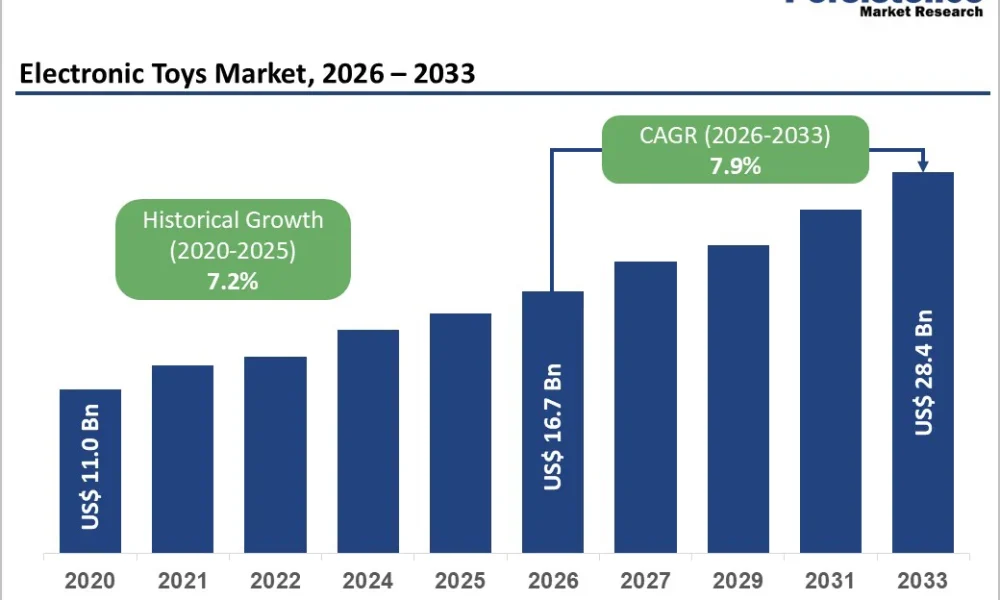
The global electronic toys market is entering a transformative phase, driven by innovation in AI, robotics, and STEM-focused learning. The market is projected to be valued at US$16.7 billion in 2026 and is expected to reach US$28.4 billion by 2033, growing at a CAGR of 7.9% during the forecast period. This growth reflects the increasing preference for interactive, educational, and technology-enabled play experiences across global households.
Electronic toys are no longer simple battery-operated gadgets. They now integrate artificial intelligence, sensors, connectivity features, and app-based ecosystems to enhance cognitive development, creativity, and engagement. With digital-native generations growing up in connected environments, electronic toys are increasingly viewed as essential tools for early learning and skill-building.
Market Overview and Growth Dynamics
Between 2020 and 2025, the electronic toys market grew at a CAGR of 7.2%, reflecting steady demand for STEM kits, interactive robots, and learning tablets. From 2026 onward, growth is expected to accelerate due to three major drivers:
- Rising demand for STEM-focused educational toys
- Increasing parental emphasis on interactive learning
- Advancements in AI-enabled and rechargeable toy technologies
Parents are actively seeking toys that balance screen exposure while still delivering digital literacy. Electronic toys address this need by combining hands-on play with programmable features, robotics, and adaptive learning.
North America is anticipated to lead the market in 2026, accounting for approximately 35% of global revenue. Meanwhile, Asia Pacific is expected to be the fastest-growing region due to rising disposable incomes and expanding awareness of STEM education in countries such as India and China.
Market Drivers: Growth, Barriers, and Opportunities
Rising Demand for STEM-Focused Play
STEM education (Science, Technology, Engineering, and Mathematics) has become central to childhood development strategies worldwide. Electronic toys designed around coding, robotics, logic-building, and problem-solving are witnessing rapid uptake.
Products such as LEGO’s LEGO Education SPIKE Prime allow children to construct programmable robots, blending creativity with coding. These systems provide hands-on learning while introducing programming fundamentals in a child-friendly manner.
Similarly, robotic toys like Sphero’s Sphero BOLT integrate sensors and programmable LED displays, enabling children to experiment with drag-and-drop coding or advanced scripting in JavaScript and Python.
Such interactive systems reduce passive screen time and encourage active engagement, making them highly attractive to modern parents
High Development and Safety Testing Costs
Despite strong growth, electronic toy manufacturers face significant challenges.
Developing AI-enabled robots or app-connected devices requires:
- Advanced microprocessors
- Secure firmware systems
- Cloud integration capabilities
- Rigorous safety testing
Compliance with global toy safety standards such as CPSIA and ASTM involves extensive drop testing, battery safety validation, overheating prevention measures, and data privacy safeguards.
The cost burden is particularly high for smaller companies attempting to enter the market with innovative smart toys. Specialized materials, high-grade plastics, and multi-batch quality testing significantly extend development timelines and increase capital requirements.
Innovation in AI-Enabled and Rechargeable Platforms
One of the most transformative opportunities lies in AI-powered learning toys.
Modern electronic toys now feature:
- Voice recognition
- Adaptive difficulty levels
- Cloud-based software updates
- Personalized learning paths
AI integration reduces engagement drop-off by adjusting tasks based on a child’s learning speed. This improves retention and minimizes frustration, ultimately enhancing brand loyalty.
Rechargeable battery systems also represent a major innovation. Long-life lithium-ion batteries and wireless charging docks are replacing disposable batteries in many premium products.
For example, Energizer Holdings introduced EcoAdvanced batteries made with recycled materials, signaling broader sustainability trends in the industry.
Rechargeable systems reduce long-term costs for parents and align with growing environmental consciousness.
Elevate your business strategy with comprehensive market data. Request a sample report now: https://www.persistencemarketresearch.com/samples/20491
Category-Wise Analysis
Product Type Insights
Educational toys dominate the market, holding approximately 40% of the revenue share in 2026. Their popularity stems from strong parental preference for skill-building and curriculum-aligned play.
Brands like VTech Holdings Limited specialize in interactive learning tablets and electronic reading systems designed for early childhood education.
Robotic toys represent the fastest-growing segment. Their programmable capabilities foster creativity and introduce coding at younger ages. As robotics becomes integrated into school curricula, adoption is accelerating across North America and Europe.
Age Group Insights
Preschoolers account for over 35% of total revenue in 2026. Early childhood development programs increasingly emphasize sensory engagement, language development, and motor skills.
Companies such as Fisher-Price and LeapFrog Enterprises design interactive products specifically tailored for children aged 3–5, promoting phonics, counting, and basic logic skills.
The school-age segment is growing fastest, driven by advanced STEM kits and coding-based robotics platforms used in classrooms.
Power Source Insights
Rechargeable batteries lead the market with nearly 60% revenue share in 2026. Sustainability concerns and long-term cost savings are pushing parents toward eco-friendly solutions.
However, non-rechargeable batteries remain relevant in price-sensitive segments. Brands such as Duracell continue to supply disposable alkaline batteries widely used in budget-friendly toys.
The balance between affordability and sustainability will shape future power source innovations.
Sales Channel Insights
Online retail is expected to account for approximately 45% of global revenue in 2026. E-commerce platforms provide:
- Wide product selection
- User reviews
- Competitive pricing
- Easy returns
Amazon dominates online toy sales globally, leveraging strong logistics networks and personalized recommendation engines.
Meanwhile, specialty stores are emerging as the fastest-growing channel. Retailers such as FAO Schwarz offer curated assortments, immersive in-store experiences, and expert guidance for premium purchases.
The tactile experience and personalized assistance offered by specialty stores are particularly valuable for high-end robotic and AI-driven toys.
Regional Market Trends
North America
North America is projected to account for nearly 35% of global revenue in 2026. High parental spending, advanced retail infrastructure, and widespread STEM awareness drive regional growth.
The U.S. leads innovation through established players such as Mattel and Hasbro, which continue investing in tech-integrated product lines.
Strong educational campaigns promoting robotics and coding further reinforce adoption.
Europe
Europe benefits from government-backed education initiatives and eco-conscious consumer behavior. Demand for rechargeable, sustainable electronic toys is particularly strong in Germany, France, and the U.K.
Innovation in AI-enabled play platforms aligns well with Europe’s emphasis on structured learning and safety compliance.
Asia Pacific
Asia Pacific is the fastest-growing region, supported by rising disposable incomes and expanding manufacturing ecosystems.
Countries such as India and China are investing heavily in STEM education and local toy production. Companies like Funskool India Ltd. have recently expanded into electronic toy manufacturing, reflecting regional momentum.
Growing middle-class populations and increasing online retail penetration are expected to drive substantial revenue gains.
Competitive Landscape
The global electronic toys market features intense competition between legacy toy manufacturers and emerging tech-driven brands.
Leading companies include:
- Mattel
- Hasbro
- LEGO
- Funko
- Jazwares
- IMC Toys
- VTech Holdings Limited
Strategic collaborations, product launches, and acquisitions are common as firms aim to integrate AI, app ecosystems, and sustainable power solutions.
Key Industry Developments
In December 2025, Funskool India Ltd. announced the launch of electronic toy production, marking a strategic shift toward interactive learning products in the Indian market.
In March 2025, Bambu Lab revealed plans for the MakerWorld CyberBrick ecosystem, a modular platform combining 3D printing and electronic modules to build Bluetooth-enabled interactive toys and gadgets.
Such innovations highlight the merging of hardware, software, and creative ecosystems in the toy industry.
Future Outlook (2026–2033)
Looking ahead, the electronic toys market will continue evolving at the intersection of education, entertainment, and technology.
Key trends shaping the future include:
- AI-personalized learning toys
- Cloud-connected play ecosystems
- Sustainable rechargeable power solutions
- Expansion of robotics in school curricula
- Growth of experiential retail
As digital literacy becomes foundational, electronic toys will serve as early gateways into programming, engineering, and problem-solving.
With projected revenues of US$28.4 billion by 2033, the market represents a dynamic growth arena for manufacturers, retailers, and investors alike.
Electronic toys are no longer optional entertainment—they are becoming essential developmental tools for the next generation.
Related Reports:




