
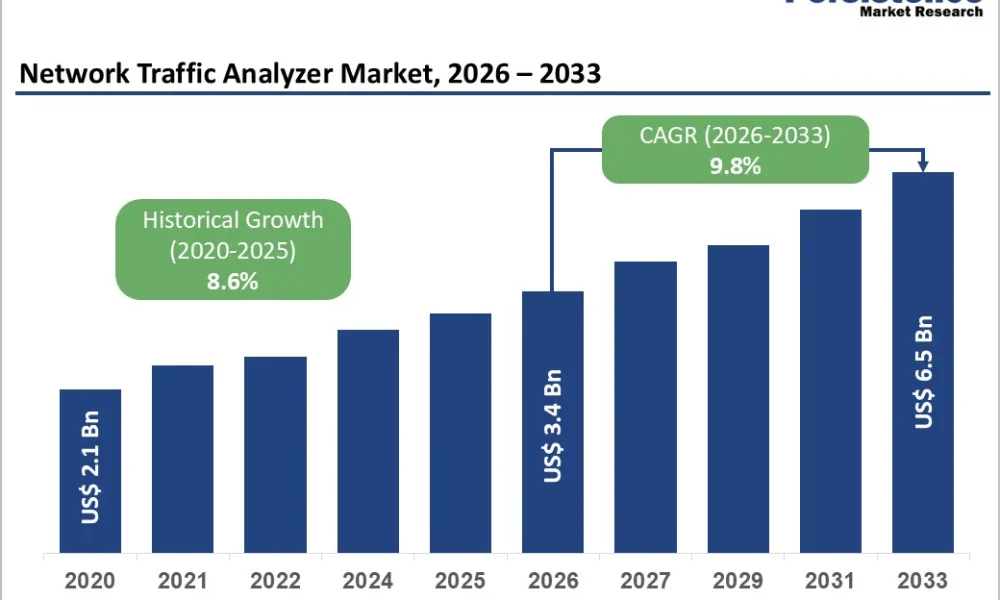
The global Network Traffic Analyzer Market is projected to be valued at US$ 3.4 billion in 2026 and is forecast to reach US$ 6.5 billion by 2033, expanding at a CAGR of 9.8% between 2026 and 2033. This steady growth reflects the increasing importance of real-time network visibility, advanced threat detection, and regulatory-driven monitoring requirements across enterprises and telecom operators.
Three primary forces are accelerating market expansion. First, escalating cyber threats demand real-time anomaly detection and behavioral analytics. Second, regulatory mandates require detailed traffic logging and documentation. Third, the widespread adoption of cloud infrastructure has created complex hybrid environments that require unified network observability platforms capable of delivering end-to-end visibility.
As digital ecosystems become more distributed—spanning on-premises data centers, public clouds, and edge nodes—network traffic analyzers have evolved from troubleshooting tools into mission-critical components of cybersecurity and performance assurance strategies.
Key Industry Highlights
- Regional Leadership: North America accounts for 34% of global market share.
- Component Dominance: Solutions segment leads with 72% share in 2026.
- Largest End-user: Telecommunications & service providers hold 26% share.
- Growth Catalyst: Rising cyber threats and stricter regulatory enforcement.
- Emerging Opportunity: AI-driven predictive observability.
- 5G Acceleration: Network slicing and edge expansion increase demand for traffic analytics.
Market Dynamics
Drivers
Regulatory Compliance and Cybersecurity Mandates
Governments and regulators worldwide are strengthening cybersecurity enforcement. In the United States, the Federal Communications Commission (FCC) issued regulatory clarifications under CALEA requiring telecommunications carriers to secure networks against unauthorized interception. This mandate compels telecom operators to implement advanced traffic analysis systems capable of detecting suspicious activity and maintaining audit trails.
Similarly, the European Union’s NIS2 Directive mandates enhanced network monitoring across critical infrastructure sectors, with penalties reaching up to €10 million or 2% of annual global turnover for non-compliance.
Compliance-driven demand is especially strong in financial services, healthcare, and telecom industries. Regulations such as GDPR’s 72-hour breach notification rule require organizations to demonstrate “appropriate technical measures,” reinforcing the necessity for real-time traffic monitoring platforms.
Cloud-Native Complexity and Digital Transformation
Digital transformation initiatives are generating unprecedented network complexity. According to industry estimates, global data creation is approaching 175 zettabytes, with edge devices and IoT systems contributing significantly to traffic volumes.
Cloud adoption has reached over 90% among enterprises, creating hybrid infrastructures combining on-premises environments with public cloud platforms such as Amazon Web Services, Microsoft Azure, and Google Cloud.
Traditional monitoring tools lack the scalability and integration capabilities required for these distributed architectures. Modern network traffic analyzers integrate:
- NetFlow and sFlow analytics
- Deep packet inspection (DPI)
- Machine learning-based behavioral modeling
- Unified dashboards for multi-cloud visibility
This convergence is transforming traffic analyzers into comprehensive observability platforms.
Elevate your business strategy with comprehensive market data. Request a sample report now: https://www.persistencemarketresearch.com/samples/20188
AI-Driven Threat Detection Evolution
Cyber threats have become more sophisticated, with advanced persistent threats (APTs), ransomware campaigns, and zero-day exploits bypassing signature-based detection systems.
AI/ML-powered traffic analyzers are closing this gap. These solutions use anomaly detection, behavioral baselining, and unsupervised learning models to reduce false positives and detect subtle deviations.
For example, Broadcom introduced hardware-level neural inference capabilities in advanced network chips, enabling real-time traffic pattern recognition at line rate. Organizations deploying AI-enhanced traffic analysis report substantial reductions in mean-time-to-detection (MTTD) and mean-time-to-response (MTTR).
Restraints
Integration and Legacy Compatibility Challenges
Despite growth momentum, integration complexity remains a barrier. Enterprises often operate heterogeneous environments including legacy switching platforms, proprietary protocols, and decentralized monitoring systems.
Migrating packet capture strategies from physical networks to virtualized and containerized environments (e.g., Kubernetes-based workloads) introduces architectural challenges. Approximately one-third of enterprises report deployment delays exceeding initial timelines due to compatibility issues.
High total cost of ownership (TCO), skilled workforce requirements, and ongoing software updates further limit adoption among small and mid-sized enterprises.
Emerging Opportunities
AI-Driven Predictive Observability
The next phase of growth lies in transitioning from reactive monitoring to predictive network observability. Instead of merely detecting anomalies after they occur, advanced systems leverage AI to anticipate congestion patterns, predict SLA violations, and trigger automated remediation.
In March 2025, Arista Networks introduced AI job-centric observability capabilities via CloudVision Universal Network Observability (CV UNO). These innovations allow millisecond-level visibility into AI cluster traffic flows, addressing emerging demands in GPU-intensive computing environments.
Organizations adopting predictive traffic analyzers report significant reductions in unplanned downtime and improved application performance metrics.
5G and Edge Infrastructure Modernization
Global 5G deployments and edge computing expansion are driving additional demand. Telecom operators managing network slicing architectures require traffic analyzers capable of monitoring:
- Virtualized RAN environments
- Network slice isolation
- Ultra-low-latency service chains
India’s large-scale 5G deployment, along with infrastructure buildouts in North America and East Asia, creates multi-year procurement opportunities for vendors offering 5G-optimized monitoring solutions.
Category-Wise Analysis
Solution Module Insights
The solutions segment holds 72% of market share in 2026. Enterprises prefer integrated platforms combining packet capture, flow analysis, metadata processing, and visualization capabilities.
Advanced platforms now support deployment across physical appliances, virtual machines, containers, and cloud-native architectures.
In 2025, Cloudflare enhanced its Radar platform with localized traffic intelligence and Certificate Transparency insights, improving granular monitoring across autonomous systems and regions.
End-User Insights
Telecommunications and Service Providers (26% Share)
Telecom operators represent the largest segment. They use traffic analyzers for:
- Capacity planning
- Congestion management
- SLA enforcement
- Security monitoring
International operators such as Deutsche Telekom and Vodafone deploy carrier-grade solutions supporting exabyte-scale traffic volumes.
IT & Cloud Providers (Fastest Growing)
Hyperscalers and data center operators represent the fastest-growing segment. Providers like Alibaba Cloud and global hyperscale operators require advanced observability tools for distributed infrastructures spanning multiple availability zones.
Regional Insights
North America (34% Share)
North America leads the market, driven by mature IT ecosystems and regulatory enforcement. The U.S. benefits from compliance mandates from federal agencies and securities regulators.
Public companies subject to cybersecurity disclosure rules must detect and report incidents rapidly, strengthening demand for real-time traffic intelligence systems.
East Asia (17% Share)
East Asia demonstrates strong growth, particularly in China, Japan, and South Korea. China’s 5G expansion and smart city initiatives generate significant network monitoring requirements.
Japan’s Society 5.0 vision emphasizes AI-optimized data centers, further stimulating adoption of advanced traffic analytics platforms.
Europe (27% Share)
Europe’s growth is shaped by strict GDPR compliance and NIS2 mandates. Organizations maintain higher baseline investments in monitoring infrastructure to comply with privacy regulations.
The region prioritizes secure, privacy-aware network observability frameworks integrated into digital transformation initiatives.
Competitive Landscape
The market is moderately consolidated, dominated by established vendors with strong R&D capabilities. Leading companies include:
- Arista Networks
- Broadcom
- Cisco Systems
- Juniper Networks
- SolarWinds
- Riverbed Technology
- NEC Corporation
- NETSCOUT
- Zoho Corporation
Competition centers on scalability, AI integration, telemetry precision, deployment flexibility, and cross-cloud visibility capabilities.
Future Outlook (2026–2033)
The Network Traffic Analyzer Market is transitioning from traditional monitoring toward intelligent, predictive, and AI-driven observability ecosystems. As enterprises expand hybrid cloud, edge, and 5G infrastructures, unified network intelligence becomes foundational for both security and performance optimization.
Between 2026 and 2033, sustained growth will be driven by:
- AI-integrated traffic analytics
- Compliance automation
- Edge and 5G traffic visibility
- Cloud-native observability platforms
With projected revenues reaching US$ 6.5 billion by 2033, the market is positioned as a critical pillar in global cybersecurity, digital infrastructure resilience, and next-generation network performance management.
Related Reports:




