
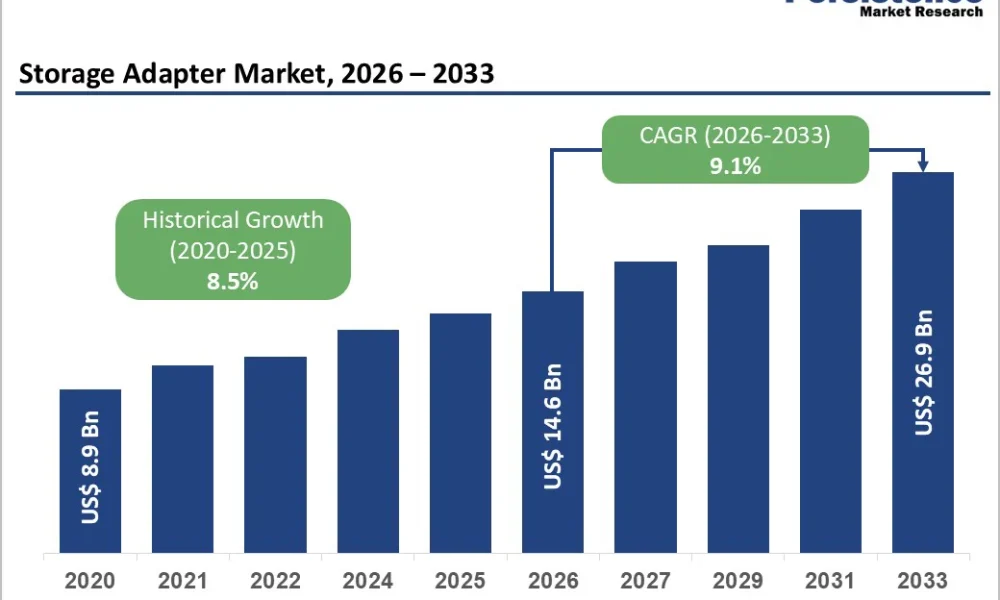
The global storage adapter market is projected to reach US$ 14.6 billion in 2026 and grow to US$ 26.9 billion by 2033, registering a steady CAGR of 9.1% during the forecast period. The market’s expansion reflects the exponential rise in enterprise data generation, rapid cloud transformation, and the accelerating demand for high-speed storage interconnect solutions across hyperscale, AI-driven, and edge environments.
Storage adapters—encompassing host bus adapters (HBAs), RAID controllers, Fibre Channel cards, and NVMe-over-Fabrics (NVMe-oF) interfaces—serve as critical hardware components enabling seamless connectivity between servers and storage arrays. As modern workloads become increasingly data-intensive, the need for ultra-low-latency and high-bandwidth connectivity has intensified across industries.
The surge in NVMe adoption, flash-based storage migration, and high-performance computing (HPC) deployments further reinforces the growth trajectory. In parallel, 5G infrastructure upgrades and edge computing investments are strengthening long-term demand for robust, compact, and energy-efficient storage interconnect solutions.
Key Market Highlights
- Leading Region: North America holds 43.2% market share, driven by hyperscale cloud providers and early technology adoption.
- Fastest-Growing Region: Asia Pacific accounts for 39.2% share, supported by 5G rollout and large-scale digital transformation.
- Dominant Product Segment: Fibre Channel (FC) leads with approximately 38% share in mission-critical SAN environments.
- Fastest-Growing Speed Segment: 32–100+ Gbps adapters are expanding rapidly to support AI and NVMe workloads.
- Key Opportunity: Edge computing infrastructure requiring ruggedized, compact storage adapters.
Market Dynamics
Drivers: Hyperscale Data Center Expansion
The accelerating buildout of hyperscale data centers is a major growth catalyst. Cloud leaders such as Amazon Web Services, Microsoft Azure, and Google Cloud continue expanding server and storage capacity to support Zettabyte-scale data volumes.
These facilities depend on high-performance storage adapters to maintain seamless connectivity across SAN, NAS, and distributed storage systems. As organizations embrace hybrid and multi-cloud architectures, demand for resilient physical interconnects continues to surge.
The shift toward software-defined storage (SDS) and hyperconverged infrastructure (HCI) further magnifies this need. Modern architectures rely heavily on NVMe-oF, SAS, and Fibre Channel adapters to maintain scalability and throughput consistency.
Drivers: NVMe and Flash Storage Adoption
The migration from HDD-based systems to flash and NVMe ecosystems is transforming storage connectivity requirements. Flash-driven architectures demand significantly higher IOPS and lower latency, rendering legacy interfaces inadequate.
Next-generation adapters supporting 32G, 64G, and 100G+ speeds are becoming essential in applications such as:
- AI model training
- Real-time analytics
- Financial trading platforms
- Genomic sequencing
Technologies like PCIe Gen 5 and Gen 6 are increasingly embedded into new HBA and RAID controller designs, aligning storage bandwidth with modern CPUs and GPU accelerators.
Restraints: Rising Cybersecurity Risks
As enterprises deploy NVMe-oF, FCoE, and advanced Ethernet-based storage networks, cybersecurity risks increase. Misconfigured zoning, weak authentication protocols, and unsecured ports can create vulnerabilities.
Industries handling sensitive data—banking, healthcare, and government—must integrate encryption, zero-trust frameworks, and traffic monitoring systems. These measures increase hardware overhead and implementation complexity, slowing modernization efforts for smaller organizations.
Restraints: Skills Gap and Operational Complexity
High-performance storage networking requires expertise in Fibre Channel fabrics, RDMA protocols, virtualization integration, and firmware management. However, global IT skill shortages limit deployment efficiency.
Organizations often depend on OEM-managed services, increasing operational costs. SMEs frequently delay upgrades due to configuration complexity and interoperability concerns.
Elevate your business strategy with comprehensive market data. Request a sample report now: https://www.persistencemarketresearch.com/samples/33427
Emerging Opportunities
Edge Computing and IoT Deployment
Edge computing represents a major growth avenue. With IoT devices, smart infrastructure, and remote industrial systems generating real-time data, localized processing is essential.
Edge nodes demand:
- Compact form factors
- Energy efficiency
- Ruggedized design
- High throughput
5G rollouts further intensify edge data traffic, expanding demand for purpose-built storage adapters in telecom, manufacturing, and industrial automation environments.
AI and Generative AI Workloads
The rapid adoption of AI, machine learning, and generative AI is reshaping data center architecture. Storage adapters now need to support:
- GPU-direct storage
- RDMA-over-Ethernet
- High-speed InfiniBand fabrics
- Intelligent offload engines
Advanced adapters with onboard compression, encryption, and erasure coding capabilities reduce CPU load while optimizing performance. Vendors that integrate computational storage features will gain a competitive edge in AI infrastructure buildouts.
Category-Wise Analysis
Product Type Insights
Fibre Channel (FC) leads with nearly 38% market share. Enterprises in banking, healthcare, and government rely on FC for deterministic, lossless data transport.
Continuous upgrades to 32G and 64G FC technologies sustain dominance. The installed base of legacy SAN environments also drives steady replacement cycles.
FCoE is the fastest-growing segment, offering Ethernet consolidation and reduced cabling complexity in modern data centers.
Application Insights
Data center infrastructure accounts for approximately 42% share. Hyperscale expansion and workload consolidation require high-density HBAs and RAID controllers.
Cloud and virtualized workloads represent the fastest-growing application segment. Increasing adoption of SaaS, PaaS, and AI services accelerates procurement of high-bandwidth adapters optimized for distributed environments.
Data Transfer Speed Insights
The 32–100+ Gbps segment leads with roughly 35% share. As NVMe SSD arrays generate higher throughput, legacy 12G/16G standards become bottlenecks.
The ultra-high-performance tier powered by PCIe Gen 5/6 is expanding fastest, fueled by AI training clusters and GPU-accelerated computing.
End-User Insights
The commercial segment dominates with about 60% share. Enterprises, telecom operators, and cloud providers are primary consumers of premium SAN/NAS connectivity hardware.
Cloud-native enterprises and digital service providers form the fastest-growing user group, deploying NVMe-oF and 200GbE solutions to support distributed and containerized workloads.
Regional Insights
North America
North America leads with 43.2% share, driven by enterprise modernization and hyperscale investments. The region benefits from early adoption of NVMe-oF and 400GbE technologies.
Key technology innovators such as Intel, Broadcom, and NVIDIA accelerate next-generation adapter development.
Sustained capital expenditure in AI, analytics, and hybrid cloud infrastructure reinforces long-term market dominance.
Europe
Europe is growing at a CAGR of 9.9%, supported by GDPR compliance requirements and sovereign cloud initiatives like GAIA-X.
Countries such as Germany and the U.K. emphasize green data centers and energy-efficient infrastructure. High-performance computing collaborations led by CERN further boost demand for low-latency storage connectivity.
Asia Pacific
Asia Pacific is the fastest-growing region, accounting for 39.2% share. Rapid digitalization in China, India, South Korea, and Southeast Asia fuels demand.
China’s “Eastern Data, Western Computing” initiative accelerates large-scale storage deployments. Manufacturing hubs in Taiwan and South Korea strengthen supply chains.
SMEs increasingly adopt SAS and SATA adapters, while hyperscalers upgrade storage fabrics for enhanced throughput and latency performance.
Competitive Landscape
The storage adapter market is highly consolidated. Key players dominate high-performance Fibre Channel and enterprise RAID segments.
Major companies include:
- Broadcom
- Intel
- Dell Technologies
- Hewlett Packard Enterprise
- Cisco Systems
- Microchip Technology
- Lenovo
- IBM
- Huawei
- Marvell Technology
High entry barriers stem from engineering complexity, firmware certification requirements, and enterprise reliability standards.
Recent Market Developments
- In October 2024, Broadcom launched its Gen 7 Fibre Channel HBAs designed for autonomous SAN operations.
- In August 2024, Hewlett Packard Enterprise expanded collaboration with Intel to integrate silicon photonics-based storage adapters into ProLiant servers.
- In March 2023, Microchip Technology introduced 24G SAS/PCIe Gen 4 Tri-Mode storage controllers.
Future Outlook
Between 2026 and 2033, the storage adapter market will remain integral to digital infrastructure expansion. The intersection of AI acceleration, cloud-native computing, and edge deployment will redefine performance expectations.
Vendors investing in intelligent adapters, ultra-high-bandwidth connectivity, and secure firmware innovation will gain competitive advantage. As enterprises modernize toward NVMe and AI-optimized architectures, storage interconnect solutions will evolve from passive connectivity components into performance-enabling intelligence layers within next-generation data centers.
With a projected market value of US$ 26.9 billion by 2033, the storage adapter industry stands positioned as a foundational pillar of global digital transformation.
Related Reports:




