
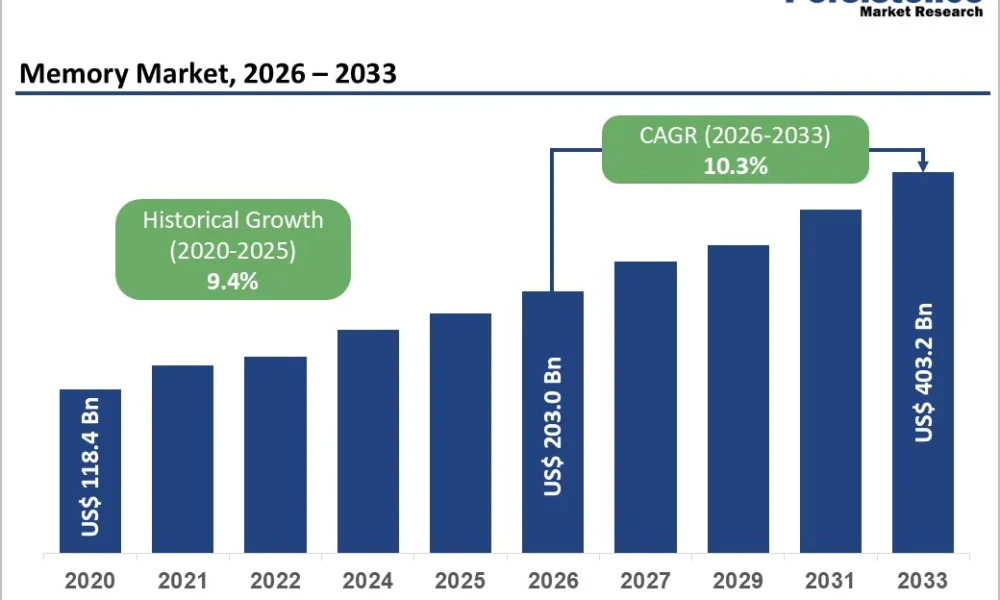
The global memory market is entering a powerful expansion phase, driven by artificial intelligence, cloud computing, edge infrastructure, and next-generation automotive systems. Valued at US$ 203.0 billion in 2026, the market is projected to reach US$ 403.2 billion by 2033, expanding at a CAGR of 10.3% during the forecast period.
This growth marks a structural transformation rather than a typical semiconductor upcycle. Advanced memory architectures such as High Bandwidth Memory (HBM), DDR5 DRAM, and 3D NAND are redefining computing performance standards. As AI model complexity increases and data center modernization accelerates, memory intensity per device, server, and vehicle continues to rise.
Market Overview: Structural Shift Toward AI-Optimized Memory
Historically, memory demand was closely tied to PC and smartphone cycles. However, the current growth trajectory is increasingly anchored in AI clusters, hyperscale cloud data centers, automotive computing platforms, and edge-connected IoT systems.
Between 2020 and 2025, the market expanded at a CAGR of 9.4%. Moving forward, AI-led infrastructure investments are expected to sustain even stronger momentum. Data-center memory demand alone is forecast to grow at approximately 33% annually through 2030.
Industry leaders including Samsung Electronics, SK Hynix, and Micron Technology are aggressively expanding production capacity, particularly for high-margin AI-optimized memory products.
Key Industry Highlights
- Leading Region: Asia Pacific holds 42.3% of global market value.
- Fastest-Growing Region: North America, expanding at 11.2% CAGR.
- Dominant Technology: DRAM commands 45% share.
- Fastest-Growing End-User: Data centers.
- Key Opportunity: Automotive and edge computing memory expansion.
Market Dynamics
- Explosive Demand for Artificial Intelligence Infrastructure
Artificial intelligence is fundamentally reshaping memory architecture priorities. AI training and inference workloads require ultra-high bandwidth and low-latency memory subsystems. As a result, High Bandwidth Memory (HBM) shipments surged more than 200% in 2024 and are expected to grow another 70% in 2025.
Technology giants such as Microsoft, Google, and OpenAI are securing long-term HBM supply agreements to support massive AI infrastructure scaling.
In late 2025, SK Hynix confirmed that its 2026 HBM output was fully allocated, signaling multi-year supply tightness. This structural imbalance is expected to persist through at least 2027, supporting strong pricing dynamics and revenue visibility for manufacturers.
- Proliferation of Data-Intensive Computing Across Verticals
Memory intensity is rising sharply across industries.
- Automotive: Vehicle memory content is projected to increase from approximately 90 GB per vehicle in 2025 to nearly 278 GB in 2026. Autonomous-ready electric vehicles could reach 2 TB per vehicle.
- Smartphones: Flagship devices now integrate up to 1 TB of onboard storage.
- IoT: Global connected devices exceeded 18.5 billion in 2024 and are expected to surpass 21.1 billion, expanding embedded memory demand across smart manufacturing, healthcare, and industrial robotics.
This diversification reduces dependence on legacy PC cycles and enhances long-term resilience.
- Restraint: Cyclical Supply Constraints and Capital Intensity
Despite strong demand, supply expansion remains challenging. Building an advanced fabrication facility requires:
- 24–36 months construction timeline
- US$ 5–10 billion capital investment
Manufacturers are prioritizing premium HBM and advanced DRAM nodes, limiting supply of conventional memory products. Capacity expansion strategies remain cautious due to concerns about potential AI infrastructure corrections.
This creates a selective supply imbalance—strong profitability in high-end segments but constrained availability in mid-range applications.
- Geopolitical Tensions and Trade Restrictions
Global memory manufacturing is heavily concentrated in Asia Pacific, particularly South Korea. Export restrictions on advanced memory technologies have intensified supply chain fragmentation.
Governments are responding with industrial policy initiatives such as:
- U.S. CHIPS and Science Act
- European Chips Act
These programs aim to localize semiconductor production. However, new fabrication plants require years to achieve operational maturity, increasing short-term costs and duplicative investments.
Chinese memory producer Yangtze Memory Technologies Co. continues expanding domestic capabilities, though advanced lithography access remains restricted.
Elevate your business strategy with comprehensive market data. Request a sample report now: https://www.persistencemarketresearch.com/samples/33356
Category-Wise Analysis
Technology Insights
DRAM: The Dominant Segment
DRAM accounts for roughly 45% of global memory revenue. It remains essential across:
- Data centers
- Smartphones
- PCs
- AI accelerators
DDR5 adoption is accelerating, while HBM’s share of overall DRAM bit capacity continues to rise.
High Bandwidth Memory: The Fastest-Growing Technology
HBM represents the most dynamic growth segment. Its advantages include:
- Exceptional bandwidth performance
- Lower energy consumption
- Tight integration with GPUs and AI accelerators
Roadmaps for HBM4 and HBM4E indicate further performance doubling, ensuring sustained multi-year expansion.
End-User Insights
Data Centers: The Primary Growth Engine
Data centers are expected to contribute approximately 35% of total memory market value by 2033.
Hyperscalers are deploying GPU-dense clusters, significantly increasing memory per rack. AI-driven workloads require dense, energy-efficient memory pools capable of supporting parallel compute architectures.
AI & Machine Learning Infrastructure
AI-specific deployments represent the fastest-expanding segment. Large language models and generative AI applications require massive memory bandwidth for both training and inference.
Model-as-a-service platforms and enterprise AI adoption further amplify memory consumption across global infrastructure.
Regional Analysis
Asia Pacific: The Manufacturing Powerhouse (42.3% Share)
Asia Pacific dominates both production and consumption. South Korea remains central to DRAM and NAND manufacturing, led by Samsung Electronics and SK Hynix.
China, Taiwan, and Japan contribute significantly to NAND production and semiconductor supply chain integration.
Emerging hubs in Southeast Asia and India are strengthening diversification efforts while expanding electronics manufacturing ecosystems.
North America: Fastest Growth Momentum (11.2% CAGR)
North America accounts for 31.5% of global demand, driven by AI infrastructure concentration in the United States.
Major hyperscalers—including Amazon, Meta, and Google—are expanding AI data centers at unprecedented rates.
Domestic semiconductor investments across Arizona, Texas, and New York are strengthening long-term supply resilience.
Europe: Automotive and Industrial Growth
Europe is witnessing steady expansion supported by automotive electrification, industrial automation, and cloud infrastructure growth.
Companies such as Infineon Technologies and STMicroelectronics are enhancing regional semiconductor capabilities.
Although import-dependent for high-end DRAM and NAND, Europe is improving mid-range production stability through policy-backed investments.
Opportunity Landscape
- Data Center Modernization and SSD Transition
Cloud providers are migrating from HDDs to high-density SSDs, including 30TB and 60TB NAND-based architectures.
Advancements in QLC NAND and 1-terabyte die technologies are enabling:
- Higher storage density
- Lower power consumption
- Reduced latency
As enterprises adopt cloud-first strategies, long-term demand for high-capacity memory modules will accelerate.
- Automotive and Edge Computing Expansion
Modern vehicles incorporate advanced driver assistance systems (ADAS), autonomous navigation, and intelligent cockpit systems. These systems require:
- Functional safety-certified memory
- Real-time processing capabilities
- Extreme environmental resilience
At the same time, edge computing deployments across smart factories and IoT networks are driving demand for compact, low-power embedded memory solutions.
Competitive Landscape
The memory semiconductor industry is highly consolidated. A handful of manufacturers control approximately 85–90% of global output.
Key companies include:
- Samsung Electronics
- SK Hynix
- Micron Technology
- Kioxia
- Western Digital
- Nanya Technology
- Winbond Electronics
These players dominate advanced DRAM, HBM, and NAND segments. Their competitive advantages include:
- Technological leadership
- Capital intensity barriers
- Long-term hyperscaler partnerships
- AI-focused product roadmaps
Smaller players remain concentrated in legacy or niche applications with limited participation in AI-optimized segments.
Key Market Developments
- Full Allocation of 2026 HBM Output:
In December 2025, SK Hynix confirmed complete allocation of its 2026 HBM capacity, indicating sustained supply tightness. - Strategic AI Supply Agreements:
In October 2025, Samsung Electronics and SK Hynix signed preliminary agreements with OpenAI to scale HBM output to approximately 900,000 chips per month by 2029. - HBM4 Validation Completion:
In September 2025, SK Hynix completed validation of HBM4 chips, doubling bandwidth while improving energy efficiency by roughly 40% compared to HBM3E.
Future Outlook: Sustained Structural Expansion
The global memory market is no longer defined solely by consumer electronics cycles. Instead, it is increasingly shaped by AI-driven infrastructure, cloud transformation, automotive digitization, and edge intelligence.
Persistent supply constraints, high capital barriers, and strong hyperscaler partnerships are likely to sustain favorable pricing dynamics through at least 2027. Meanwhile, innovation in HBM, advanced DRAM, and next-generation NAND architectures will continue pushing performance boundaries.
With projected revenues reaching US$ 403.2 billion by 2033, the memory industry stands at the center of the global digital transformation wave. As AI workloads intensify and connected ecosystems expand, memory will remain one of the most strategically critical segments of the semiconductor value chain for the foreseeable future.
Related Reports:




