
The CAR T-cell therapy market is one of the most rapidly expanding sectors in the biopharmaceutical industry, driven by significant advancements in gene-editing technology, regulatory support, and an increasing demand for personalized cancer treatments. This immunotherapy involves modifying a patient’s own T-cells to target and destroy cancer cells more effectively. As a result, CAR T-cell therapy has emerged as a groundbreaking treatment for various forms of hematological malignancies and shows promising potential for solid tumors.
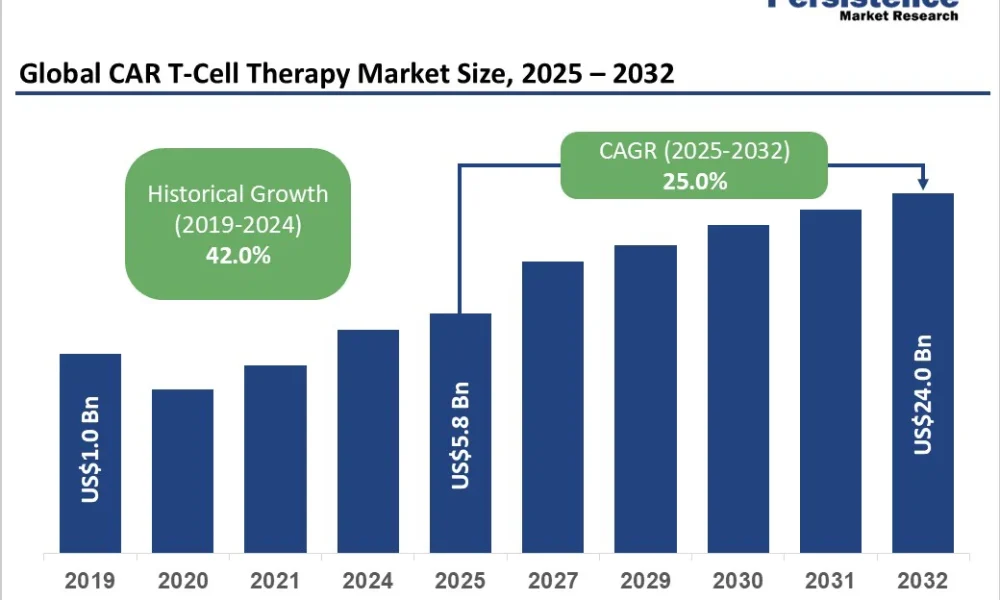
With the global CAR T-cell therapy market projected to grow from US$5.8 billion in 2025 to US$24 billion by 2032, the market is poised to witness a CAGR of 25% during the forecast period from 2025 to 2032. The driving forces behind this growth include increasing cancer prevalence, improved treatment outcomes, and the growing adoption of gene-editing technologies. However, the market is not without its challenges, such as high treatment costs, scalability issues, and regional disparities in access to advanced therapies. Despite these obstacles, CAR T-cell therapies remain a beacon of hope for patients with difficult-to-treat cancers.
Download Your Free Sample & Explore Key Insights: https://www.persistencemarketresearch.com/samples/28264
Key Highlights from the Report
• Market Size (2025E): US$5.8 billion
• Market Value Forecast (2032F): US$24 billion
• Projected Growth (CAGR 2025-2032): 25%
• Leading Disease Indication: Lymphoma, accounting for 40% of the market share
• Fastest-growing Drug Type: Abecma, with the highest CAGR
• Dominant Region: North America, expected to hold 45% market share in 2025
Market Segmentation
The CAR T-cell therapy market is segmented based on product type, disease indication, target antigen, and geographical region. These segments provide insights into the therapeutic potential and market dynamics that define the overall growth trajectory of the sector.
Product Type
The primary product types in the CAR T-cell therapy market include approved therapies like Yescarta (Gilead Sciences) and Kymriah (Novartis), which target B-cell malignancies like non-Hodgkin lymphoma and acute lymphoblastic leukemia (ALL). These therapies have shown efficacy in treating relapsed or refractory cases of these cancers. Additionally, therapies like Abecma, which targets multiple myeloma, represent a fast-growing segment within the market due to their impressive clinical trial results and FDA approvals.
Disease Indication
The market is largely driven by hematological malignancies, particularly lymphoma and multiple myeloma. Lymphoma is expected to maintain the largest market share, constituting approximately 40% of the global market in 2025, while multiple myeloma is expected to be the fastest-growing segment. This growth is attributed to the increasing prevalence of these diseases and the success of CAR T-cell therapies in offering long-term remission for patients who have failed conventional treatments.
Target Antigen
Currently, CD19-targeted CAR T-cell therapies dominate the market due to their efficacy in treating B-cell malignancies. However, BCMA-targeted therapies, which are used to treat multiple myeloma, are projected to grow rapidly. Both targets are critical in the development of targeted immunotherapies, driving market growth and encouraging innovation in treatment regimens.
Geographical Region
North America is expected to continue dominating the CAR T-cell therapy market, accounting for approximately 45% of the global market share in 2025. The U.S. is at the forefront of CAR T-cell therapy development due to its advanced healthcare infrastructure, high treatment adoption rates, and favorable reimbursement policies. In contrast, the Asia Pacific region is poised to experience the fastest growth, driven by improving healthcare infrastructure, rising cancer prevalence, and increasing government investments in biotechnology.
Regional Insights
North America
North America is projected to hold the largest share of the CAR T-cell therapy market in 2025, with the U.S. leading the charge. The U.S. boasts a highly advanced healthcare system, a robust innovation ecosystem, and strong regulatory support from the FDA. These factors contribute to an early adoption of CAR T-cell therapies, making the U.S. a key player in market growth. Additionally, the region benefits from a high level of disease awareness, increasing public and private sector investments, and favorable reimbursement policies that drive wider patient access.
Europe
Europe is expected to hold 30% of the global CAR T-cell therapy market in 2025, with countries like Germany, the U.K., and France driving the market in the region. Europe benefits from regulatory harmonization under the European Medicines Agency (EMA), which has helped streamline approval processes and foster innovation. The region’s market is further bolstered by government-backed healthcare financing reforms, which have facilitated greater access to CAR T-cell therapies.
Asia Pacific
The Asia Pacific region is set to be the fastest-growing market for CAR T-cell therapies, with countries like China, Japan, and India leading the charge. Increasing government healthcare spending, rising cancer prevalence, and improved access to treatments are fueling market demand. As regulatory bodies in China and Japan modernize approval pathways, the region is poised for accelerated growth. Additionally, lower production costs and a growing number of biopharmaceutical investments make Asia Pacific a crucial area for business expansion.
Get Custom Insights Designed for Your Business: https://www.persistencemarketresearch.com/request-customization/28264
Market Drivers
Several factors contribute to the rapid expansion of the CAR T-cell therapy market. The most significant driver is the rising prevalence of hematologic malignancies, particularly lymphoma and multiple myeloma. As these cancers become more common globally, the demand for innovative treatments like CAR T-cell therapies increases. According to the International Agency for Research on Cancer (IARC), the number of lymphoma cases worldwide reached over 550,000 in 2022, with a 50% mortality rate. This makes lymphoma a key focus for CAR T-cell therapies.
Another key driver is the continuous advancements in CAR T-cell technology. Innovations in gene-editing tools, such as CRISPR, as well as improvements in manufacturing processes, are making CAR T-cell therapies more efficient, accessible, and cost-effective. The development of allogeneic CAR T-cell therapies, which involve “off-the-shelf” products, promises to lower production costs and reduce the time it takes to deliver therapy to patients.
Moreover, regulatory support, such as the FDA’s accelerated approval pathways and the EMA’s endorsement of advanced therapies, is encouraging investment in CAR T-cell research. These regulatory frameworks facilitate the swift introduction of new therapies to the market, expanding patient access and driving demand.
Market Restraints
Despite its promising potential, the CAR T-cell therapy market faces several obstacles that could hinder its growth. One of the biggest challenges is the high cost of treatment, often exceeding US$400,000 per patient. This places a significant financial burden on patients and healthcare systems, especially in emerging markets where reimbursement frameworks are not well-developed. The National Health Service (NHS) in the U.K. and similar organizations worldwide have raised concerns about the cost-effectiveness of CAR T-cell therapies, making reimbursement and accessibility issues a major barrier to wider adoption.
Another challenge is the complexity of manufacturing CAR T-cells, which requires highly specialized facilities and skilled personnel. The process of collecting, modifying, and reinfusing T-cells is intricate and can lead to delays, especially during global disruptions such as the COVID-19 pandemic, which exposed vulnerabilities in the supply chain.
Market Opportunities
As the market continues to expand, several opportunities are emerging that could drive further growth. The most significant opportunity lies in the development of next-generation CAR T-cell therapies. Advances in dual-targeting CAR T-cells, as well as gene-editing technologies like CRISPR, are creating new opportunities to treat a broader range of cancers, including solid tumors, which have traditionally been more difficult to target with immunotherapy.
Additionally, emerging markets in Asia Pacific, Latin America, and the Middle East represent significant growth opportunities. These regions are witnessing an increase in cancer incidence and have the potential to benefit from improved healthcare infrastructure and government initiatives to expand access to innovative treatments.
Checkout Now & Download Complete Market Report: https://www.persistencemarketresearch.com/checkout/28264
Company Insights
The CAR T-cell therapy market is moderately consolidated, with key players holding significant shares of the market. Some of the prominent companies operating in the market include:
• Gilead Sciences, Inc. (Kite Pharma)
• Novartis AG
• Bristol-Myers Squibb Company
• Legend Biotech Corporation
• Cellectis S.A.
• Autolus Therapeutics Plc
• Adaptimmune Therapeutics plc
• Mustang Bio, Inc.
• Bellicum Pharmaceuticals, Inc.
• MaxCyte, Inc.
Recent Developments
In March 2025, Cellogen Therapeutics launched the first indigenously developed Bi-Specific 3rd Gen CAR T-cell therapy in India, targeting dual antigens to enhance efficacy and reduce resistance.
In October 2025, the ZUMA-24 study demonstrated that outpatient Yescarta treatment for diffuse large B-cell lymphoma (DLBCL) was safe and effective, reducing hospital stays and improving patient quality of life.
The CAR T-cell therapy market represents a transformative shift in cancer treatment, with immense growth potential over the next decade. Advancements in gene-editing technologies, regulatory support, and expanding patient populations are key factors driving the market forward.




