
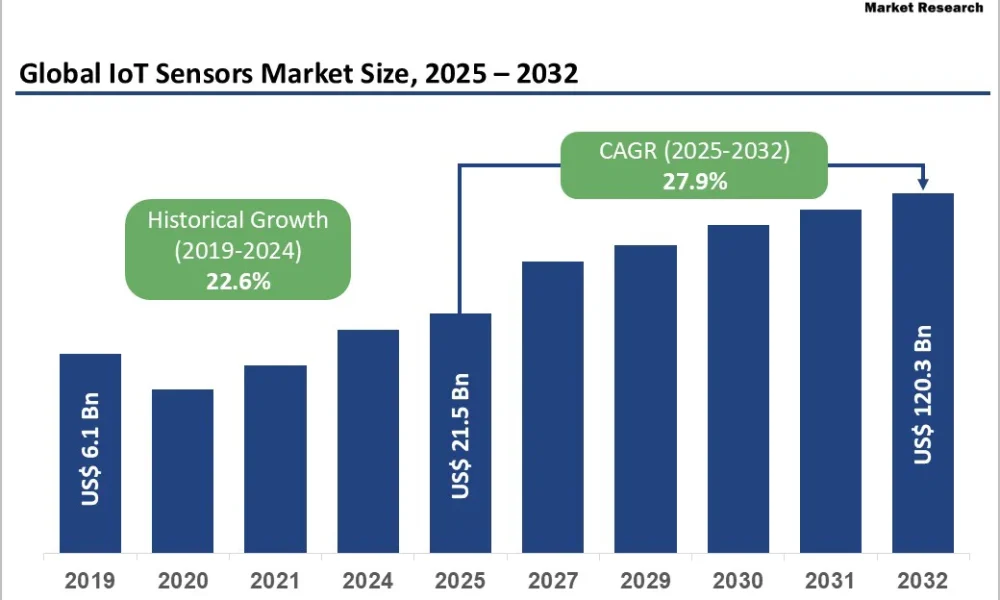
The global IoT sensors market is entering a transformative growth phase, fueled by rapid digitalization, smart infrastructure investments, and the expansion of connected ecosystems. Valued at US$21.5 billion in 2025, the market is projected to reach an impressive US$120.3 billion by 2032, reflecting a strong compound annual growth trajectory.
This remarkable expansion highlights the increasing integration of IoT sensor technology across industrial automation, automotive electrification, smart cities, healthcare, and consumer electronics. As businesses shift toward data-driven decision-making and predictive intelligence, IoT-enabled sensing solutions are becoming the foundation of modern connected systems.
Understanding the IoT Sensors Market Landscape
IoT sensors are hardware components that collect environmental and operational data such as temperature, pressure, motion, humidity, vibration, and proximity. These sensors transmit real-time information to cloud platforms or edge computing systems for analysis, automation, and control.
The growing deployment of connected devices across industries is driving unprecedented demand for intelligent sensing technologies. From predictive maintenance in factories to autonomous driving systems and remote patient monitoring, IoT sensors serve as the primary data acquisition layer.
Between 2019 and 2024, the market grew at a CAGR of 22.6%, indicating strong adoption momentum. The forecast period from 2025 to 2032 continues this upward trend, supported by advancements in semiconductor miniaturization, 5G connectivity, AI integration, and energy-efficient sensor design.
Key Growth Drivers Powering Market Expansion
- Industry 4.0 and Smart Manufacturing
Industrial and manufacturing applications represent the largest end-use segment, accounting for 29.4% of the IoT sensors market in 2025. Smart factories increasingly rely on sensor networks to monitor equipment performance, optimize production processes, and reduce downtime.
IoT-enabled pressure sensors, vibration sensors, and temperature sensors are widely used for predictive maintenance, quality control, and energy management. Real-time data analytics improves operational efficiency and lowers maintenance costs, making IoT sensors indispensable in industrial automation strategies.
- Automotive Electrification and Autonomous Mobility
The automotive and transportation sector is the fastest-growing end-use segment, holding 18.3% market share in 2025. The rapid evolution of electric vehicles (EVs), connected cars, and autonomous driving systems has significantly increased the number of sensors embedded in vehicles.
Motion sensors, pressure sensors, LiDAR systems, and environmental sensors support advanced driver assistance systems (ADAS), battery management, collision avoidance, and structural health monitoring. As vehicles become more software-defined and sensor-rich, demand for high-precision IoT sensors continues to accelerate.
- Smart City Infrastructure Development
Governments worldwide are investing heavily in smart city initiatives to improve urban sustainability and public safety. IoT sensors play a central role in traffic monitoring, smart lighting, air quality management, waste management, and energy optimization.
East Asia, particularly China, Japan, and South Korea, is witnessing strong adoption driven by large-scale urban digitization projects. The region holds a 15.7% market share in 2025 and is the fastest-growing regional market.
- Healthcare Digitalization and Remote Monitoring
The healthcare sector increasingly uses IoT sensors in wearable health devices, remote patient monitoring systems, and hospital asset tracking. Advanced biosensors and motion sensors enable continuous tracking of vital signs, supporting preventive healthcare and reducing hospital readmissions.
North America leads the global IoT sensors market with a 35.8% share in 2025, largely due to advanced healthcare infrastructure and high digital adoption rates.
Sensor Type Analysis
Pressure Sensors – Market Dominance
Pressure sensors dominate the IoT sensor type segment, capturing 31.4% market share in 2025. Their extensive application across industrial automation, automotive systems, healthcare devices, and energy infrastructure supports sustained demand.
In industrial settings, pressure sensors monitor hydraulic systems, gas pipelines, and fluid control processes. In automotive applications, they enable tire pressure monitoring systems (TPMS), fuel system management, and brake systems.
The versatility and reliability of pressure sensing technology make it one of the most widely adopted IoT sensor categories.
Motion Sensors – Fastest Growing Segment
Motion sensors account for 23.6% market share in 2025 and represent the fastest-growing segment. Their adoption is expanding rapidly across autonomous vehicles, robotics, wearable devices, and smart security systems.
In smart homes and commercial buildings, motion sensors enable automated lighting, intrusion detection, and occupancy-based climate control. In robotics and industrial automation, they support movement tracking and navigation.
The increasing emphasis on AI-powered automation further strengthens the growth potential of motion sensing technologies.
Elevate your business strategy with comprehensive market data. Request a sample report now: https://www.persistencemarketresearch.com/samples/21670
Regional Market Insights
North America – Market Leader
North America commands 35.8% of the global IoT sensors market in 2025. The region benefits from strong investments in digital transformation, advanced manufacturing, and smart healthcare systems.
The presence of major technology companies, semiconductor manufacturers, and IoT solution providers accelerates innovation and commercialization. Additionally, government funding for smart infrastructure and cybersecurity regulations supports long-term growth.
Europe – Strong Manufacturing and Regulatory Framework
Europe holds a 25.6% share of the global IoT sensors market in 2025. The region’s well-established manufacturing base and focus on Industry 4.0 initiatives contribute significantly to demand.
European governments emphasize cybersecurity compliance, data protection, and energy efficiency standards. These regulations encourage the adoption of high-quality, secure IoT sensor solutions across industrial and infrastructure sectors.
East Asia – Rapid Expansion
East Asia is the fastest-growing regional market with a 15.7% share in 2025. China leads in large-scale smart city development and industrial IoT deployments. Japan and South Korea contribute through advanced electronics manufacturing and automotive innovation.
The region’s strong semiconductor ecosystem and government-backed digital transformation programs position it as a key growth engine for the IoT sensors industry.
Emerging Technology Trends
Edge Computing Integration
The integration of edge computing with IoT sensors reduces latency and enhances real-time data processing. Instead of transmitting all data to centralized cloud servers, edge devices analyze information locally, improving efficiency and security.
This trend is particularly critical in autonomous vehicles, industrial robotics, and healthcare monitoring, where real-time decision-making is essential.
AI-Enabled Smart Sensors
Artificial intelligence is transforming traditional sensors into intelligent systems capable of data filtering, anomaly detection, and predictive insights. AI-enabled IoT sensors reduce bandwidth consumption and improve operational accuracy.
Smart sensors are increasingly embedded with machine learning algorithms that enable adaptive performance and self-calibration.
Miniaturization and Energy Efficiency
Advancements in semiconductor fabrication technologies have led to smaller, more power-efficient IoT sensors. Low-power wide-area networks (LPWAN) and energy-harvesting technologies extend battery life, making sensors suitable for remote and large-scale deployments.
Miniaturized sensors are especially critical in wearable electronics, medical devices, and consumer IoT applications.
Competitive Landscape
The IoT sensors market is characterized by intense competition and continuous innovation. Leading players focus on product differentiation, advanced materials research, and strategic partnerships.
Key strategies include:
- Development of multi-functional sensor platforms
- Integration of cybersecurity features
- Expansion into emerging markets
- Collaboration with automotive and industrial OEMs
Companies are also investing heavily in research and development to improve sensitivity, durability, and energy efficiency.
Challenges Impacting Market Growth
Despite strong growth prospects, the IoT sensors industry faces several challenges:
Cybersecurity Risks
As sensor networks expand, vulnerabilities increase. Protecting connected devices from cyber threats remains a critical priority.
Data Privacy Concerns
Regulatory frameworks such as GDPR in Europe impose strict data protection standards, influencing sensor deployment strategies.
Supply Chain Constraints
Semiconductor shortages and raw material disruptions can impact production timelines and cost structures.
Integration Complexity
Implementing large-scale IoT systems requires interoperability across hardware, software, and communication protocols.
Addressing these challenges will be crucial for sustained market expansion.
Future Outlook
The future of the IoT sensors market is closely tied to the evolution of connected ecosystems. As industries increasingly adopt smart automation and AI-driven analytics, demand for high-performance sensing solutions will continue to rise.
By 2032, IoT sensors are expected to become deeply embedded in next-generation smart grids, autonomous transportation systems, digital healthcare platforms, and intelligent urban infrastructure.
The transition toward carbon neutrality and energy efficiency will further accelerate the deployment of environmental and energy-monitoring sensors. Meanwhile, advancements in 5G and future 6G networks will enhance connectivity and enable ultra-low-latency sensor communication.
With strong historical growth and accelerating innovation, the IoT sensors market is positioned as one of the most dynamic segments within the broader IoT ecosystem.
Conclusion
The global IoT sensors market is undergoing rapid transformation, expanding from US$21.5 billion in 2025 to a projected US$120.3 billion by 2032. Driven by Industry 4.0 adoption, automotive electrification, smart city development, and healthcare digitalization, the market presents substantial growth opportunities.
Pressure sensors lead the segment landscape, while motion sensors are emerging as the fastest-growing category. Regionally, North America dominates, Europe maintains strong industrial demand, and East Asia demonstrates exceptional growth momentum.
As IoT networks become more intelligent, secure, and energy-efficient, IoT sensors will remain the backbone of connected technologies worldwide. The coming decade will redefine how industries collect, process, and leverage data — with advanced sensing technologies at the center of this digital revolution.
Related Reports:




