
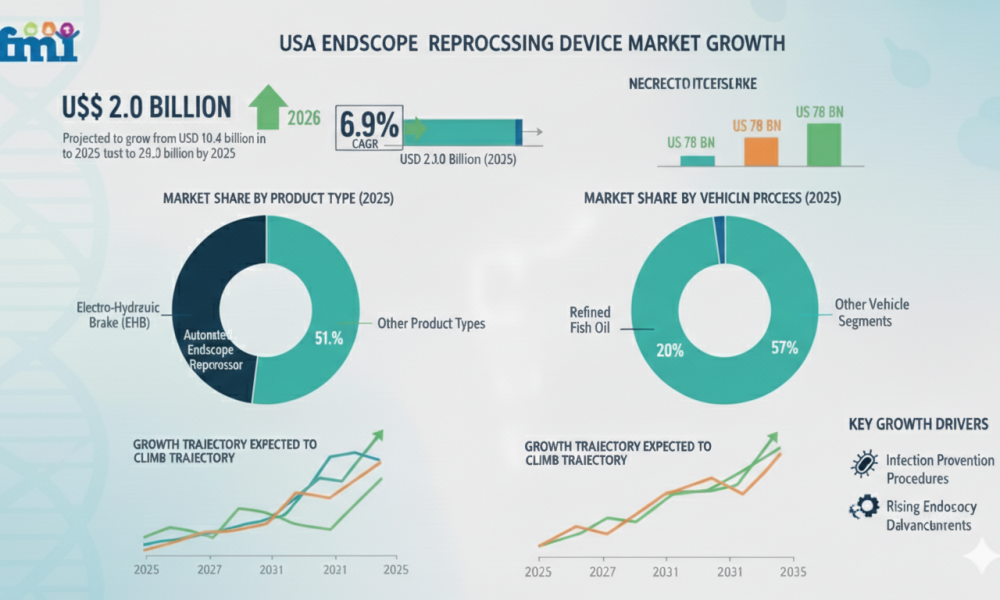
The United States Endoscope Reprocessing Device Market is on a trajectory of significant expansion, driven by escalating demands for patient safety, regulatory compliance, and technological innovation in healthcare settings. According to the latest comprehensive market analysis, the sector is projected to grow from USD 1.0 billion in 2025 to USD 2.0 billion by 2035, achieving a compound annual growth rate (CAGR) of 6.9%. This growth underscores the critical role of endoscope reprocessing devices in preventing healthcare-associated infections (HAIs) during essential procedures in gastroenterology, pulmonology, and urology.
As an industry leader in healthcare insights, Future Market Insights highlights how this market evolution reflects broader trends in minimally invasive surgeries and diagnostic advancements. “The surge in endoscopic procedures is not just a statistic—it’s a lifeline for millions of patients seeking less invasive options for diagnosis and treatment,” said a senior analyst at Future Market Insights. “However, with this increase comes an imperative for flawless reprocessing to eliminate risks of cross-contamination, making these devices indispensable tools in modern healthcare.”
Market Dynamics: Drivers Fueling Expansion
The primary catalysts propelling the market include the rising volume of endoscopic procedures across hospitals, ambulatory surgical centers (ASCs), and specialty clinics. With an aging population and growing prevalence of chronic conditions like gastrointestinal disorders and respiratory issues, the need for efficient, reusable endoscopes has never been higher. Stringent regulations from bodies such as the FDA and CDC are mandating validated disinfection protocols, pushing facilities to adopt advanced reprocessing technologies that ensure compliance and reduce HAIs.
Technological advancements are also key drivers. Automated systems are gaining traction for their ability to minimize human error, enhance throughput, and provide consistent sterilization outcomes. Early in the forecast period (2025-2030), volume growth will dominate, with market values climbing steadily from USD 1.1 billion in 2026-2027 to USD 1.4 billion by 2030. From 2031 onward, pricing dynamics will play a larger role, reflecting investments in premium features like digital monitoring and eco-friendly designs, leading to USD 1.7 billion in 2033 and the USD 2.0 billion milestone in 2035.
Challenges and Restraints: Navigating Hurdles
Despite the optimistic outlook, the market faces notable restraints that industry leaders must address. High initial costs of sophisticated devices can strain budgets, particularly for smaller clinics and ASCs, limiting widespread adoption. The complexity of these systems demands specialized training for staff, adding operational challenges. Additionally, concerns over the efficacy of older equipment in fully eliminating pathogens persist, alongside inconsistencies in institutional policies that hinder standardization.
“These barriers are opportunities in disguise,” noted the analyst. “By focusing on cost-effective solutions and comprehensive training programs, manufacturers can democratize access to high-quality reprocessing, ensuring even mid-sized facilities can meet top-tier safety standards.”
Opportunities and Trends: Shaping the Future
Looking ahead, opportunities abound in the expansion of healthcare infrastructure and the integration of digital technologies. The shift toward sustainable reprocessing solutions—minimizing waste and environmental impact—aligns with global sustainability goals, appealing to eco-conscious providers. Real-time tracking and documentation via digital platforms will enhance traceability, reducing liability and improving efficiency.
Key trends include a strong emphasis on automation, with automated endoscope reprocessors capturing a dominant 51% market share. Semi-automatic operation modes lead with 57% share, offering a balance of control and efficiency. Modalities such as floor-standing/bench-top and mobile units cater to diverse facility needs, while end users span hospitals, specialty clinics, ASCs, academic institutions, and central sterile services departments (CSSDs).
Regionally, the West USA emerges as a hotspot with an 8.0% CAGR, followed by the South at 7.1%, Northeast at 6.4%, and Midwest at 5.5%. This geographic variance highlights varying procedure volumes and infrastructure development, with urban centers in the West and South leading due to higher adoption of advanced endoscopy services.
Competitive Landscape: Leaders Driving Innovation
The competitive arena is characterized by a select group of global players vying for dominance through superior disinfection reliability, user-friendly designs, and comprehensive service support. Major companies include Getinge, Olympus Corporation, STERIS plc, ASP India Private Ltd., and Steelco S.p.A., each focusing on validated systems that meet rigorous standards.
These leaders are prioritizing high-volume applications in hospitals and the burgeoning ASC sector, where endoscopy services are expanding amid tightened infection-control mandates. “Innovation isn’t optional—it’s essential,” emphasized the analyst. “Companies that integrate AI-driven monitoring and sustainable materials will not only comply with regulations but set new benchmarks for the industry.”
Subscribe for Year-Round Insights → Stay ahead with quarterly and annual data updates: https://www.futuremarketinsights.com/reports/brochure/rep-gb-29657
Request for Sample Report | Customize Report |purchase Full Report –https://www.futuremarketinsights.com/reports/sample/rep-gb-29657
Strategic Implications for Decision-Makers
For healthcare executives, investors, and policymakers, this market narrative offers decision-grade insights. Prioritizing investments in automated and semi-automatic devices can yield long-term cost savings through reduced HAIs and operational efficiencies. Regional strategies should target high-growth areas like the West and South, where procedure demands are surging.
In summary, the US Endoscope Reprocessing Device Market represents a vital pillar of healthcare safety and innovation. As procedures proliferate and regulations evolve, stakeholders who embrace these trends will lead the charge toward a safer, more efficient future. This analysis positions the market not just as a growth story, but as a human-centered narrative where technology safeguards lives.
About Future Market Insights (FMI)
Future Market Insights, Inc. (FMI) is an ESOMAR-certified, ISO 9001:2015 market research and consulting organization, trusted by Fortune 500 clients and global enterprises. With operations in the U.S., UK, India, and Dubai, FMI provides data-backed insights and strategic intelligence across 30+ industries and 1200 markets worldwide.
Why FMI: Decisions that Change Outcomes- https://www.futuremarketinsights.com/why-fmi
Contact Us:
Future Market Insights Inc.
Christiana Corporate, 200 Continental Drive,
Suite 401, Newark, Delaware – 19713, USA
T: +1-347-918-3531
Website: https://www.futuremarketinsights.com
LinkedIn| Twitter| Blogs | YouTube
Have a specific Requirements and Need Assistant on Report Pricing or Limited Budget please contact us – [email protected]



