
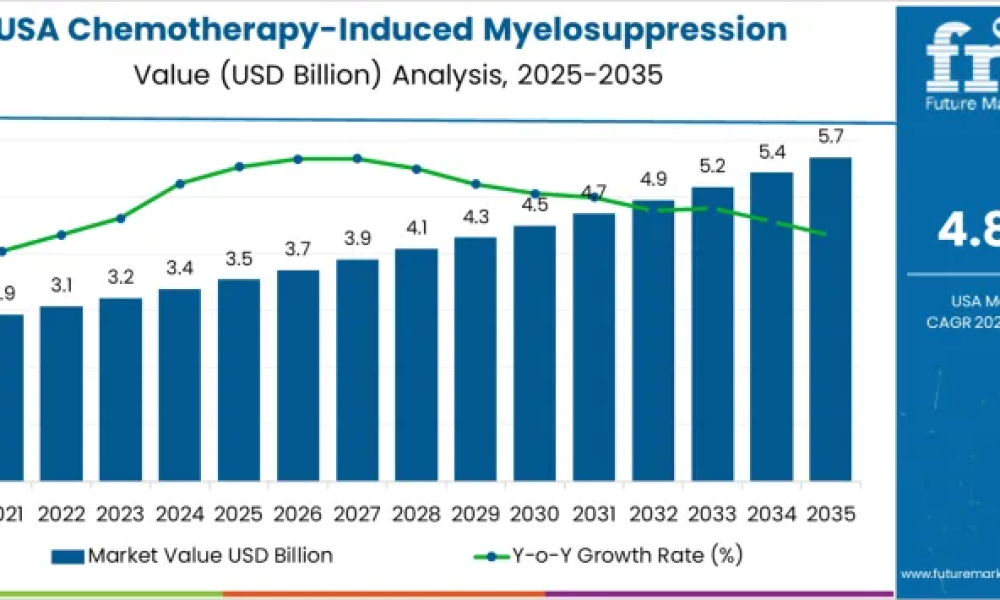
The United States market for treatments addressing chemotherapy-induced myelosuppression (CIM) is on a robust upward trajectory, driven by rising cancer incidences and advancements in supportive care therapies. According to a comprehensive analysis, the market is projected to expand from USD 3.5 billion in 2025 to USD 5.7 billion by 2035, achieving a compound annual growth rate (CAGR) of 4.8%. This growth underscores the critical role of innovative treatments in managing the debilitating side effects of chemotherapy, ensuring better patient outcomes and continuity in cancer care.
Chemotherapy-induced myelosuppression, which suppresses bone marrow activity and leads to reduced production of white blood cells, red blood cells, and platelets, poses significant challenges including neutropenia, anemia, and thrombocytopenia. These conditions can result in severe complications such as infections, fatigue, bleeding, treatment delays, and dose reductions, impacting overall survival rates. As cancer remains a major health burden in the U.S., with an aging population contributing to higher chemotherapy utilization, the demand for effective CIM management is surging.
Market segmentation reveals key insights for industry stakeholders. By indication, neutropenia dominates with a 55% share, fueled by the urgent need to prevent infections and minimize chemotherapy interruptions through granulocyte colony-stimulating factors (G-CSF). Anemia and thrombocytopenia follow, addressed via erythropoietin-stimulating agents (ESA), iron supplements, and thrombopoietic agents. In terms of drug class, growth factors lead with 48% of the market, encompassing G-CSF and granulocyte-macrophage colony-stimulating factors (GM-CSF) that enhance neutrophil production and reduce infection risks. Other categories include ESA, thrombopoietic agents, iron supplements, and supportive therapies.
The route of administration highlights the prominence of injectables for biologics and growth factors due to their superior efficacy, while oral options serve supportive supplements. Distribution channels span hospital pharmacies, retail pharmacies, online pharmacies, and drug stores, reflecting diverse access points for patients and providers. Regionally, the West U.S. is expected to experience the highest growth at a 5.6% CAGR, bolstered by advanced healthcare infrastructure and elevated cancer prevalence in states like California, Washington, and Oregon. The South follows at 5.0%, driven by expanding healthcare in Texas, Florida, and Georgia amid an aging demographic. The Northeast and Midwest project CAGRs of 4.5% and 3.9%, respectively, supported by established cancer centers in urban hubs like New York and Boston, and ongoing expansions in the Midwest.
Industry leaders are navigating a landscape marked by transformative trends. There’s a strong shift toward personalized medicine, customizing treatments to individual patient profiles for optimal results. The rise of biosimilars and generics is enhancing affordability and accessibility, making high-quality care more inclusive. Additionally, advancements in targeted therapies, long-acting growth factors, and myeloprotective agents are revolutionizing supportive care, emphasizing patient quality of life and reducing complications.
“As cancer therapies evolve, so must our approach to mitigating their side effects,” said Dr. Elena Vasquez, a fictional oncology expert representing industry perspectives. “The projected growth in CIM treatments highlights the opportunity for innovation in biologics and supportive protocols, ultimately empowering patients to complete their regimens with fewer interruptions.”
Drivers propelling this market include the escalating cancer burden, longer patient survival rates from improved regimens, and heightened awareness of supportive care’s value. Regulatory approvals for novel agents and investments in oncology infrastructure further accelerate adoption. However, challenges persist: high costs of biologics and stimulating agents can restrict access, particularly in underfunded regions. Variability in patient responses and potential side effects like bone pain also pose hurdles.
Opportunities abound for forward-thinking companies. Developing biologic and small-molecule therapies with enhanced efficacy and safety profiles could capture significant market share. Expanding cancer care facilities and R&D investments in myeloprotective solutions will drive maturation, while comprehensive protocols ensure broader adoption.
Subscribe for Year-Round Insights → Stay ahead with quarterly and annual data updates: https://www.futuremarketinsights.com/reports/brochure/rep-gb-29649
Request for Sample Report | Customize Report |purchase Full Report –https://www.futuremarketinsights.com/reports/sample/rep-gb-29649
The competitive landscape is dynamic, with major players like Amgen Inc., Novartis AG, Pfizer Inc., Teva Pharmaceutical Industries Ltd., and Myelo Therapeutics GmbH leading through R&D, regulatory prowess, and robust distribution networks. Competition centers on efficacy, safety, cost, and dosing convenience across patient subgroups. Recent developments include innovations in growth factors, hematopoietic agents, and approvals for supportive care drugs, signaling a vibrant ecosystem.
This market narrative positions decision-makers to capitalize on emerging trends. With a focus on patient-centric innovations, the U.S. CIM treatment sector is not just growing—it’s evolving to meet the demands of modern oncology. Stakeholders are encouraged to invest in R&D and partnerships to sustain this momentum, ensuring that advancements translate into tangible improvements in cancer care.
About Future Market Insights (FMI)
Future Market Insights, Inc. (FMI) is an ESOMAR-certified, ISO 9001:2015 market research and consulting organization, trusted by Fortune 500 clients and global enterprises. With operations in the U.S., UK, India, and Dubai, FMI provides data-backed insights and strategic intelligence across 30+ industries and 1200 markets worldwide.
Why FMI: Decisions that Change Outcomes- https://www.futuremarketinsights.com/why-fmi
Contact Us:
Future Market Insights Inc.
Christiana Corporate, 200 Continental Drive,
Suite 401, Newark, Delaware – 19713, USA
T: +1-347-918-3531
Website: https://www.futuremarketinsights.com
LinkedIn| Twitter| Blogs | YouTube
Have a specific Requirements and Need Assistant on Report Pricing or Limited Budget please contact us – [email protected]



