
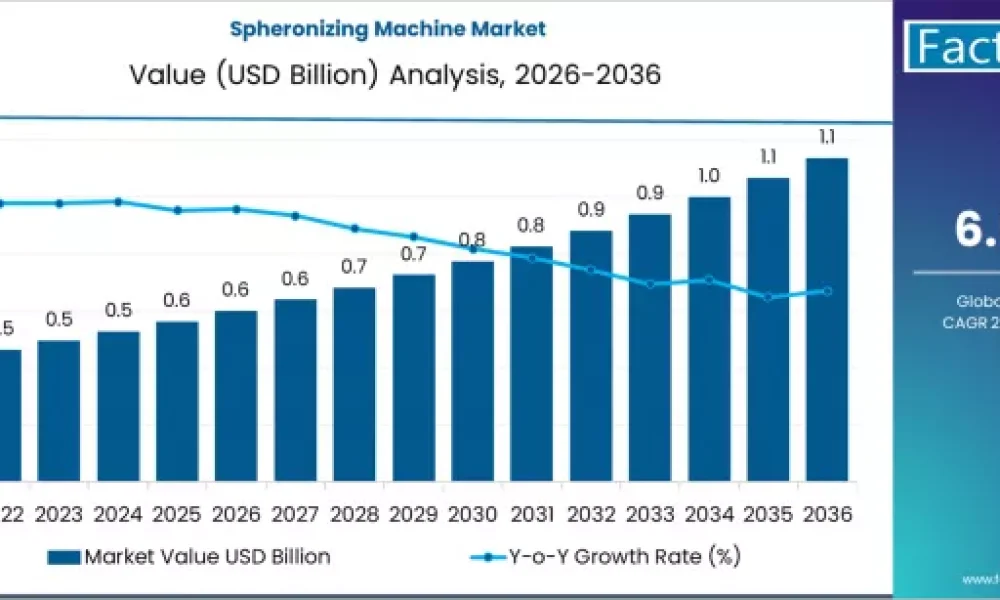
The global pharmaceutical manufacturing landscape is undergoing a significant transition toward precision dosage forms, propelling the Spheronizing Machine Market to new heights. Driven by the critical need for uniform, dust-free pellets in controlled-release medications, the market is benefiting from a surge in multiparticulate drug delivery system (MDDS) development. As of early 2026, industry data indicates that nearly 65% of new drug formulations in the pipeline utilize multiparticulate technology, establishing spheronization as a mandatory pillar of modern pharmaceutical engineering.
By converting wet extrudates into high-density, spherical pellets, spheronizing machines—also known as marumerizers—enable superior flow properties and consistent thin-layer coating. This process is essential for achieving the predictable release profiles required for next-generation oncology, cardiovascular, and neurological therapeutics.
Request for Sample Report | Customize Report |purchase Full Report – https://www.factmr.com/connectus/sample?flag=S&rep_id=13601
The Precision Manufacturing Shift: Who, What, and Why
The market’s acceleration is being led by established global technology providers and specialized engineering firms, including GEA Group, Caleva Process Solutions, Glatt GmbH, and Alexanderwerk. These industry leaders are being joined by a robust cohort of regional manufacturers in India and China, such as Umang Pharmatech, Prism Pharma Machinery, and Rikon Pharma, who are scaling production to meet the “Make in India” and “China 2025” industrial mandates.
The “why” behind this market expansion is centered on three core industrial drivers:
- Rise of Controlled-Release Dosage: Patients and healthcare providers increasingly favor medications with prolonged therapeutic effects and fewer side effects, a requirement met by spherical pellets that offer high surface-area-to-volume ratios.
- Technological Integration: 2026 marks the widespread adoption of Industry 4.0 in pelletization. Modern spheronizers now feature real-time monitoring of disk speed and residence time, reducing batch failure rates by up to 15–20%.
- Regulatory Compliance: With roughly 78% of new installations now featuring cGMP-validated documentation systems, manufacturers are utilizing automated spheronizers to meet the rigorous evidence standards set by the FDA and EMA.
Technological Benchmarks: Micro-Dosage and Continuous Processing
The 2026 landscape is defined by the industry’s shift from batch processing toward Continuous Manufacturing.
- Micro-Pellet Capabilities: The “Below 0.5 mm” segment is currently the fastest-growing subtype, driven by the demand for micro-dosage formulations used in pediatric and geriatric care.
- Material Science Innovations: Modern friction plates are now being manufactured with specialized non-stick coatings and tungsten carbide surfaces to handle increasingly complex and “sticky” active pharmaceutical ingredients (APIs).
- Automated Yield Optimization: Companies like GEA have introduced instant feedback loops that adjust disk speed mid-cycle based on real-time moisture sensors, ensuring batch consistency regardless of environmental humidity.
Regional Outlook: Asia-Pacific Challenges Global Leadership
While North America remains the largest market by value due to its leadership in high-potency drug R&D, the Asia-Pacific region is the global engine of growth. With a projected 9.2% CAGR, the region is fueled by the rapid expansion of export-oriented manufacturing hubs in India and China. These markets are increasingly transitioning from manual loading to semi-automatic and fully automated systems to maintain global competitiveness and lower long-term labor costs.
“Spheronization is no longer just about shape; it’s about predictability,” says a lead pharmaceutical process engineer. “In 2026, the machine is the primary guardian of a drug’s therapeutic window.”
Strategic Outlook for 2026 and Beyond
For investors and pharmaceutical leaders, the focus is shifting toward Modular Production. Manufacturers who offer “plug-and-play” extruders and spheronizers that can be integrated into existing cleanrooms are capturing significant market share. As the industry moves toward 2030, the integration of Digital Twins to simulate pellet formation before the first batch is ever run is expected to become the new global benchmark for R&D efficiency.
About the Spheronizing Machine Market Report:
This press release summarizes 2026 market intelligence, highlighting the technological and economic shifts within the global pharmaceutical pelletization and drug delivery sectors.
About Fact.MR
Fact.MR is a global market research and consulting firm, trusted by Fortune 500 companies and emerging businesses for reliable insights and strategic intelligence. With a presence across the U.S., UK, India, and Dubai, we deliver data-driven research and tailored consulting solutions across 30+ industries and 1,000+ markets. Backed by deep expertise and advanced analytics, Fact.MR helps organizations uncover opportunities, reduce risks, and make informed decisions for sustainable growth.



