
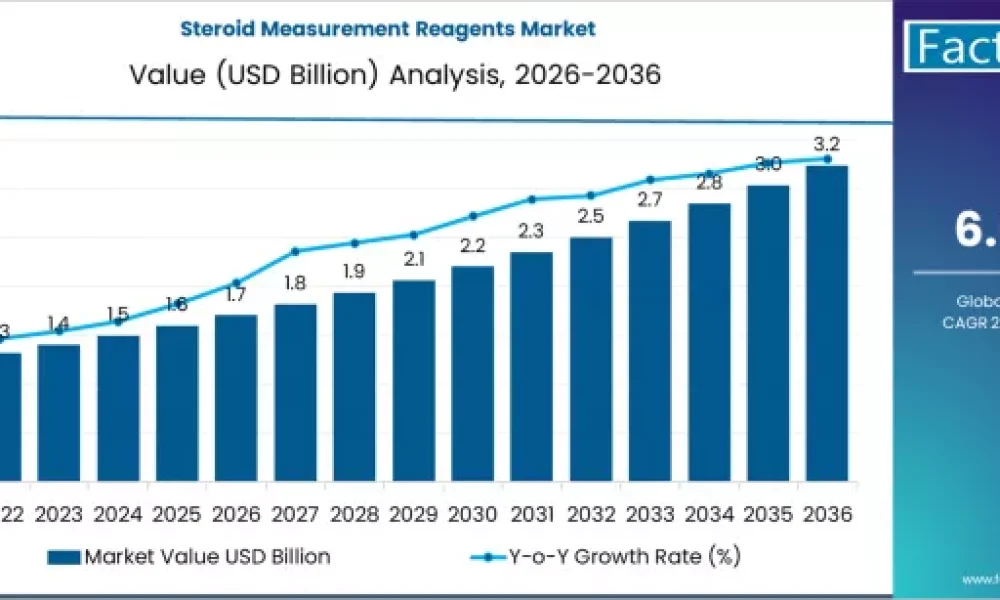
The global clinical diagnostics sector is witnessing a pivotal shift in metabolic and reproductive healthcare, propelling the Steroid Measurement Reagents Market to a valuation of USD 0.6 billion in 2026. Driven by a 6.6% CAGR, the industry is increasingly focused on high-specificity hormone quantification to address the rising global burden of endocrine disorders, hormone-dependent cancers, and infertility.
As of early 2026, the market has transitioned from simple screening to precision monitoring. This evolution is largely necessitated by the “silent” epidemic of conditions like Polycystic Ovary Syndrome (PCOS), adrenal insufficiency, and hypogonadism, which require precise, longitudinal measurements of cortisol, testosterone, and estradiol to manage long-term patient outcomes.
Request for Sample Report | Customize Report |purchase Full Report – https://www.factmr.com/connectus/sample?flag=S&rep_id=13606
The Diagnostic Precision Mandate: Who, What, and Why
The rapid maturation of the steroid measurement reagents sector is being led by global diagnostic heavyweights, including Roche Diagnostics, Abbott, Siemens Healthineers, Beckman Coulter, and DiaSorin. These industry leaders are pioneering the integration of specialized reagents into fully automated, high-throughput systems, allowing hospital laboratories to manage record-breaking testing volumes with unprecedented accuracy.
The “why” behind this market acceleration is rooted in three primary healthcare catalysts:
- Rise in Fertility and IVF Monitoring: With approximately 22% of market applications now tied to reproductive health, reagents for estradiol and progesterone are essential for the growing number of patients undergoing assisted reproductive technologies (ART).
- Oncology and Adrenal Health: The increasing incidence of hormone-dependent cancers and chronic stress-related adrenal disorders has made cortisol and testosterone assay reagents a mandatory staple in diagnostic menus, holding a combined 34% market share.
- The Shift to LC-MS/MS: While traditional immunoassays remain dominant, there is a significant move toward Liquid Chromatography-Mass Spectrometry (LC-MS/MS) steroid panels. These high-specificity reagents account for 19% of the market, offering a “gold standard” alternative that eliminates cross-reactivity with structurally similar compounds.
Technological Benchmarks: Automation and Sensitivity
The 2026 landscape is defined by the quest for Low-End Sensitivity.
- Calibrators and Standardisation: Reagents for sample preparation and calibrators now hold a 21% share, as laboratories strive for inter-platform comparability and alignment with international reference standards.
- Pediatric Endocrinology: A growing niche is the development of ultra-sensitive reagents for pediatric patients, where hormone levels are significantly lower and require assays with high analytical sensitivity to avoid misdiagnosis.
- Automated Integration: Modern reagents are now engineered for “random-access” analyzers, enabling labs to run steroid panels alongside general chemistry tests, reducing the “turnaround time” (TAT) for critical hormone results to under 40 minutes.
Regional Outlook: Asia-Pacific Challenges Global Benchmarks
While North America remains the largest market (anchored by guideline-driven protocols and a 5.9% growth rate), the Asia-Pacific region is the global engine of diagnostic expansion. India (9.9% CAGR) and China (8.9% CAGR) are leading the world in new laboratory commissions and the adoption of advanced endocrine testing, fueled by a massive increase in private diagnostic networks and a burgeoning middle class prioritizing preventative health.
“We are moving away from ‘yes/no’ hormone testing toward ‘how much and how often’,” says a lead clinical biochemist. “In 2026, the quality of the reagent is the primary determinant of whether a patient receives the correct dosage of hormone replacement therapy.”
Strategic Outlook for 2026 and Beyond
For investors and lab directors, the focus is shifting toward Multiplexed Steroid Panels. Companies that can provide a single kit capable of measuring a full profile of adrenal or sex steroids from one sample are gaining a significant competitive edge. As the industry moves toward 2030, the integration of Point-of-Care (POC) steroid testing for acute stress monitoring is expected to become the next major frontier in personalized diagnostics.
About the Steroid Measurement Reagents Market Intelligence:
This press release is based on 2026 market intelligence, providing a comprehensive overview of the technological and economic drivers defining the future of hormone quantification in global healthcare.
About Fact.MR
Fact.MR is a global market research and consulting firm, trusted by Fortune 500 companies and emerging businesses for reliable insights and strategic intelligence. With a presence across the U.S., UK, India, and Dubai, we deliver data-driven research and tailored consulting solutions across 30+ industries and 1,000+ markets. Backed by deep expertise and advanced analytics, Fact.MR helps organizations uncover opportunities, reduce risks, and make informed decisions for sustainable growth.



