
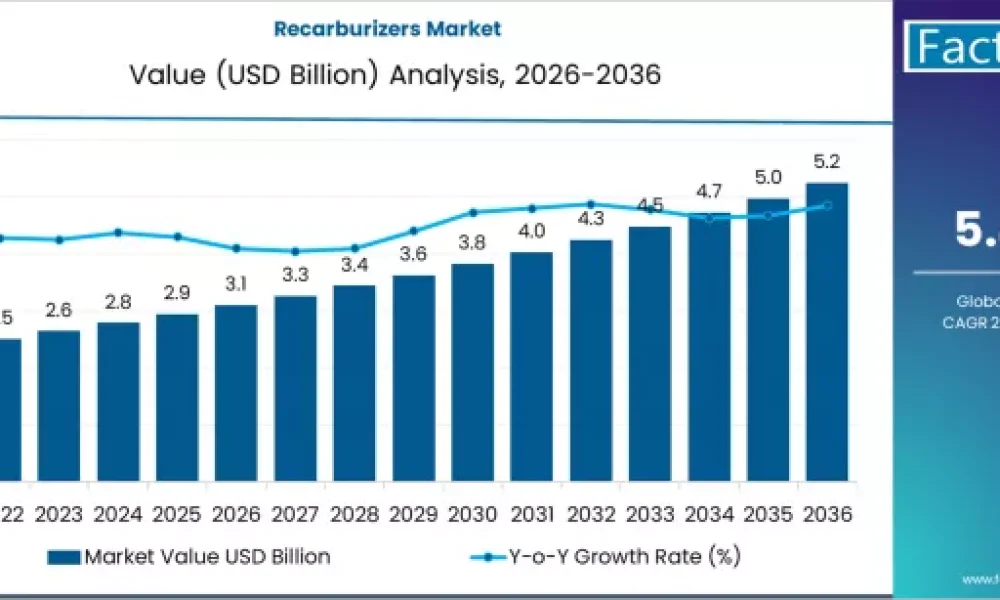
As the global metallurgical industry undergoes a fundamental shift toward carbon-neutral production and high-performance alloys, the Recarburizers Market has emerged as a vital pillar of industrial quality control. Driven by the expansion of Electric Arc Furnace (EAF) steelmaking and the rising demand for lightweight automotive castings, the market is valued at approximately USD 3.1 billion in 2026, maintaining a steady 5.4% CAGR through the next decade.
In early 2026, the “carbon-additive” process is no longer viewed as a simple raw-material adjustment. With the steel and iron sectors facing unprecedented pressure to reduce slag and energy consumption, high-purity recarburizers—specifically synthetic graphite and low-sulfur petroleum coke—have become essential for achieving the precise mechanical properties required in the aerospace, construction, and electric vehicle (EV) sectors.
Request for Sample Report | Customize Report |purchase Full Report – https://www.factmr.com/connectus/sample?flag=S&rep_id=8799
The Quality Mandate: Who, What, and Why
The rapid maturation of the recarburizer sector is being led by a global coalition of carbon specialists and materials traders, including Rain Carbon, Oxbow Carbon, Pioneer Carbon, Elkem, Superior Graphite, and thyssenkrupp Materials Trading. These organizations are transitioning away from commodity-grade additives toward specialized formulations that offer absorption rates exceeding 95%, significantly reducing the “tap-to-tap” time in modern melt shops.
The “why” behind this market surge is rooted in three critical industrial drivers:
- The EAF Revolution: As steelmakers pivot from traditional blast furnaces to Electric Arc Furnaces to meet 2030 decarbonization goals, the demand for external carbon sources (recarburizers) has increased by nearly 15% to compensate for the lower carbon content of scrap-metal charges.
- Ductile Iron Expansion: The automotive industry’s shift toward lightweight, high-strength ductile iron for EV motor housings requires ultra-low sulfur recarburizers (S < 0.05%) to prevent nodularity defects.
- Digital Smelting: In 2026, “Smart Foundries” are using real-time spectrometer data to automate the dosing of recarburizers, requiring additives with extreme consistency to ensure predictable carbon recovery and avoid expensive re-melt cycles.
Technological Benchmarks: Purity and Crystallinity
The 2026 landscape is defined by a flight to quality. R&D is currently focused on Graphitization Science—the process of heating carbon to 3,000°C to reorganize its molecular structure for faster dissolution.
- Synthetic Dominance: Synthetic graphite recarburizers are outperforming natural alternatives in the premium segment due to their ultra-low nitrogen content, which is critical for preventing pinhole defects in high-grade nitrogen-sensitive steels.
- Calcination Innovation: Suppliers like Rain Carbon are utilizing advanced rotary kiln technologies to produce calcined petroleum coke with optimized porosity, allowing the carbon to “sink” and dissolve into the melt more efficiently than traditional coal-based risers.
- Cored Wire Integration: A growing percentage of recarburizers are now being delivered via “cored wire” technology, which allows for deep-injection carbon trimming at the final stage of refining, providing accuracy within ±0.01% carbon.
Regional Outlook: Asia-Pacific Fuels Global Production
Asia-Pacific continues to dominate the recarburizers market, accounting for 56% of global demand in 2026. This is primarily fueled by China and India, which together represent the world’s largest hubs for both steel production and automotive foundry clusters. However, North America remains the leader in “Specialty Carbon” R&D, with a focus on developing recycled carbon anodes and biomass-based recarburizers to meet localized “Buy Green” procurement laws.
“In 2026, carbon is no longer just an ingredient; it is a performance variable,” says a lead metallurgical analyst. “The difference between a standard bridge beam and a high-performance EV component often comes down to the purity of the recarburizer used in the furnace.”
Strategic Outlook for 2026 and Beyond
For investors and procurement officers, the focus has shifted toward Supply Chain De-risking. Manufacturers who secure long-term off-take agreements with petroleum refineries or invest in domestic graphitization facilities are gaining a significant competitive edge. As the industry moves toward 2030, the integration of bio-recarburizers (derived from sustainably sourced wood waste) is expected to become the next major frontier for steelmakers aiming for true “Net Zero” certification.
About the Recarburizers Market Intelligence:
This press release is based on 2026 market intelligence, providing a comprehensive overview of the technological and economic drivers defining the future of carbon additives in the global metal manufacturing sector.
About Fact.MR
Fact.MR is a global market research and consulting firm, trusted by Fortune 500 companies and emerging businesses for reliable insights and strategic intelligence. With a presence across the U.S., UK, India, and Dubai, we deliver data-driven research and tailored consulting solutions across 30+ industries and 1,000+ markets. Backed by deep expertise and advanced analytics, Fact.MR helps organizations uncover opportunities, reduce risks, and make informed decisions for sustainable growth.



