
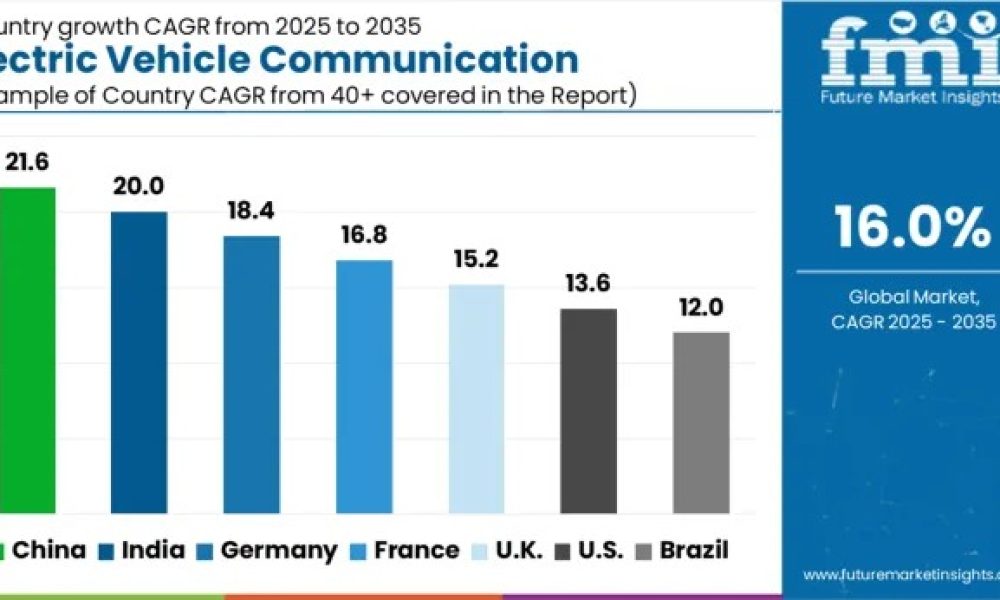
The global electric vehicle communication controller (EVCC) market is entering a phase of accelerated expansion, underpinned by the rapid electrification of mobility, large-scale investments in charging infrastructure, and the growing complexity of vehicle-to-grid communication. The market is projected to grow from USD 0.8 billion in 2025 to USD 3.6 billion by 2035, creating an absolute dollar opportunity of USD 2.8 billion over the forecast period and advancing at a strong compound annual growth rate (CAGR) of 16.0%.
This growth trajectory reflects the EVCC’s evolution from a supporting electronic component to a mission-critical system within the electric vehicle ecosystem. As electric vehicles increasingly interact with charging stations, smart grids, and energy management platforms, communication controllers are becoming central to ensuring safe, efficient, and interoperable power transfer.
Two-Phase Growth Curve Highlights Structural Momentum
Market expansion is expected to follow a clearly defined two-phase trajectory. During the first phase (2025–2030), the market is projected to grow from USD 0.8 billion to USD 1.7 billion, adding USD 0.9 billion, which represents 32.1% of total incremental growth. This phase is driven primarily by rising EV penetration in key automotive markets and the foundational build-out of public and private charging networks.
The second phase (2030–2035) is expected to contribute a substantially larger USD 1.9 billion, accounting for 67.9% of total market growth. This acceleration reflects the point at which EV communication controllers become indispensable for advanced charging use cases, including vehicle-to-grid (V2G), smart charging, load balancing, and real-time energy optimization. Annual market increments are projected to rise from USD 0.2 billion in the early years to USD 0.5 billion by 2035, highlighting the compounding impact of infrastructure scale and system integration.
Get access to comprehensive data tables and detailed market insights — request your sample report today!
https://www.futuremarketinsights.com/reports/sample/rep-gb-25411
EVCC Systems Anchor Market Leadership
By system type, EVCC dominates the market, accounting for 61.5% of total revenue in 2025. EVCCs play a central role in managing communication between electric vehicles and charging stations, handling critical functions such as authentication, charging authorization, fault detection, and energy flow control. Their compatibility with global communication standards and charging protocols has positioned EVCCs as the preferred choice for automakers and infrastructure developers seeking scalable and future-ready solutions.
As charging environments become more intelligent and interconnected, EVCC systems are increasingly being designed with enhanced cybersecurity, real-time data processing, and interoperability capabilities. These features are essential to support next-generation charging scenarios and ensure reliable operation across diverse vehicle models and grid architectures.
Wired Charging and Passenger Cars Drive Near-Term Demand
From a charging perspective, wired solutions lead the market with a 68.2% revenue share in 2025. Wired charging remains the dominant technology due to its reliability, lower energy losses, and widespread infrastructure availability. Investments in high-power wired charging stations capable of supporting faster charging times are further strengthening demand for advanced communication controllers optimized for stable, high-capacity energy transfer.
By vehicle type, passenger cars account for 53.8% of market revenue, reflecting their dominance in global EV registrations. Communication controllers designed for passenger vehicles are being optimized to support a wide range of charging scenarios, including home charging, workplace charging, and public fast-charging networks. Government incentives, emission reduction targets, and expanding model availability continue to reinforce passenger cars as the primary deployment segment for EVCC technologies.
Regulatory Alignment and Smart Energy Integration Accelerate Adoption
Regulatory frameworks promoting standardized charging interfaces and interoperability across manufacturers are playing a pivotal role in market growth. Governments and industry bodies are increasingly emphasizing harmonized communication protocols to ensure seamless interaction between vehicles, chargers, and grids. This regulatory push is accelerating adoption of EVCC systems that comply with international standards while offering flexibility for regional grid requirements.
At the same time, the integration of smart charging and V2G technologies is reshaping the market landscape. EVs are evolving into distributed energy assets capable of feeding power back into the grid during peak demand. This transition significantly elevates the importance of robust communication controllers that can manage bidirectional energy flow, real-time pricing signals, and grid stability requirements.
Asia-Pacific Emerges as the Fastest-Growing Region
Regionally, Asia-Pacific stands out as the primary growth engine, led by China and India. China is projected to grow at a CAGR of 21.6%, driven by aggressive government policies supporting EV adoption, extensive charging infrastructure investments, and a strong domestic automotive manufacturing base. India follows closely with a 20.0% CAGR, supported by clean energy initiatives, rapid urbanization, and expanding EV adoption across passenger and commercial segments.
In Europe, Germany is forecast to grow at 18.4%, benefiting from its advanced automotive ecosystem, leadership in EV technology, and strong focus on smart grid integration. The United Kingdom, growing at 15.2%, continues to expand its urban charging infrastructure and promote sustainable transportation. The United States, while comparatively slower at 13.6%, remains a strategically important market due to ongoing investments in fast-charging networks and smart grid technologies.
Drive Your Business Growth Strategy: Checkout the Report for Key Insights
https://www.futuremarketinsights.com/checkout/25411
Competitive Landscape Defined by Technology Leadership
The competitive environment is shaped by established industrial and technology leaders, including Bosch, BYD, LG Innotek, Schneider Electric, Siemens, Engie, and Tesla. These companies are investing heavily in advanced communication architectures, cybersecurity, and integration with renewable energy systems. Innovations in wireless communication, V2X technologies, and real-time data analytics are emerging as key differentiators in an increasingly sophisticated market.
Outlook: EVCCs as the Backbone of Intelligent EV Charging
As electric vehicles transition from early adoption to mass deployment, electric vehicle communication controllers are becoming foundational to the entire EV value chain. Their role in enabling efficient charging, grid interaction, and energy optimization positions them at the center of future mobility and energy systems. With USD 2.8 billion in incremental value expected by 2035, the EVCC market offers compelling long-term growth potential driven by infrastructure scale, regulatory alignment, and the global push toward intelligent electrification.
Why Choose FMI: Empowering Decisions that Drive Real-World Outcomes: https://www.futuremarketinsights.com/why-fmi
About Future Market Insights (FMI)
Future Market Insights, Inc. (FMI) is an ESOMAR-certified, ISO 9001:2015 market research and consulting organization, trusted by Fortune 500 clients and global enterprises. With operations in the U.S., UK, India, and Dubai, FMI provides data-backed insights and strategic intelligence across 30+ industries and 1200 markets worldwide.



