
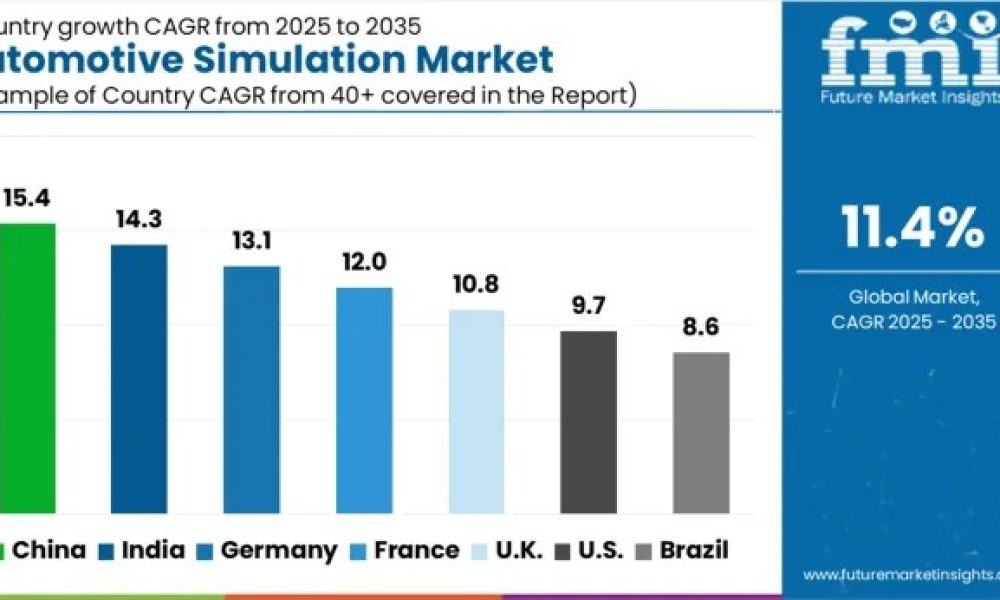
The global automotive simulation market is entering a decade of sustained, high-impact growth as automakers and suppliers accelerate the shift toward digital-first vehicle development. The market is projected to expand from USD 4.0 billion in 2025 to USD 11.8 billion by 2035, registering a strong compound annual growth rate (CAGR) of 11.4% over the forecast period. This expansion reflects the rising strategic importance of simulation technologies in reducing development cycles, lowering costs, and enabling compliance with increasingly complex safety, performance, and sustainability requirements.
Between 2025 and 2030, the market is expected to grow from USD 4.0 billion to USD 6.9 billion, signaling accelerated adoption of simulation tools across passenger vehicles, electric mobility platforms, and advanced driver-assistance systems (ADAS). During this phase, automakers and Tier-1 suppliers are scaling investments in virtual prototyping, real-time modeling, and predictive analytics to offset the rising costs and time constraints associated with physical testing.
From 2030 to 2035, growth is forecast to intensify further, with market value increasing from USD 6.9 billion to USD 11.8 billion. This second-half acceleration is closely linked to the global transition toward connected, autonomous, shared, and electric (CASE) mobility, where digital validation is no longer optional but foundational to vehicle development strategies.
Simulation Emerges as a Core Enabler of Modern Vehicle Development
Automotive simulation has evolved from a supplementary engineering tool into a mission-critical capability across the vehicle lifecycle. The increasing complexity of modern vehicles—particularly electric and autonomous models—has made traditional, prototype-heavy development approaches economically and operationally unsustainable. Simulation platforms now support high-fidelity modeling across vehicle dynamics, crashworthiness, aerodynamics, powertrain efficiency, thermal management, and electronic control systems.
A major driver of adoption is the ability to significantly reduce physical prototyping and testing costs while improving design precision. By identifying performance bottlenecks, safety risks, and compliance gaps early in the development cycle, simulation enables faster iterations and more informed engineering decisions. Integration of artificial intelligence (AI), machine learning, and real-time analytics further enhances predictive accuracy, allowing engineers to model complex, real-world scenarios with greater confidence.
Get access to comprehensive data tables and detailed market insights — request your sample report today!
https://www.futuremarketinsights.com/reports/sample/rep-gb-25409
Hardware Segment Anchors Market Demand
By component, hardware remains the leading segment, accounting for 42.7% of the market in 2025. High-performance simulation hardware provides the computational power required for real-time processing, multi-physics modeling, and large-scale scenario testing. Its importance is amplified in applications such as autonomous vehicle validation, ADAS testing, and electric drivetrain optimization, where simulation accuracy and speed are critical.
Investments in next-generation processors, GPUs, and hybrid cloud-compatible infrastructure are reinforcing the dominance of this segment. As cloud-based simulation platforms gain traction, demand is also rising for hybrid environments where advanced hardware supports scalable, virtual workflows.
Vehicle Dynamics Simulation Leads by Functionality
Among simulation types, vehicle dynamics simulation holds a commanding 36.5% share, reflecting its central role in evaluating handling, stability, ride comfort, and overall performance. This simulation category enables manufacturers to optimize chassis design, suspension systems, and control strategies under a wide range of operating conditions without extensive on-road testing.
The growing adoption of electric and autonomous vehicles has elevated the importance of precise dynamic modeling, as these platforms introduce new weight distributions, torque characteristics, and control complexities. Continuous advancements in physics engines, AI-enhanced models, and integrated simulation frameworks are strengthening this segment’s long-term relevance.
Design and Prototyping Drive Application Demand
By application, design and prototyping lead the market with a 31.4% share, underscoring the shift toward virtual-first product development. Simulation-driven design allows automakers to visualize, test, and refine vehicle architectures before committing to physical builds, significantly reducing development risk and cost.
The adoption of virtual reality (VR), augmented reality (AR), and digital twin technologies is transforming collaborative engineering, enabling geographically dispersed teams to work on unified, real-time models. As pressure mounts to deliver innovative, compliant vehicles faster, design and prototyping applications are expected to remain a cornerstone of simulation adoption.
Asia-Pacific Accelerates, While North America and Europe Drive Innovation
Regionally, Asia-Pacific is emerging as a major growth engine, led by China and India. Expanding automotive production, rapid electrification, and strong government support for smart mobility are driving high simulation adoption rates. China alone is forecast to grow at a 15.4% CAGR, reflecting deep integration of simulation into EV, ADAS, and autonomous vehicle programs.
North America and Europe continue to lead in innovation, supported by advanced R&D ecosystems and early adoption of scenario-based testing, hardware-in-the-loop (HIL), and cloud-enabled simulation platforms. Germany, France, the UK, and the United States remain critical hubs for digital engineering, with simulation playing a key role in meeting stringent safety and emission regulations.
Drive Your Business Growth Strategy: Checkout the Report for Key Insights
https://www.futuremarketinsights.com/checkout/25409
Competitive Landscape Defined by Technology Depth and Integration
Competition in the automotive simulation market is shaped by technological breadth, scalability, and ecosystem integration. Leading players such as Ansys, Altair Engineering, Dassault Systèmes, AVL List, dSPACE, ESI Group, Autodesk, Anthony Best Dynamics, Design Simulation Technologies, and Gamma Technologies are expanding their portfolios across multi-physics modeling, digital twins, and real-time validation.
Strategic partnerships with OEMs, Tier-1 suppliers, and semiconductor companies are strengthening platform interoperability and accelerating adoption. As simulation becomes deeply embedded in automotive R&D workflows, differentiation increasingly depends on accuracy, computational efficiency, and the ability to support complex CASE mobility requirements.
Market Outlook
With nearly threefold growth projected by 2035, the automotive simulation market is positioned as a foundational pillar of next-generation vehicle development. Rising vehicle complexity, regulatory scrutiny, and cost pressures are driving a structural shift toward digital validation and predictive engineering. As AI-driven simulation, cloud platforms, and digital twins mature, simulation technologies are expected to play an even greater role in shaping safer, more efficient, and more sustainable mobility solutions worldwide.
This sustained expansion highlights the strategic value of automotive simulation as the industry transitions toward a fully digital, software-defined future.
Why Choose FMI: Empowering Decisions that Drive Real-World Outcomes: https://www.futuremarketinsights.com/why-fmi
About Future Market Insights (FMI)
Future Market Insights, Inc. (FMI) is an ESOMAR-certified, ISO 9001:2015 market research and consulting organization, trusted by Fortune 500 clients and global enterprises. With operations in the U.S., UK, India, and Dubai, FMI provides data-backed insights and strategic intelligence across 30+ industries and 1200 markets worldwide.



