
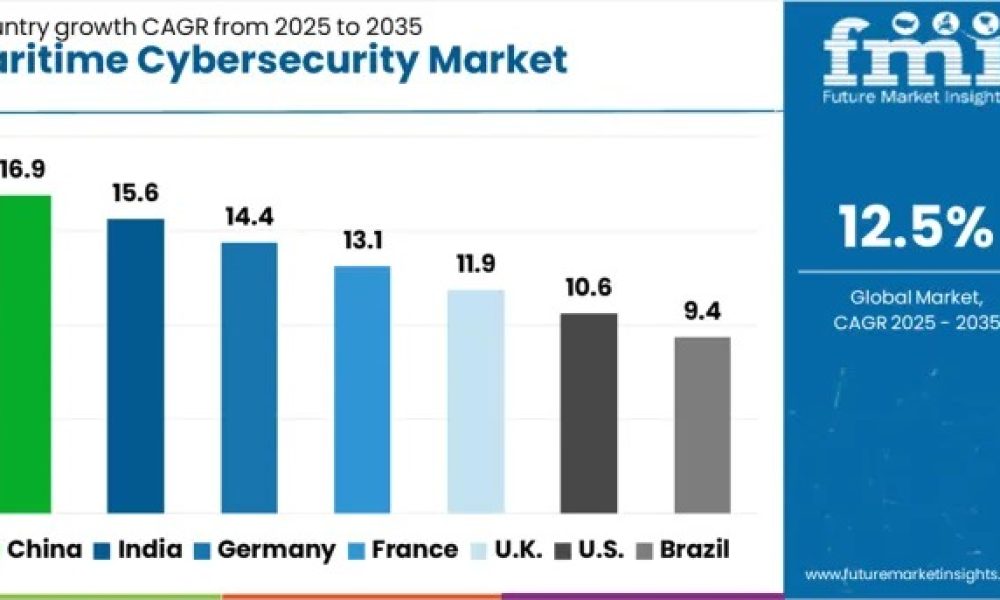
The global maritime cybersecurity market is entering a decisive growth phase, driven by the rapid digitalization of shipping, port operations, and offshore infrastructure. Valued at USD 3.5 billion in 2025, the market is projected to reach USD 11.4 billion by 2035, representing an absolute increase of USD 7.9 billion over the forecast period. This expansion reflects a 225.7% total growth and a robust compound annual growth rate (CAGR) of 12.5%, underscoring the strategic importance of cybersecurity in safeguarding global maritime trade and critical infrastructure.
The market is expected to grow nearly 3.3 times over the next decade as maritime organizations increasingly recognize cyber risk as an operational, financial, and safety-critical exposure rather than a purely IT concern. Modern vessels and ports now operate as interconnected digital ecosystems, integrating navigation systems, cargo management platforms, satellite communications, industrial control systems, and cloud-based analytics. This digital transformation has expanded the maritime cyber attack surface, elevating demand for specialized, mission-critical cybersecurity solutions.
Early Growth Anchored in Digital Adoption and Compliance Pressure
Between 2025 and 2030, the maritime cybersecurity market is forecast to expand from USD 3.5 billion to USD 6.3 billion, generating USD 2.8 billion in incremental value, equivalent to 35.4% of total decade-long growth. This period is characterized by accelerated adoption of digital technologies across commercial shipping fleets and port operations, alongside a sharp increase in cyber incidents targeting navigation systems, cargo databases, and port terminal networks.
Regulatory momentum plays a defining role in this phase. International maritime organizations and national authorities are reinforcing cybersecurity mandates that require documented risk assessments, continuous monitoring, and incident response capabilities. As compliance requirements tighten, shipping companies and port operators are prioritizing enterprise-grade cybersecurity platforms that integrate network security, endpoint protection, and operational technology (OT) security into unified frameworks.
Get access to comprehensive data tables and detailed market insights — request your sample report today!
https://www.futuremarketinsights.com/reports/sample/rep-gb-26135
Advanced Analytics and Autonomous Systems Drive Post-2030 Acceleration
The most significant value creation is expected between 2030 and 2035, when the market is projected to grow from USD 6.3 billion to USD 11.4 billion, adding USD 5.1 billion—or 64.6% of total forecast growth. This acceleration reflects the increasing complexity of maritime digital infrastructure and the emergence of next-generation operational models.
Artificial intelligence (AI) and machine learning–powered threat detection systems are expected to move from pilot deployments to mainstream adoption, enabling predictive risk analysis and real-time anomaly detection across vessel and port networks. At the same time, the rise of autonomous vessels, smart ports, and digitally integrated supply chains is creating demand for advanced cybersecurity analytics, secure data exchange platforms, and comprehensive managed security services tailored to maritime-specific risks.
Solutions Dominate as Cybersecurity Becomes Mission-Critical
By component, solutions account for approximately 68.7% of the market in 2025, reflecting strong demand for integrated cybersecurity platforms rather than fragmented point products. Maritime organizations favor solutions that provide continuous threat detection, prevention, and response while aligning with regulatory and operational requirements unique to maritime environments.
From a security perspective, network security represents 33.2% of total market demand, highlighting the critical need to protect communication links connecting vessels, ports, and logistics systems. These networks form the backbone of global shipping operations, making them prime targets for cyber intrusion and disruption.
Deployment trends further emphasize operational realities. On-premise solutions account for 65% of deployments, driven by the need for autonomous cybersecurity capabilities during long sea voyages and in port environments with limited or intermittent connectivity. Direct control over security infrastructure remains a priority for operators managing safety-critical systems.
Commercial Shipping and Large Enterprises Lead Adoption
By end user, commercial shipping commands 42.1% of market demand, reflecting the scale, complexity, and economic importance of container shipping, bulk transport, and tanker operations. These fleets face persistent threats to navigation systems, cargo data integrity, and operational continuity, making cybersecurity investment a strategic necessity.
Organization size analysis shows large enterprises holding 70.8% of market share, as multinational shipping companies, port authorities, and maritime service providers manage extensive digital assets across multiple geographies. Their requirements for enterprise-wide governance, compliance reporting, and advanced threat intelligence continue to drive sustained demand for high-value cybersecurity platforms.
Asia-Pacific Emerges as a Growth Engine
While North America and Europe remain established markets, Asia-Pacific is emerging as the fastest-growing region, led by China and India. China’s maritime cybersecurity market is expanding at a CAGR of 16.9%, supported by smart port development, port automation, and government mandates for operational technology security. India follows closely at 15.6%, driven by port modernization under the Sagarmala program and expanding coastal and inland shipping networks.
Europe continues to demonstrate strong growth, with Germany (14.4%) and France (13.1%) emphasizing regulatory compliance, advanced maritime technology integration, and naval cybersecurity requirements. The United States, growing at 10.6%, remains anchored in critical infrastructure protection and naval cybersecurity programs.
Drive Your Business Growth Strategy: Checkout the Report for Key Insights
https://www.futuremarketinsights.com/checkout/26135
Competitive Landscape Shaped by Specialization and Scale
The competitive environment includes global cybersecurity leaders and specialized maritime security providers. Companies such as Marlink, Fortinet, Naval Dome, Cydome, CyberOwl, ABS Group, Waterfall Security Solutions, Kongsberg, Thales, BAE Systems, Honeywell, Cisco, Raytheon Technologies, and Wärtsilä are investing heavily in maritime-specific threat intelligence, OT security, and integrated platform capabilities.
Strategic partnerships, regulatory expertise, and the ability to deliver scalable, compliance-ready solutions are increasingly defining competitive advantage as maritime cybersecurity becomes a core operational requirement rather than a discretionary investment.
Outlook: Cybersecurity as a Structural Pillar of Maritime Operations
The maritime cybersecurity market is transitioning from reactive protection to proactive, intelligence-driven security architectures. As digitalization reshapes global shipping and port operations, cybersecurity is emerging as a structural pillar of operational resilience, safety, and supply chain integrity. The scale and pace of projected growth highlight the urgency for maritime stakeholders to reassess their security posture and invest in comprehensive, future-ready cybersecurity frameworks.
With rising regulatory scrutiny, escalating threat sophistication, and accelerating digital adoption, the coming decade is set to redefine cybersecurity as a fundamental enabler of secure and efficient maritime trade—positioning this market as one of the most strategically significant segments within the broader global cybersecurity landscape.
Why Choose FMI: Empowering Decisions that Drive Real-World Outcomes: https://www.futuremarketinsights.com/why-fmi
About Future Market Insights (FMI)
Future Market Insights, Inc. (FMI) is an ESOMAR-certified, ISO 9001:2015 market research and consulting organization, trusted by Fortune 500 clients and global enterprises. With operations in the U.S., UK, India, and Dubai, FMI provides data-backed insights and strategic intelligence across 30+ industries and 1200 markets worldwide.



