
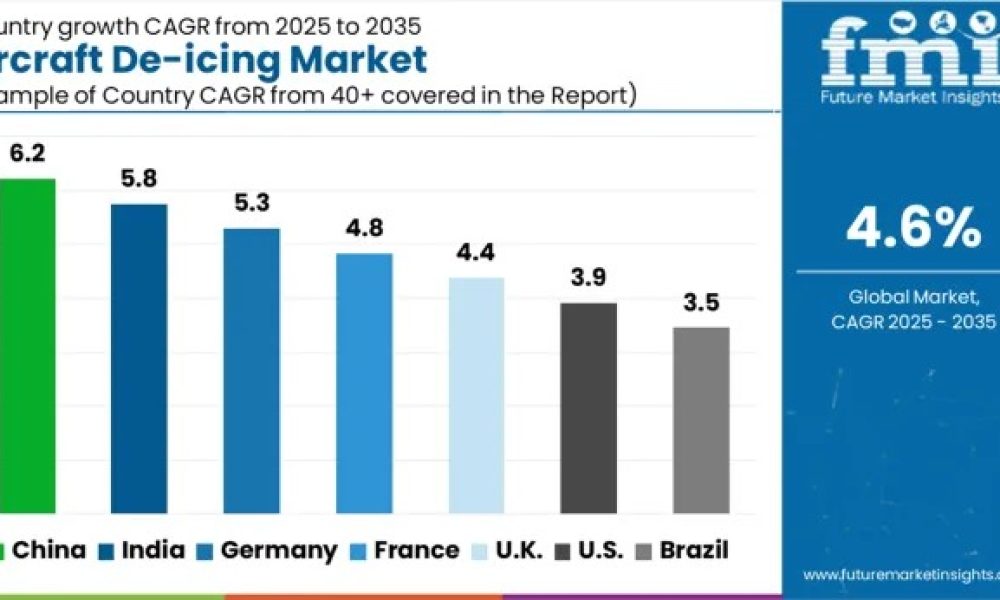
The global aircraft de-icing market is positioned for sustained and resilient growth over the next decade, underpinned by rising air traffic volumes, stricter aviation safety regulations, and continuous investment in airport infrastructure across cold-weather and climate-variable regions. The market is estimated to be valued at USD 1.8 billion in 2025 and is projected to reach USD 2.8 billion by 2035, expanding at a compound annual growth rate (CAGR) of 4.6% during the forecast period.
Aircraft de-icing remains a mission-critical activity within the aviation ecosystem, directly influencing flight safety, on-time performance, and regulatory compliance. Market expansion reflects not only growth in aircraft movements but also the increasing complexity of winter operations, where reliability, environmental compliance, and operational efficiency are non-negotiable requirements.
Uneven Regional Growth Highlights Asia-Pacific as the Primary Expansion Engine
While global growth remains steady, market expansion is unevenly distributed across regions due to differences in aviation traffic density, climate exposure, and regulatory frameworks. Asia-Pacific is expected to account for the highest incremental growth, supported by rapid airport expansion programs, rising passenger travel, and increasing fleet sizes. Large-scale investments in ground handling infrastructure and modernization of airport operations are accelerating the adoption of advanced de-icing equipment and high-performance fluids across both major hubs and regional airports.
Europe continues to demonstrate moderate but stable growth, anchored by its mature aviation infrastructure and some of the world’s most stringent environmental and operational regulations. Demand in the region is driven less by capacity expansion and more by compliance with strict chemical usage standards, glycol runoff controls, and safety certification requirements. This regulatory intensity sustains consistent demand while moderating overall growth rates compared to emerging regions.
North America represents a mature and technology-driven market, where growth is largely incremental. Adoption is primarily focused on upgrading existing de-icing fleets, improving fluid efficiency, and integrating automated systems rather than expanding de-icing capacity. Together, these regional dynamics position Asia-Pacific as the dominant growth driver, Europe as a compliance-led demand center, and North America as a stable market focused on operational optimization.
Get access to comprehensive data tables and detailed market insights — request your sample report today!
https://www.futuremarketinsights.com/reports/sample/rep-gb-26054
Fluids-Based De-icing Remains the Industry Standard
By method, de-icing with fluids accounts for approximately 58.4% of the total market, maintaining its position as the dominant approach. Its leadership is supported by proven performance, rapid application, and compatibility across a wide range of aircraft types. Fluid-based de-icing remains the preferred solution for effectively removing frost, ice, and snow while providing short-term anti-icing protection during ground delays.
Continuous innovation in glycol-based and alternative eco-friendly formulations has strengthened this segment’s position. Advances in viscosity control, freeze-point suppression, and corrosion resistance allow operators to meet increasingly strict safety and environmental standards without compromising efficiency. As dispensing systems and application technologies continue to improve, de-icing with fluids is expected to retain its leading role over the forecast period.
De-icing Chemicals and Fluids Drive Market Value Creation
From an offering perspective, de-icing chemicals and fluids represent approximately 62.7% of total market revenue, making them the largest value-generating segment. This dominance reflects the recurring and high-volume nature of fluid consumption, particularly during peak winter months. Type I and Type IV fluids remain essential for ensuring safe takeoff performance and regulatory compliance under freezing conditions.
Airports and airlines increasingly prioritize long-term supply agreements and strategic partnerships with chemical manufacturers to secure consistent performance, environmental compliance, and supply reliability. Ongoing research and development focused on biodegradable, low-toxicity formulations is reshaping procurement strategies, reinforcing the strategic importance of this segment within the overall market.
Commercial Aviation Accounts for the Majority of Demand
By application, the commercial segment commands approximately 71.5% of market share, reflecting the high frequency of scheduled passenger and cargo operations that require dependable and repeatable de-icing processes. Commercial airlines operate under tight turnaround schedules, making efficient de-icing critical to maintaining punctuality, minimizing delays, and ensuring passenger safety.
The expansion of international and regional airline networks in cold-weather geographies, coupled with rising passenger volumes, continues to drive demand. Investment in automated de-icing vehicles, high-capacity fluid systems, and digitally enabled monitoring tools is increasingly tailored to the needs of large commercial fleets, reinforcing the segment’s long-term dominance.
Technology, Automation, and Sustainability Redefine Competitive Advantage
Recent developments in the aircraft de-icing market underscore a clear shift toward automation, data-driven operations, and environmental stewardship. High-efficiency spray systems, heated fluid circulation technologies, and automated de-icing vehicles are improving throughput while reducing chemical consumption. Integration with ground operations management systems and predictive weather analytics enables more precise resource allocation and faster response times.
Environmental considerations are increasingly shaping purchasing decisions. Airports are investing in fluid recovery systems, recycling infrastructure, and biodegradable formulations to reduce ecological impact and comply with tightening regulations. These sustainability-driven innovations are no longer optional differentiators but core requirements for long-term market participation.
Drive Your Business Growth Strategy: Checkout the Report for Key Insights
https://www.futuremarketinsights.com/checkout/26054
Country-Level Growth Reflects Infrastructure Investment and Safety Priorities
Growth trajectories vary significantly at the country level. China leads with a projected CAGR of 6.2%, driven by rapid expansion of commercial aviation and deployment of advanced de-icing technologies. India follows at 5.8%, supported by rising air traffic and modernization of regional airports. In Europe, Germany records 5.3% growth, reflecting strong regulatory enforcement and investment in high-performance solutions, while the UK grows at 4.4%. The United States expands at 3.9%, underpinned by technology upgrades and stable winter operations across a large installed base.
Competitive Landscape Focused on Performance, Compliance, and Reliability
The competitive environment is shaped by a combination of chemical innovators and specialized ground support equipment providers, including BASF SE, Clariant, Cryotech (General Atomics), DuPont de Nemours, Kilfrost, Oshkosh Aerotech, Textron GSE, Tronair, and Vestergaard Company, among others. Differentiation is increasingly based on fluid performance metrics, environmental compliance, automation capabilities, and service reliability rather than price alone.
Outlook
As climate variability intensifies and global air travel continues to expand, aircraft de-icing will remain a foundational element of safe and efficient aviation operations. Market growth through 2035 will be driven by regulatory enforcement, infrastructure investment, and technological innovation, positioning de-icing as a strategically vital segment within the broader aviation support ecosystem.
Why Choose FMI: Empowering Decisions that Drive Real-World Outcomes: https://www.futuremarketinsights.com/why-fmi
About Future Market Insights (FMI)
Future Market Insights, Inc. (FMI) is an ESOMAR-certified, ISO 9001:2015 market research and consulting organization, trusted by Fortune 500 clients and global enterprises. With operations in the U.S., UK, India, and Dubai, FMI provides data-backed insights and strategic intelligence across 30+ industries and 1200 markets worldwide.



