
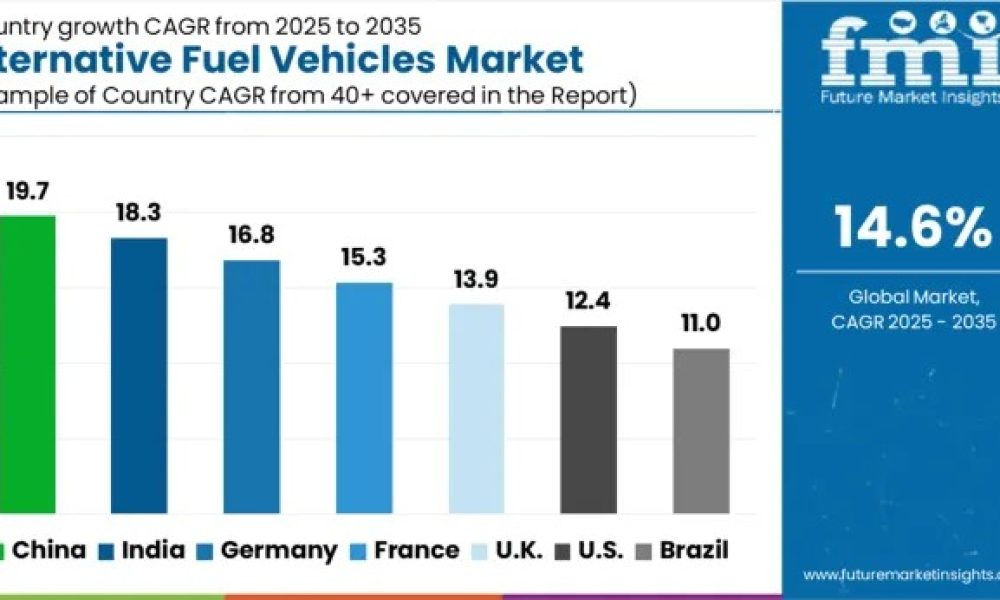
The global alternative fuel vehicles (AFVs) market is entering a decisive growth phase as regulatory mandates, technology maturity, and infrastructure investment converge to reshape the automotive landscape. Valued at USD 912.4 billion in 2025, the market is projected to reach USD 3,564.9 billion by 2035, expanding at a robust CAGR of 14.6% over the forecast period. This expansion reflects a structural shift away from internal combustion engine dependency toward diversified, low- and zero-emission propulsion systems across passenger, commercial, and public transport segments.
Market momentum is being driven by increasingly stringent emission control mandates, fuel efficiency standards, and policy instruments designed to accelerate decarbonization. Across major economies, regulatory frameworks targeting tailpipe emissions have materially altered purchasing behavior and OEM investment priorities, directly supporting the market’s growth trajectory from USD 912.4 billion in 2025 to USD 1,373.3 billion by 2028, and ultimately to USD 3.56 trillion by 2035.
Regulatory Architecture Becomes a Primary Growth Engine
Policy intervention remains one of the most influential market catalysts. Governments worldwide are deploying a combination of tax credits, rebates, purchase subsidies, and penalty mechanisms to favor alternative fuel adoption. Incentives for battery-electric vehicles (BEVs), plug-in hybrids, and hydrogen fuel cell vehicles have reduced upfront cost barriers, while penalties on high-emission vehicles are accelerating fleet and consumer transition.
Parallel investment in charging and refueling infrastructure has reinforced adoption at scale. Standards governing battery performance, safety, vehicle interoperability, and emissions compliance have further strengthened consumer confidence and manufacturer alignment. Collectively, regulatory measures have evolved from compliance requirements into strategic market accelerators, shaping technology development, capital allocation, and long-term mobility planning.
Get access to comprehensive data tables and detailed market insights — request your sample report today!
https://www.futuremarketinsights.com/reports/sample/rep-gb-26049
Electric Propulsion Dominates, but Fuel Diversification Expands Market Depth
By fuel type, electric vehicles lead the market with a 51.6% share, underpinned by rapid advancements in battery energy density, charging speed, and cost reduction. Expansion of fast-charging networks and continued decline in lithium-ion battery prices have enhanced economic viability, particularly in urban and suburban markets.
Beyond electrification, hydrogen fuel cell vehicles, biofuel-compatible platforms, and hybrid architectures are gaining traction in specific use cases. Hydrogen solutions are increasingly positioned for long-range, heavy-duty, and high-utilization applications, while biofuels contribute to energy diversification and carbon intensity reduction. This multi-fuel evolution is expanding the addressable market and enabling tailored solutions across mobility segments.
Passenger Vehicles Anchor Volume, Fleets Drive Economic Scale
By vehicle category, passenger vehicles account for approximately 62.4% of total AFV demand, supported by expanding model availability, improved range performance, and incentives such as reduced registration fees and urban access benefits. Consumer preference is increasingly shaped by total cost of ownership economics, environmental considerations, and access to connected and intelligent vehicle features.
From an end-use perspective, the commercial and fleet segment leads with a 39.5% share, reflecting accelerated adoption by logistics providers, public transport operators, and corporate fleets. Lower fuel and maintenance costs, coupled with regulatory pressure on fleet emissions, are reinforcing large-scale procurement. Depot-based charging infrastructure, telematics integration, and route optimization technologies are strengthening the economic case for fleet electrification and alternative fuel deployment.
Technology Integration Reshapes Competitive Positioning
Recent market developments highlight a shift toward platform-based vehicle architectures, modular drivetrains, and software-defined mobility. OEMs are integrating lightweight materials, advanced battery management systems, regenerative braking, and connected energy management solutions to improve efficiency and performance.
Collaboration between automakers, energy providers, infrastructure developers, and software firms is accelerating ecosystem maturity. Connected vehicle platforms and over-the-air updates are enhancing user experience, while smart energy integration aligns vehicle operation with renewable power availability. These advancements are positioning AFVs not merely as cleaner alternatives, but as intelligent mobility assets.
Asia-Pacific and Europe Set the Pace as Adoption Becomes Systemic
Regionally, Asia-Pacific, North America, and Europe remain the core growth engines. China leads global expansion with a 19.7% CAGR, supported by aggressive incentives, extensive charging infrastructure, and strong domestic manufacturing capacity. India follows at 18.3%, driven by policy support, urban electrification, and rising consumer awareness.
Germany’s 16.8% CAGR reflects its technology-driven automotive ecosystem and alignment with EU emission targets, while the UK and France continue to benefit from regulatory clarity and infrastructure deployment. The United States, growing at 12.4%, is seeing sustained investment in EV production, battery innovation, and nationwide charging networks, particularly for commercial and delivery fleets.
Drive Your Business Growth Strategy: Checkout the Report for Key Insights
https://www.futuremarketinsights.com/checkout/26049
Competitive Landscape Defined by Scale, Technology, and Compliance
The AFV market is shaped by a mix of established global OEMs and electrification leaders. Audi, BMW, Mercedes-Benz, and Toyota emphasize performance, efficiency, and hybrid integration, while BYD Company and Hyundai Motor focus on mass-market affordability and range efficiency. Ford Motor, General Motors, Honda Motors, and Fiat Chrysler Automobiles are leveraging modular platforms and multi-fuel adaptability to serve diverse regional requirements.
Competitive differentiation increasingly depends on battery technology, software integration, compliance readiness, and infrastructure compatibility, rather than vehicle hardware alone. Strategic investments in R&D, manufacturing scale, and ecosystem partnerships are becoming decisive factors.
Outlook: From Transition to Transformation
The alternative fuel vehicles market is transitioning from early adoption to systemic transformation. Regulatory alignment, declining technology costs, and infrastructure readiness are converting sustainability objectives into commercial reality. With the market projected to surpass USD 3.56 trillion by 2035, alternative fuel vehicles are positioned to redefine global mobility, supply chains, and energy consumption patterns.
As policy frameworks tighten and innovation accelerates, the AFV market presents a compelling growth narrative rooted in long-term structural change rather than cyclical demand—underscoring the strategic importance of detailed market intelligence in navigating the next decade of mobility evolution.
Why Choose FMI: Empowering Decisions that Drive Real-World Outcomes: https://www.futuremarketinsights.com/why-fmi
About Future Market Insights (FMI)
Future Market Insights, Inc. (FMI) is an ESOMAR-certified, ISO 9001:2015 market research and consulting organization, trusted by Fortune 500 clients and global enterprises. With operations in the U.S., UK, India, and Dubai, FMI provides data-backed insights and strategic intelligence across 30+ industries and 1200 markets worldwide.



