
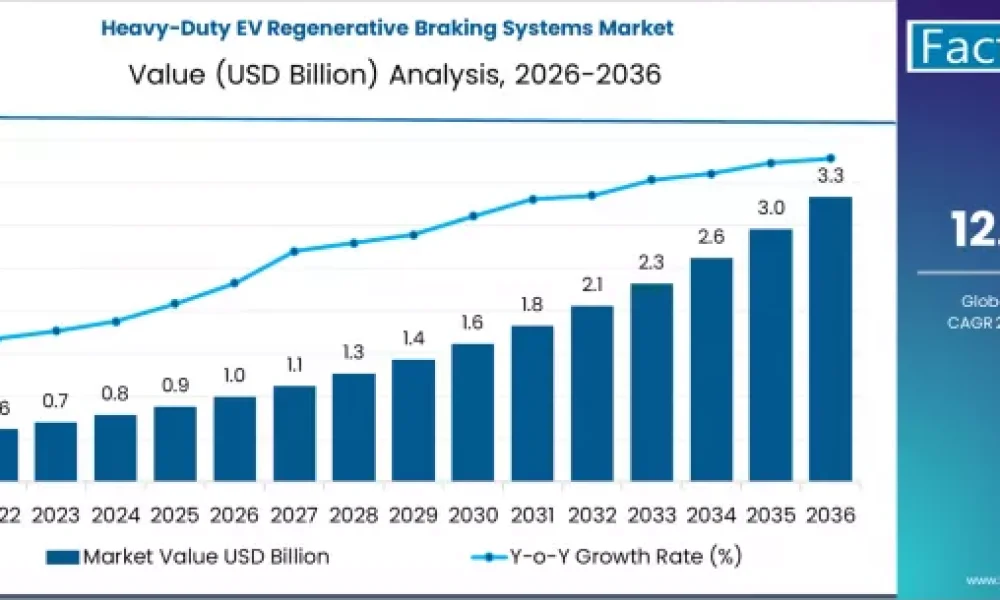
The global Heavy-Duty EV Regenerative Braking Systems Market is projected to witness significant growth through 2036 as electrification accelerates across commercial transport sectors, including buses, delivery trucks, long-haul freight vehicles, and industrial applications. Regenerative braking systems — which capture kinetic energy during braking and convert it into electrical energy for reuse — are critical technologies for heavy-duty electric vehicles (EVs), enhancing energy efficiency, extending driving range, and reducing overall operating costs. With increasing focus on reducing greenhouse gas emissions, improving fuel economy, and meeting stringent environmental regulations, these systems are becoming essential components of heavy-duty EV powertrain architectures.
The adoption of regenerative braking technologies is also driven by rising fuel prices, government incentives for zero-emission vehicles, and corporate commitments toward sustainable logistics. As fleets evolve toward electrification, regenerative braking systems deliver measurable gains in energy recapture, reduced wear on mechanical brake components, and improved vehicle performance under variable load conditions.
Market Outlook (2026–2036)
Market Size in 2026: Estimated at USD 4.7 billion
Market Size in 2036: Projected to exceed USD 15.8 billion
Forecast CAGR (2026–2036): Approximately 12.9%
Leading System Type: Integrated Motor-Generator Regenerative Systems
Primary End Users: Electric Buses, Electric Trucks, Commercial EV Fleets
Key Drivers: Electrification mandates, emission reduction goals, fleet efficiency initiatives
The market’s strong projected growth reflects expanding deployment of heavy-duty EVs across urban transit, logistics, and industrial segments where regenerative braking delivers measurable operational benefits.
To Access the Complete Data Tables & in-depth Insights, Request a Discount on this report: https://www.factmr.com/connectus/sample?flag=S&rep_id=13509
Market Overview
Regenerative braking systems in heavy-duty EVs convert energy normally lost as heat during braking into usable electrical energy by leveraging the traction motor as a generator. This reclaimed energy is stored in onboard batteries or supercapacitors and reused to support propulsion, accessory loads, or auxiliary systems. In heavy-duty applications — where vehicle mass and frequent braking cycles are significant — energy recovery potential is especially high, leading to extended range and lower energy consumption.
Beyond energy efficiency, regenerative braking reduces wear on traditional friction brake assemblies, lowering maintenance costs and increasing component life. Integration of advanced controls, brake blending strategies, and real-time system optimization further enhances performance and driver control, especially under variable payload and terrain conditions.
Key Market Drivers
1. Electrification of Commercial Vehicle Fleets
Governments worldwide are implementing policies and incentives to accelerate adoption of electric buses, delivery trucks, refuse vehicles, and long-haul EVs as part of emission reduction and clean air initiatives. Heavy-duty regenerative braking systems are integral to these electrification strategies.
2. Energy Efficiency and Range Enhancement
Regenerative braking significantly improves energy utilization in heavy EVs, especially in stop-and-go urban transit and delivery operations. The captured energy reduces reliance on grid charging and enhances vehicle range — a key performance metric for fleet operators.
3. Cost Savings and Total Cost of Ownership (TCO) Reduction
By recapturing energy and reducing mechanical brake wear, regenerative braking systems help lower operational expenses over vehicle lifetimes. These savings are increasingly attractive to fleet managers focused on TCO improvements.
4. Stricter Emission Standards and Sustainability Goals
Environmental regulations targeting nitrogen oxides (NOx), particulate matter (PM), and carbon dioxide (CO₂) emissions are prompting commercial operators to transition to zero-emission powertrains. Regenerative braking complements electric systems by optimizing energy usage and supporting sustainability targets.
Market Segmentation Insights
By System Type:
Integrated Motor-Generator Regenerative Systems: Combine driving and braking energy recovery in a unified unit for highest efficiency.
Electric Retarder and Auxiliary Regenerative Systems: Provide supplemental braking energy recovery alongside main driving motors.
Hydraulic-Electric Hybrid Regenerative Systems: Leverage both hydraulic and electric recapture for specific heavy-duty applications.
By Vehicle Type:
Electric Buses and Public Transit Vehicles
Electric Delivery and Distribution Trucks
Electric Long-Haul Freight Vehicles
Construction and Industrial EV Platforms
Specialty Heavy-Duty EVs (Refuse, Utility, Mining)
By Component:
Generators/Motors with Regenerative Functionality
Regenerative Controllers and Braking Control Units
Energy Storage Interfaces (Battery/Supercapacitor Interfaces)
Sensor and Feedback Systems for Regeneration Optimization
By End Use Sector:
Urban Mass Transit
Logistics and Distribution Fleets
Industrial and Construction Operations
Utility and Specialty Fleet Services
Regional Demand Dynamics
North America is expected to capture a significant share of the market due to strong regulatory support for zero-emission vehicles, high investment in electric bus and truck deployments, and advanced charging and EV infrastructure. Public transit electrification and corporate fleet modernization further bolster regional growth.
Europe remains a key market as emission standards tighten across the European Union and national policies encourage heavy-duty EV adoption. Urban low-emission zones and incentives for electric public transport contribute to regenerative braking demand.
Asia Pacific is projected to exhibit the fastest growth, driven by expanding electric bus initiatives in China, India, and Southeast Asia, rapid logistics electrification, and substantial fleet electrification investments. Government incentives and infrastructure development continue to support broad market uptake.
Emerging demand is also visible in Latin America and Middle East & Africa as sustainability initiatives and urban air quality imperatives encourage adoption of heavy-duty electric vehicles and energy optimization technologies.
Competitive Landscape
The heavy-duty EV regenerative braking systems market is moderately competitive, featuring participation from global automotive component manufacturers, electric powertrain developers, system integrators, and control electronics innovators. Companies are focusing on enhancing regeneration efficiency, improving integration with vehicle control systems, and developing modular solutions compatible with diverse heavy-duty EV platforms.
Strategic collaborations between OEMs, battery and energy storage providers, and software developers are accelerating deployment of advanced regenerative solutions. Continued investments in R&D for predictive brake blending, advanced control algorithms, and integration with thermal and traction management systems are strengthening competitive positioning.
Future Outlook
The Heavy-Duty EV Regenerative Braking Systems Market is expected to maintain strong momentum through 2036 as commercial transport electrification expands and energy efficiency becomes a core performance metric for electric fleets. Continued innovation in power electronics, motor-generator design, system controls, and energy storage integration will further enhance regenerative braking capabilities — driving operational efficiency, range extension, and reduced environmental impact.
As fleet operators pursue sustainable, cost-effective mobility solutions for heavy-duty applications, regenerative braking systems will play a central role in optimizing energy usage and supporting growth of zero-emission transport ecosystems worldwide.
Have specific requirements or need assistance on report pricing or have a limited budget? Please contact [email protected]
About Fact.MR:
Fact.MR is a global market research and consulting firm, trusted by Fortune 500 companies and emerging businesses for reliable insights and strategic intelligence. With a presence across the U.S., UK, India, and Dubai, we deliver data-driven research and tailored consulting solutions across 30+ industries and 1,000+ markets. Backed by deep expertise and advanced analytics, Fact.MR helps organizations uncover opportunities, reduce risks, and make informed decisions for sustainable growth



