
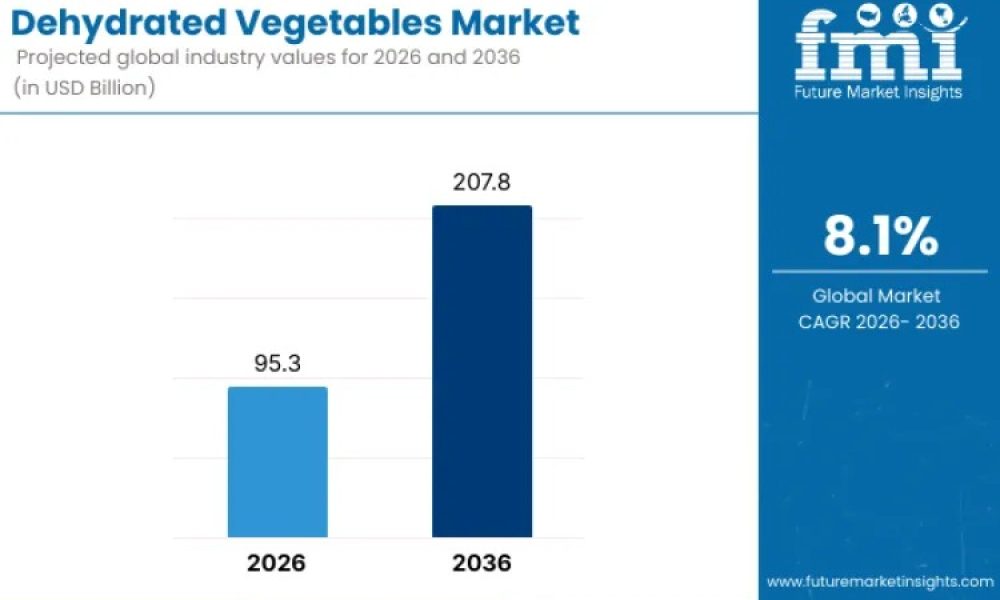
The global dehydrated vegetables market is poised for robust expansion, with market value projected to rise from USD 95.3 billion in 2026 to USD 207.8 billion by 2036, reflecting a strong CAGR of 8.1%. This growth is being fueled by evolving consumer lifestyles, rapid urbanization, and an increasing preference for convenient, shelf-stable ingredients across processed foods, ready-to-cook meals, snacks, and packaged convenience products.
Dehydrated vegetables offer the dual advantage of long shelf life and reduced storage requirements, making them indispensable for both industrial food manufacturers and retail-ready solutions. Innovations in processing, such as freeze-drying, vacuum-drying, and spray-drying, are helping manufacturers retain flavor, texture, and nutrients while enhancing supply chain efficiency. Rising awareness of plant-based diets and healthy eating further strengthens their adoption across households and foodservice channels globally.
Explore trends before investing – request a sample report today!
Market Snapshot
- Market Value (2026): USD 95.3 billion
- Market Forecast Value (2036): USD 207.8 billion
- Forecast CAGR (2026–2036): 8.1%
- Leading End User (2026): Food Manufacturers (55% share)
- Key Growth Regions: Asia Pacific, North America, Europe
Product Type Leadership
Among various vegetable types, onions dominate with a 40% share in 2026. Their concentrated flavor, consistent quality, and long shelf life make them ideal for soups, sauces, seasoning blends, ready meals, and snacks. Continuous improvements in dehydration technology, coupled with stringent quality controls, are cementing dehydrated onions as a foundational ingredient for large-scale food production.
Other key products include potatoes, carrots, broccoli, and specialty vegetables, each gaining traction in ready-to-eat and convenience food formulations.
End-Use Segments Driving Growth
Food manufacturers account for 55% of total demand, driven by the need for ingredients that simplify storage, reduce preparation time, and ensure uniform taste in large-batch production. Dehydrated vegetables are widely used in:
- Instant meals and ready-to-cook products
- Seasoning mixes and bakery fillings
- Snacks and convenience foods
As packaged meal consumption continues to rise, manufacturers remain the core driver of market growth.
Regional Market Dynamics
- Asia Pacific: Fastest-growing region, led by India (CAGR 10.1%) and China (CAGR 9.0%), supported by expanding food processing infrastructure, modernization of agriculture, and increasing adoption of packaged meals and snacks.
- North America: The U.S. market (CAGR 7.2%) benefits from technological innovation, automation, and consumer preference for minimally processed, clean-label products.
- Europe: Germany (CAGR 6.0%) and Spain (CAGR 6.5%) leverage advanced drying technologies and strong retail networks to meet both domestic and export demand.
- Latin America: Brazil (CAGR 6.8%) emphasizes industrial modernization and exports to support market growth.
- Japan: CAGR 5.5%, driven by premium processing, culinary innovation, and demand for high-quality convenience products.
Key Market Trends
- Shift toward freeze-drying and vacuum dehydration to preserve flavor, color, and nutrients
- Adoption of smart packaging and portion-controlled packs for improved supply chain efficiency
- Rising interest in organic, clean-label, and value-added vegetable ingredients
Market Drivers and Restraints
The market is being shaped by several growth drivers:
- Increased demand for convenience foods and ready-to-cook solutions
- Enhanced shelf stability and reduced food wastage
- Rising export-oriented production and contract manufacturing
Challenges include seasonal raw material fluctuations, capital-intensive dehydration systems, price volatility, and competition from fresh and frozen vegetables. Manufacturers are addressing these through advanced processing, efficient supply chain management, and equipment modernization.
Competitive Landscape
Leading companies are leveraging technological expertise and integrated supply chains to maintain market leadership. Key players include:
- McCain Foods
- Olam Group (Olam International)
- Ingredion Incorporated
- Lamb Weston
- J.R. Simplot Company
- Dak Foods / BCFoods
- Mercer Foods, LLC
- Chengde Shenli Food
- Naturex S.A. (now part of Givaudan)
- Symrise AG
These companies focus on quality control, dehydration technology upgrades, and innovative packaging to deliver consistent flavor, texture, and nutritional content. Clean-label, organic, and convenient product formats are gaining prominence to meet evolving consumer preferences.
To Access The Full Market Analysis, Strategic Recommendations, And Analyst Support, Purchase The Complete Report Here.
Outlook
Supportive government policies on food security, food loss reduction, and investment in preservation technologies are expected to unlock additional revenue opportunities estimated at USD 2–4 billion over the next decade. With continued innovation, rising health consciousness, and modern retail expansion, the dehydrated vegetables market is positioned for sustained growth.
About Future Market Insights (FMI)
Future Market Insights, Inc. (FMI) is an ESOMAR-certified, ISO 9001:2015 market research and consulting organization, trusted by Fortune 500 clients and global enterprises. With operations in the U.S., UK, India, and Dubai, FMI provides data-backed insights and strategic intelligence across 30+ industries and 1,200 markets worldwide.



