
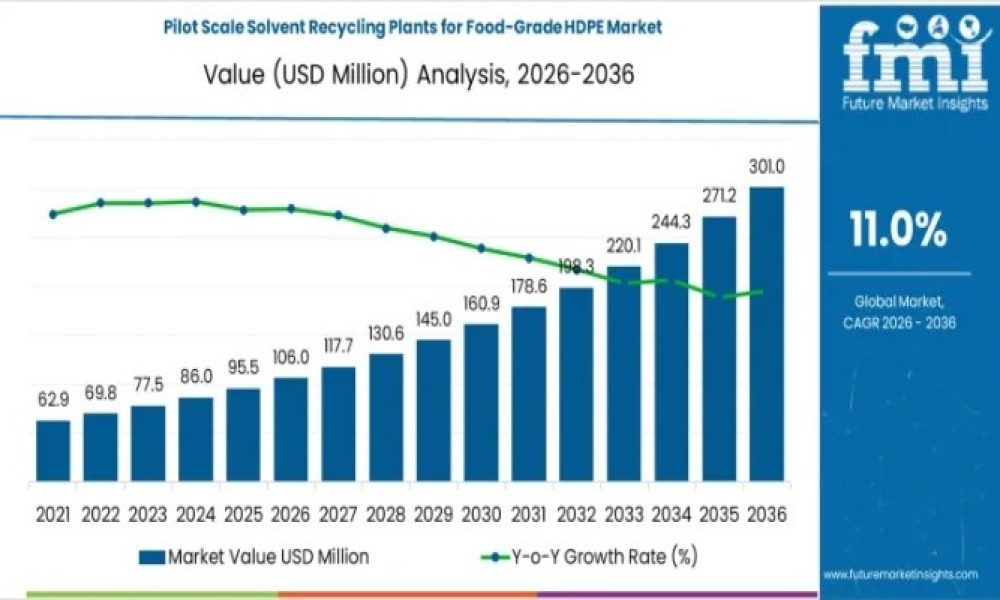
The global pilot-scale solvent recycling plants for food-grade HDPE market is entering a decisive validation-driven growth phase as regulators, brand owners, and packaging manufacturers seek credible pathways to food-contact compliant recycled plastics. Valued at USD 106 million in 2026, the market is projected to reach USD 301.0 million by 2036, expanding at a robust CAGR of 11%. Unlike volume-led recycling segments, this market is shaped by capital discipline, regulatory confidence, and technology credibility rather than aggressive capacity rollout.
Pilot-scale solvent recycling plants are increasingly viewed as gatekeeping assets—critical infrastructure that determines which recycling technologies progress toward semi-commercial and commercial deployment. Their role extends beyond material recovery into proof generation, compliance readiness, and investor de-risking.
Unlock Growth Potential and Explore Market Opportunities With Our Comprehensive Industry Overview. Request Your Sample Now
Market Snapshot: Quick Facts
- Market Value (2026): USD 106 million
- Forecast Value (2036): USD 301.0 million
- CAGR (2026–2036): 11%
- Leading Process Technology: Solvent-based dissolution
- Top Application: Food-grade HDPE pellets
- Key Growth Regions: Asia Pacific, Europe, North America
- Leading Players: Veolia, SUEZ, APK AG, MBA Polymers, ALPLA
A Capital-Disciplined Market Built on Validation, Not Volume
Early deployment of pilot-scale solvent recycling plants is defined by capital intensity. Investments are concentrated in solvent recovery systems, purification units, safety controls, and analytical monitoring. As a result, returns depend less on spot resin pricing and more on stable offtake agreements and long-term partnerships with packaging converters and brand owners.
Between 2026 and 2031, the market is expected to grow from USD 106 million to USD 178 million, accounting for about 34% of total forecast growth. This phase reflects heavy investment in solvent-based dissolution, distillation, and membrane-assisted separation technologies. Pilot plants during this period primarily serve qualification trials, regulatory data generation, and process optimization, with value captured through repeatable purity outcomes rather than throughput scale.
From 2031 to 2036, growth accelerates from USD 178 million to USD 301.0 million, contributing nearly 66% of total decade expansion. This transition marks the shift from proof-of-concept to replicable semi-commercial platforms, where margins increasingly favor technology holders integrating closed-loop solvent recovery, adsorption polishing, and digital quality tracking.
Why Pilot-Scale Plants Matter for Food-Grade HDPE
Mechanical recycling has historically struggled to meet food-contact standards due to odor retention, additive carryover, and inconsistent polymer chains. Pilot-scale solvent recycling plants address these limitations by isolating HDPE through dissolution and precipitation, effectively separating pigments, inks, and contaminants.
These facilities enable:
- Validation of solvent recovery efficiency
- Measurement of polymer purity and residue thresholds
- Documentation of closed-loop mass balance
- Generation of data for toxicology and migration testing
As regulatory scrutiny tightens, pilot plants provide the evidence base required for food-contact authorisation while containing capital exposure.
Process and Application Dynamics
Leading Process Technology: Solvent-Based Dissolution
Solvent-based dissolution accounts for 48% of pilot-scale process deployment, making it the dominant technology. Its strength lies in selectively dissolving HDPE while isolating contaminants under controlled conditions. Operators use these systems to test solvent selectivity, temperature ranges, and residence times across mixed and colored waste streams—common challenges in post-consumer HDPE.
This dominance is driven by regulatory validation priorities, as dissolution processes offer the most direct and transparent pathway to demonstrating food-contact suitability.
Top Application: Food-Grade HDPE Pellets
Food-grade HDPE pellets represent 45% of pilot-scale application demand. Pellets serve as the standard intermediate for downstream packaging qualification, enabling consistent testing of melt flow, mechanical properties, and contamination thresholds. They simplify traceability, documentation, and repeat testing—critical factors in regulatory approval and brand owner acceptance.
Regional Outlook: Where Growth Is Concentrated
- India (CAGR 11.1%) leads global growth, driven by export-aligned packaging supply chains and multinational brand sourcing requirements. Pilot plants act as learning platforms, building solvent handling and purification expertise ahead of large-scale investment.
- China (CAGR 9.6%) follows closely, supported by export-oriented packaging manufacturers validating food-grade resin purity for international markets.
- Brazil (CAGR 8.7%) shows steady expansion as recyclers integrate pilot plants with packaging producers to access higher-value food-grade applications.
- United States (CAGR 7.8%) reflects cautious, compliance-driven adoption, with pilots linked to regulatory de-risking and hybrid integration with mechanical recycling.
- United Kingdom (CAGR 7.2%) demonstrates measured growth, shaped by structured pilot programs and staged funding frameworks.
Competitive Landscape: Established Leaders and Emerging Innovators
The competitive environment favors process credibility over capacity volume. Established players such as Veolia and SUEZ leverage pilot plants to test closed-loop feasibility and reduce risk before capital-intensive scale-up. APK AG focuses on selective dissolution systems that preserve polymer structure, while MBA Polymers contributes feedstock preparation and impurity control expertise that stabilizes solvent-stage performance. ALPLA aligns pilot operations with packaging design and recycling compatibility.
At the same time, new and emerging engineering firms are entering the space with modular plant designs, advanced analytical monitoring, and digital data logging systems tailored to regulatory submission requirements. These innovations appeal to investors seeking flexibility, shorter payback periods, and reduced stranded asset risk.
Why FMI: https://www.futuremarketinsights.com/why-fmi
About Future Market Insights (FMI)
Future Market Insights, Inc. (FMI) is an ESOMAR-certified, ISO 9001:2015 market research and consulting organization, trusted by Fortune 500 clients and global enterprises. With operations in the U.S., UK, India, and Dubai, FMI provides data-backed insights and strategic intelligence across 30+ industries and 1200 markets worldwide.



