
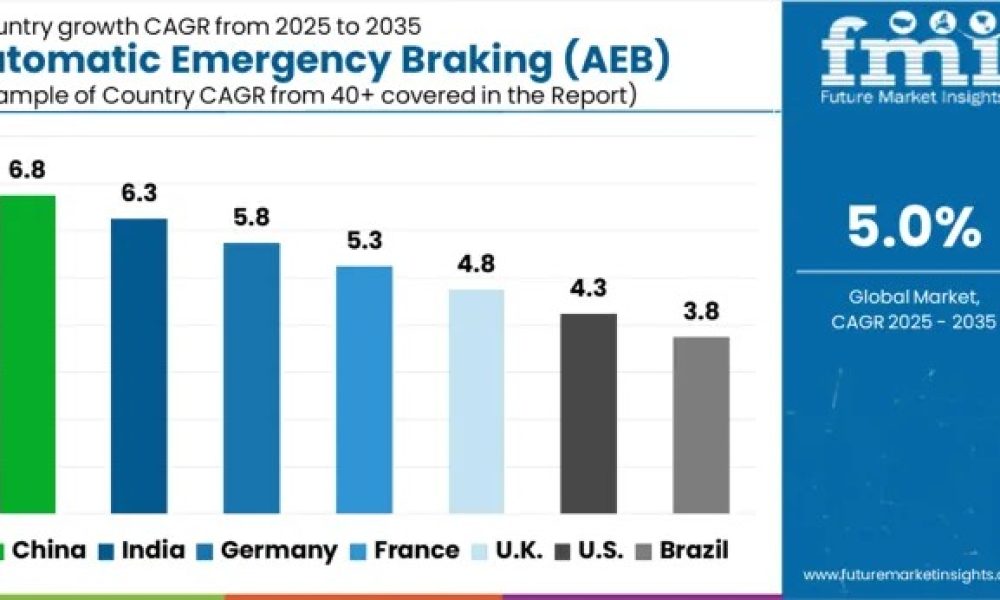
The global Automatic Emergency Braking (AEB) market is entering a phase of sustained and predictable expansion as vehicle safety requirements tighten and advanced driver-assistance systems (ADAS) move from premium offerings to mainstream standards. The market is estimated at USD 70.1 billion in 2025 and is projected to reach USD 114.2 billion by 2035, registering a compound annual growth rate (CAGR) of 5.0% over the forecast period. This steady growth trajectory reflects structural demand rather than cyclical spikes, underpinned by regulatory enforcement, rising vehicle production, and increasing acceptance of automated safety technologies across global automotive markets.
The growth curve for AEB shows a consistent upward slope with moderate acceleration in the mid-forecast years, signaling broad-based adoption rather than dependence on a single vehicle segment or geography. Passenger cars, commercial vehicles, and electric vehicles are all contributing to market expansion as AEB systems become integral to modern vehicle architectures. Emerging automotive markets are playing an increasingly important role, supported by rising vehicle ownership, urban traffic density, and stronger road safety regulations.
Regulatory Pressure Anchors Market Expansion
Regulatory mandates remain the most powerful catalyst shaping the AEB market. Safety assessment bodies such as Euro NCAP, IIHS, and NHTSA have made AEB a critical determinant of vehicle safety ratings, directly influencing OEM design priorities. In several regions, AEB is transitioning from a recommended feature to a mandatory requirement for new vehicles, compelling manufacturers to integrate the technology across both mass-market and premium models.
Governments and insurers are reinforcing this trend through incentive mechanisms, including insurance premium reductions and compliance-linked approvals. As a result, AEB adoption is no longer limited to early adopters or safety-conscious consumers; it is becoming a baseline expectation across global vehicle platforms. This regulatory-driven normalization of AEB is creating long-term revenue visibility for system suppliers, sensor manufacturers, and braking technology providers.
Get access to comprehensive data tables and detailed market insights — request your sample report today!
Technology Advancements Strengthen System Reliability
Technological progress is further reinforcing AEB market growth. OEMs and Tier-1 suppliers are increasingly deploying sensor fusion architectures that combine radar, camera, and, in advanced configurations, LiDAR inputs to enhance detection accuracy and braking response. These systems improve performance across varied driving conditions, including low visibility, adverse weather, and dense urban traffic.
Advances in braking algorithms, artificial intelligence, and real-time processing have significantly reduced false positives while improving reaction times. As production costs for radar and camera modules continue to decline, AEB systems are becoming economically viable for compact and mid-range vehicles, accelerating penetration in cost-sensitive markets. Integration with broader ADAS suites—such as adaptive cruise control, lane-keeping assistance, and pedestrian detection—further increases system value and adoption rates.
Segment Leadership Highlights Urban and Cost-Efficient Solutions
By type, Low Speed AEB Systems are projected to account for 39.4% of market revenue in 2025, making them the largest segment globally. Their dominance reflects the high frequency of low-speed collisions in urban environments, particularly involving rear-end impacts, pedestrians, and cyclists. Automakers favor low-speed AEB due to lower hardware complexity and strong alignment with city-focused safety regulations and testing protocols.
From a technology perspective, Radar-based AEB systems lead with a projected 41.8% share in 2025. Radar’s reliability under diverse weather and lighting conditions, combined with long-range detection capabilities, makes it a preferred foundation for both standalone and fused AEB solutions. Cost efficiency compared with LiDAR further supports radar’s widespread deployment across vehicle classes.
In braking hardware, Disc brakes dominate with a 66.5% market share, reflecting their superior stopping power, heat dissipation, and consistency under emergency braking conditions. OEMs increasingly standardize disc brakes in AEB-equipped vehicles to ensure optimal system performance and regulatory compliance.
Fleet, EV, and Aftermarket Demand Broadens the Base
Passenger vehicles remain the largest contributor to AEB demand, accounting for approximately 40% of the market, driven by safety mandates and consumer awareness. Commercial vehicles contribute 25%, as fleet operators prioritize collision mitigation to reduce downtime, liability, and insurance costs. The electric vehicle segment, representing 15%, is integrating AEB as a core component of digitally enabled vehicle platforms.
Beyond factory-installed systems, the aftermarket and retrofit segment, holding around 8%, is emerging as an important growth avenue. Retrofit AEB solutions allow older vehicles and commercial fleets to comply with evolving safety expectations without full replacement, expanding the addressable market and extending AEB penetration beyond new vehicle sales.
Asia Leads Growth as Global Adoption Expands
Regionally, Asia-Pacific is emerging as the fastest-growing market, led by China (6.8% CAGR) and India (6.3% CAGR). Rapid vehicle production growth, urbanization, and stricter safety regulations are accelerating adoption across passenger and commercial segments. Europe continues to be shaped by stringent safety mandates, while North America maintains steady growth driven by insurance incentives, fleet modernization, and ADAS integration.
Competitive Landscape Focused on Precision and Integration
Competition in the AEB market centers on detection accuracy, system reliability, and seamless ADAS integration. Global leaders such as Robert Bosch, Continental, ZF, Aptiv, Autoliv, Denso, Valeo, and Mobileye are investing heavily in sensor fusion, AI-driven decision-making, and software-defined braking architectures. Partnerships with OEMs, autonomous vehicle developers, and fleet operators are accelerating certification and deployment across vehicle categories.
Outlook: Predictable Growth with Strategic Importance
With revenues projected to surpass USD 114 billion by 2035, the Automatic Emergency Braking market represents a mature yet expanding segment of automotive safety technology. Its growth is anchored in regulation, reinforced by technology, and broadened by fleet and retrofit demand. As AEB becomes inseparable from vehicle safety standards worldwide, the market is positioned as a stable, long-term opportunity for stakeholders across the automotive value chain—where compliance, innovation, and integration define competitive advantage.
Why Choose FMI: Empowering Decisions that Drive Real-World Outcomes: https://www.futuremarketinsights.com/why-fmi
About Future Market Insights (FMI)
Future Market Insights, Inc. (FMI) is an ESOMAR-certified, ISO 9001:2015 market research and consulting organization, trusted by Fortune 500 clients and global enterprises. With operations in the U.S., UK, India, and Dubai, FMI provides data-backed insights and strategic intelligence across 30+ industries and 1200 markets worldwide.



