
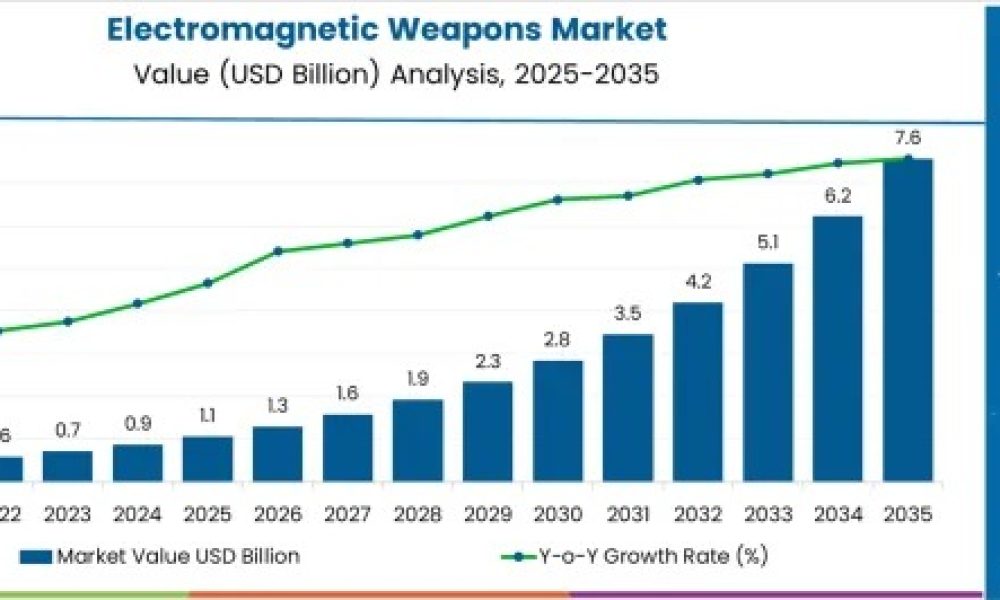
The global electromagnetic weapons market is undergoing a rapid transformation, evolving from experimental defense concepts into strategically significant components of modern military arsenals. According to recent industry analysis, the market is projected to expand from USD 1.1 billion in 2025 to USD 7.6 billion by 2035, registering a robust compound annual growth rate (CAGR) of 21.6% over the forecast period. This exceptional growth underscores a structural shift in global defense strategies toward high-energy, non-kinetic, and precision-based weapon systems.
Between 2020 and 2024, the market progressed through an early adoption phase, growing from USD 0.4 billion to USD 1.1 billion, as defense agencies and research institutions focused on prototype testing, system validation, and operational feasibility assessments. This period emphasized integration with existing defense platforms, evaluation of power and targeting capabilities, and identification of tactical use cases across land, air, and naval environments. By 2025, electromagnetic weapons are expected to reach a critical transition point, enabling broader deployment within specialized military programs.
From Experimental Systems to Scalable Defense Assets
The period from 2025 onward marks the beginning of large-scale adoption and consolidation. By 2030, the electromagnetic weapons market is projected to exceed USD 2.3 billion, driven by expanded procurement programs, increased production capacity, and deeper integration into national defense architectures. During the subsequent consolidation phase between 2030 and 2035, leading defense contractors are expected to strengthen their dominance, while smaller players integrate into larger ecosystems or exit the market. The projected USD 7.6 billion valuation by 2035 reflects electromagnetic weapons’ transition from niche capabilities to established elements of next-generation warfare.
This momentum is being reinforced by the need for rapid-response systems that offer precision engagement, reduced collateral impact, and adaptability to evolving threat environments. Electromagnetic weapons—encompassing particle beam systems, electromagnetic pulse technologies, and related directed-energy platforms—address critical gaps in traditional kinetic weaponry by enabling scalable force application and electronic system disruption.
Get access to comprehensive data tables and detailed market insights — request your sample report today!
Defense Modernization and Technological Advancements Fuel Growth
The primary driver of market expansion is the global acceleration of defense modernization programs. Governments are prioritizing advanced weapon systems that can counter drones, missiles, and electronic threats while maintaining operational efficiency. As a result, the defense and military systems sector accounts for approximately 35% of overall market influence, with advanced weapon platforms contributing an additional 20% through integration opportunities.
Technological progress has further accelerated adoption. Advances in energy storage, pulse power generation, beam control, and adaptive targeting algorithms have significantly improved system reliability and effectiveness. Integration with real-time sensors, autonomous control systems, and software-defined targeting has enhanced battlefield responsiveness, making electromagnetic weapons compatible with network-centric warfare doctrines.
Lethal Weapons and Particle Beam Technologies Lead Adoption
By product type, lethal electromagnetic weapons are projected to account for 57.6% of market revenue in 2025, reflecting strong demand for systems capable of neutralizing high-value targets with speed and precision. These weapons are increasingly favored in scenarios where operational effectiveness and strategic deterrence are critical, particularly within advanced military operations.
From a technology perspective, particle beam weapons are expected to represent 49.3% of market revenue in 2025, establishing them as the leading technology segment. Their ability to deliver highly focused energy over long distances, combined with improvements in beam modulation and power efficiency, has positioned them as preferred solutions for modern defense planners. Their scalability and compatibility with sensor fusion and autonomous targeting systems further reinforce their leadership.
Military Applications Dominate End-Use Demand
The military application segment is anticipated to hold 61.2% of market revenue in 2025, driven by increasing deployment across ground, airborne, and naval platforms. Electromagnetic weapons are being integrated into ships, fighter aircraft, unmanned systems, and ground-based defense units, supporting both offensive and defensive missions. Their ability to reduce collateral damage while maintaining mission effectiveness aligns closely with contemporary rules of engagement and strategic priorities.
Regional Dynamics Highlight Global Competition
Regionally, North America, Asia-Pacific, and Europe remain the key growth hubs. Asia-Pacific stands out for its rapid expansion, supported by rising defense budgets and aggressive modernization initiatives. China is projected to grow at a 29.2% CAGR, driven by large-scale investment in directed-energy systems and domestic manufacturing capabilities. India follows with a 27.0% CAGR, supported by strategic defense programs and international technology collaborations.
In Europe, Germany (24.8% CAGR) and the United Kingdom (20.5% CAGR) are investing heavily in electronic warfare and advanced defense technologies, while the United States, despite being a mature market, continues to grow at 18.4% CAGR due to sustained defense spending and advanced R&D infrastructure.
Competitive Landscape Driven by Innovation and Integration
The electromagnetic weapons market is characterized by strong competition among global defense leaders, including Lockheed Martin, BAE Systems, Boeing, Northrop Grumman, Raytheon Technologies, Thales, Rheinmetall, Elbit Systems, Rafael Advanced Defense Systems, General Atomics, Honeywell, L3Harris Technologies, and QinetiQ. These companies are investing heavily in research and development to enhance power output, energy efficiency, system mobility, and platform integration.
Innovation is increasingly focused on modular designs, improved energy management, and compatibility with existing command-and-control systems. As procurement decisions become more stringent, suppliers that can deliver compliant, scalable, and operationally proven solutions are expected to gain competitive advantage.
Outlook: A Core Pillar of Future Warfare
As global defense strategies evolve toward precision, automation, and electronic dominance, electromagnetic weapons are positioned to become a core pillar of future military capabilities. The market’s rapid growth trajectory reflects not only technological readiness but also strategic necessity. Detailed insights into technology trends, regional opportunities, and competitive positioning will be critical for stakeholders seeking to understand and capitalize on the long-term potential of this high-growth defense sector.
Why Choose FMI: Empowering Decisions that Drive Real-World Outcomes: https://www.futuremarketinsights.com/why-fmi
About Future Market Insights (FMI)
Future Market Insights, Inc. (FMI) is an ESOMAR-certified, ISO 9001:2015 market research and consulting organization, trusted by Fortune 500 clients and global enterprises. With operations in the U.S., UK, India, and Dubai, FMI provides data-backed insights and strategic intelligence across 30+ industries and 1200 markets worldwide.



