
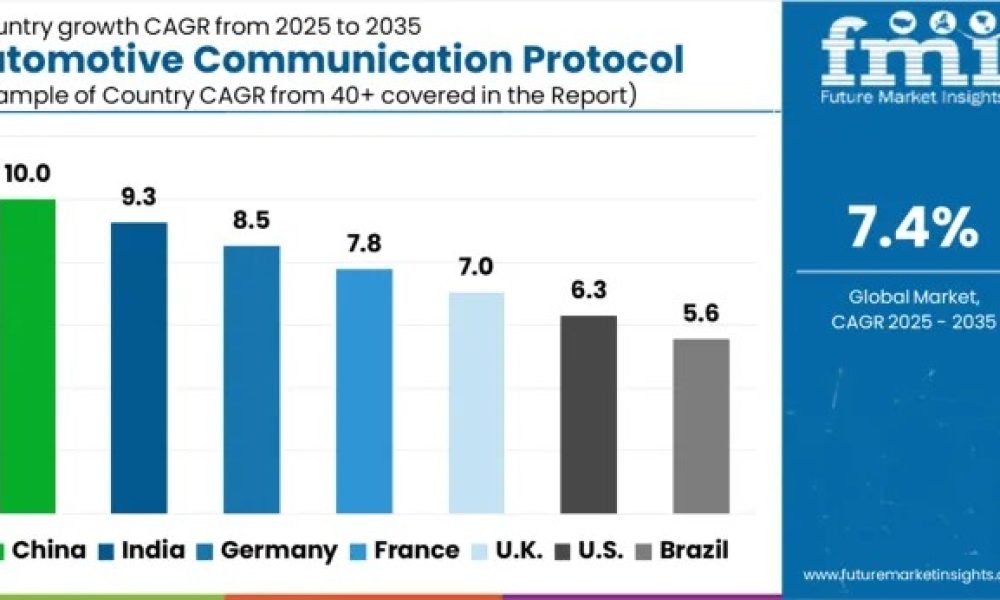
The global automotive communication protocol market is entering a phase of sustained expansion, driven by the rapid integration of electronic systems, software-defined vehicle architectures, and connected mobility technologies. Valued at USD 1.8 billion in 2025, the market is projected to reach USD 3.8 billion by 2035, registering a compound annual growth rate (CAGR) of 7.4% over the forecast period. This growth translates into an absolute dollar opportunity of USD 2.0 billion, underscoring the market’s strategic importance within the evolving automotive electronics ecosystem.
Automotive communication protocols form the backbone of in-vehicle data exchange, enabling seamless communication between electronic control units (ECUs), sensors, infotainment platforms, and safety systems. As vehicles increasingly rely on advanced driver assistance systems (ADAS), electrified powertrains, and real-time connectivity, the demand for reliable, scalable, and secure communication frameworks continues to intensify.
Steady Expansion with Clear Growth Breakpoints
Market analysis indicates a predictable and structured growth trajectory. From 2025 to 2028, the automotive communication protocol market expands from USD 1.8 billion to USD 2.1 billion, characterized by annual increases of approximately USD 0.1–0.2 billion. This phase represents a stable foundation period, allowing manufacturers and suppliers to optimize integration strategies, strengthen supply chains, and align protocol adoption with evolving vehicle architectures.
A more accelerated growth phase emerges between 2030 and 2035, during which the market grows from USD 2.6 billion to USD 3.8 billion, with annual increments averaging USD 0.3–0.4 billion. This later-stage expansion reflects rising deployment of data-intensive applications, including autonomous driving functions, vehicle-to-everything (V2X) communication, and advanced infotainment platforms. Companies positioned early to address these requirements are expected to capture substantial long-term value.
Get access to comprehensive data tables and detailed market insights — request your sample report today!
Controller Area Network (CAN) Maintains Market Leadership
By protocol type, Controller Area Network (CAN) remains the dominant segment, accounting for 34.6% of market revenue in 2025. CAN’s continued leadership is attributed to its proven reliability, cost efficiency, and robustness in real-time automotive environments. It is widely used in safety-critical applications such as engine control, braking systems, and airbag deployment, where deterministic communication and fault tolerance are essential.
Despite the emergence of high-bandwidth alternatives such as Automotive Ethernet, CAN continues to play a central role in vehicle architectures due to its extensive standardization, established diagnostic ecosystem, and interoperability across OEM platforms. Its balance of performance and cost ensures continued relevance, particularly in core control and body electronics systems.
Passenger Cars Drive Volume Demand
From a vehicle perspective, passenger cars account for 58.4% of automotive communication protocol market revenue in 2025, reflecting high production volumes and faster adoption of electronic innovations. Modern passenger vehicles integrate multiple communication networks to support infotainment, comfort features, safety systems, and connectivity services.
Competitive differentiation in the passenger car segment has accelerated the deployment of advanced communication frameworks to enable features such as over-the-air software updates, real-time diagnostics, predictive maintenance, and smartphone integration. These trends position passenger cars as the primary growth engine for protocol adoption throughout the forecast period.
Infotainment Systems Lead Application Adoption
By application, infotainment systems represent the largest segment, contributing 27.5% of market revenue in 2025. Infotainment platforms have evolved into central digital hubs that manage navigation, entertainment, communication, and vehicle settings, significantly increasing data transmission requirements.
High-resolution displays, voice recognition, cloud connectivity, and streaming services demand low-latency, high-reliability communication between subsystems. As automakers emphasize personalized, software-driven in-car experiences, infotainment systems continue to drive demand for advanced communication protocols capable of handling complex data flows without compromising safety or performance.
Regional Growth Anchored in Asia-Pacific, Europe, and North America
Geographically, Asia-Pacific, Europe, and North America remain the primary growth regions. China leads global expansion with a 10.0% CAGR, supported by large-scale adoption of connected and electric vehicles, intelligent transportation systems, and supportive government policies. India follows with 9.3% CAGR, driven by rising domestic vehicle production and increasing integration of standard protocols in connected and electric models.
In Europe, Germany records 8.5% CAGR, reflecting its strong automotive manufacturing base, emphasis on safety standards, and early adoption of autonomous and electrified vehicle technologies. The United States, expanding at 6.3% CAGR, remains a mature but resilient market, supported by steady demand for advanced automotive electronics and compliance-driven protocol upgrades.
Competitive Landscape Focused on Integration and Reliability
The automotive communication protocol market is characterized by intense competition among established semiconductor and automotive technology suppliers, including Bosch, Broadcom, Continental, Denso, Infineon, Kvaser, NXP Semiconductors, Onsemi, Renesas, and Texas Instruments. Market participants compete on protocol compatibility, data transfer performance, reliability under harsh automotive conditions, and compliance with global standards such as ISO 11898 and AUTOSAR.
Leading suppliers increasingly emphasize multi-protocol solutions, reference designs, and development kits to support flexible vehicle platforms and accelerate OEM integration. As vehicles transition toward software-defined and connected architectures, protocol interoperability, cybersecurity readiness, and scalability are becoming critical differentiators.
Outlook: Communication Protocols as Enablers of Next-Generation Mobility
The continued evolution of electric, connected, and autonomous vehicles positions automotive communication protocols as essential enablers of next-generation mobility. With predictable growth, rising absolute dollar opportunity, and expanding application scope, the market offers a compelling long-term outlook for stakeholders across the automotive electronics value chain.
As vehicles become more intelligent, connected, and software-driven, communication protocols will remain fundamental to ensuring performance, safety, and seamless user experiences—making this market a critical pillar of the future automotive ecosystem.
Why Choose FMI: Empowering Decisions that Drive Real-World Outcomes: https://www.futuremarketinsights.com/why-fmi
About Future Market Insights (FMI)
Future Market Insights, Inc. (FMI) is an ESOMAR-certified, ISO 9001:2015 market research and consulting organization, trusted by Fortune 500 clients and global enterprises. With operations in the U.S., UK, India, and Dubai, FMI provides data-backed insights and strategic intelligence across 30+ industries and 1200 markets worldwide.



