
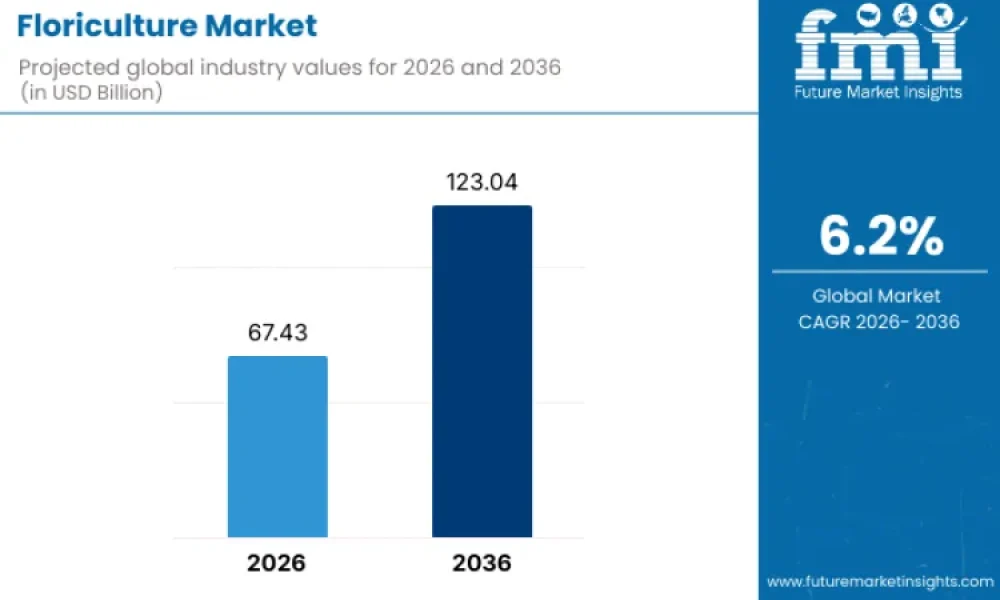
The global floriculture market is entering a decade of steady and opportunity-rich expansion, supported by lifestyle changes, urbanization, and continuous innovation in cultivation and supply chain technologies. Valued at USD 67.43 billion in 2026, the market is forecast to reach USD 123.04 billion by 2036, growing at a CAGR of 6.2%. This growth trajectory highlights strong prospects for both established industry leaders and new manufacturers seeking to expand their footprint, adopt advanced technologies, and build resilient global supply networks.
Market Growth Outlook and Demand Drivers
Floriculture demand is no longer limited to seasonal or ceremonial use. Flowers and ornamental plants are becoming an everyday lifestyle element across residential, commercial, and institutional spaces. Rising disposable incomes, expanding urban populations, and greater emphasis on aesthetics and wellness are driving year-round consumption.
Key demand contributors include:
- Increasing use of flowers in home décor, gifting, weddings, and corporate events
- Expansion of hospitality, retail complexes, airports, and urban landscaping projects
- Growth of online flower delivery platforms and subscription-based services
- Wider availability through organized retail and supermarket chains
Gain access to detailed segment-wise analysis and forecast statistics – Request the Sample Report Today
Supply-Side Innovation and Technology Expansion
On the supply side, the floriculture industry is undergoing structural transformation. Established players and emerging manufacturers alike are investing in:
- Protected cultivation and greenhouse farming
- Improved planting material and precision breeding
- Cold storage and temperature-controlled logistics
- Automation and digital supply chain systems
These advancements reduce post-harvest losses, improve quality consistency, and support long-distance exports. New entrants are leveraging modern greenhouse technologies to compete effectively, while large manufacturers are scaling operations through automation and vertical integration.
Key Market Takeaways
- Market Value (2026): USD 67.43 billion
- Forecast Value (2036): USD 123.04 billion
- Forecast CAGR (2026–2036): 6.2%
- Leading Product Type: Cut flowers (≈49% share)
- Leading Flower Type: Roses (≈46% share)
- Key Growth Regions: Europe, North America, Asia Pacific
Key Segments of the Floriculture Market
By Product Type
- Cut flowers
- Cut foliage
- Plants
- Propagation material
By Flower Type
- Rose
- Chrysanthemum
- Tulip
- Lily
- Gerbera
- Carnations
- Texas bluebell
- Freesia
- Hydrangea
- Other specialty flowers including orchids, gladiolus, alstroemeria, and snapdragons
By End Use
- Personal use
- Institutions and events
- Hotels, resorts, and spas
- Industrial landscaping
By Sales Channel
- Direct sales
- Specialty stores
- Franchises
- Florists and kiosks
- Supermarkets and hypermarkets
- Independent small stores
- Online retailers
- Corporate gifting services, subscription delivery, event planners, and wholesalers
By Region
- North America
- Latin America
- Europe
- South Asia
- East Asia
- Oceania
- Middle East and Africa
Product and Flower Type Leadership
Cut flowers dominate the global floriculture market, accounting for nearly 49% of total demand. Their popularity is driven by gifting culture, emotional purchasing behavior, high turnover rates, and strong export-oriented cold chain infrastructure.
Among flower types, roses lead with approximately 46% market share, supported by universal appeal, long vase life, color diversity, and consistent year-round demand. Roses remain central to both premium retail offerings and large-scale exports, reinforcing their commercial significance.
Regional and Country-Level Growth Highlights
The market reflects diverse growth patterns across countries:
- Netherlands (CAGR 5.8%) continues to dominate global trade through advanced greenhouse systems and auction-based exports.
- Colombia (7.1%) strengthens its export-driven position with sustainable practices and strong trade partnerships.
- United States (4.6%) maintains stability through domestic consumption and growing preference for locally grown flowers.
- India (8.7%) emerges as one of the fastest-growing markets, supported by urban demand and infrastructure investment.
- China (7.3%) expands rapidly due to urbanization, e-commerce growth, and greenhouse modernization.
- Germany, Japan, and Australia sustain steady growth through premium, sustainable, and quality-focused demand.
Competitive Landscape and Industry Players
The floriculture market competitive landscape blends scale-driven efficiency with innovation-led specialization. Leading players such as Forest Produce Ltd., Selecta Cut Flowers SAU, Native Floral Group, Tropical Foliage Plants Inc., and Oserian Group play a pivotal role in shaping supply chains, quality standards, and global availability.
At the same time, new and mid-sized manufacturers are entering the market with:
- Specialty and exotic flower varieties
- Organic and sustainable production models
- Digital-first retail and direct-to-consumer strategies
Established companies are investing in automation, breeding technologies, and logistics optimization, while newer players focus on agility, niche demand, and regional expansion. This dynamic mix continues to fuel innovation and healthy competition across the floriculture ecosystem.
Future Outlook
With rising lifestyle integration, expanding retail formats, and continuous technological advancement, the global floriculture market is well-positioned for sustained growth through 2036. Opportunities remain strong for manufacturers—both established and emerging—who invest in innovation, sustainability, and market expansion to meet evolving global demand.
Have a specific Requirements and Need Assistant on Report Pricing or Limited Budget please contact us – [email protected]
About Future Market Insights (FMI)
Future Market Insights, Inc. (FMI) is an ESOMAR-certified, ISO 9001:2015 market research and consulting organization, trusted by Fortune 500 clients and global enterprises. With operations in the U.S., UK, India, and Dubai, FMI provides data-backed insights and strategic intelligence across 30+ industries and 1200 markets worldwide.



