
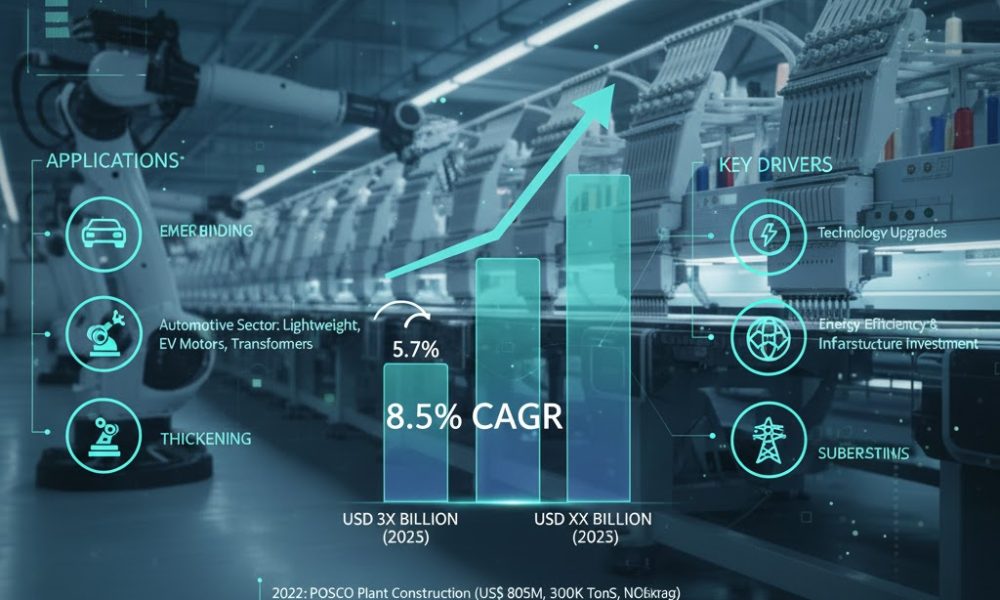
The global Electrical Steel Market is valued at approximately US$30.7 billion in 2024 and is projected to reach US$69.4 billion by 2034, growing at a CAGR of 8.5%.
Grain-Oriented Electrical Steel (GOES) accounts for ~55% of total revenue due to its dominance in transformer cores.
Non-Grain-Oriented Electrical Steel (NGOES) makes up ~45%, driven by increasing adoption in electric vehicle (EV) and industrial motor applications.
The growth is primarily fueled by rising electrification, renewable energy infrastructure, and industrial modernization. Global transformer demand alone represents ~40% of the electrical steel market.
2. Key Market Drivers
A. Electrification & Energy Efficiency
Energy losses in traditional transformers are 5–7%, and replacing or upgrading to electrical steel can reduce losses by up to 30%, driving adoption in transmission and distribution systems.
Urbanization and industrial expansion in Asia-Pacific are expected to contribute ~45% of global market growth by 2034.
To access the complete data tables and in-depth insights, request a Discount On The Report here: https://www.factmr.com/connectus/sample?flag=S&rep_id=2397
B. Electric Vehicle Revolution
Global EV production reached ~14 million units in 2024, expected to surpass 45 million by 2034.
NGOES consumption for EV motors is projected to grow at 11.5% CAGR, outpacing GOES due to high demand for high-efficiency, compact motor cores.
C. Renewable Energy Infrastructure
Wind and solar generation capacity is forecasted to grow at ~9% CAGR, driving demand for electrical steel in generator cores and inverters.
Electrical steel reduces core losses in wind turbines by up to 20%, improving energy conversion efficiency.
D. Grid Modernization & Smart Grids
Smart grid projects in North America and Europe are expected to require ~1.2 million tons of electrical steel by 2030.
Decentralized energy generation (microgrids, rooftop solar) is expected to increase NGOES usage by ~18% over the next decade.
3. Segmental Analysis
A. Product Type
GOES: Dominates transformer applications; projected revenue growth of 8% CAGR over 2024–2034.
NGOES: Primarily used in motors and industrial equipment; projected revenue CAGR of 10.5%.
High Silicon Steel: Niche applications expected to grow 12% CAGR, driven by high-performance motors.
B. Application
| Application | 2024 Market Share | 2034 Forecast | CAGR (%) |
|---|---|---|---|
| Transformers | 40% | 39% | 8% |
| Motors & Inductors | 35% | 38% | 10% |
| Generators | 15% | 13% | 7% |
| Appliances & Others | 10% | 10% | 6.5% |
Motors and inductors are the fastest-growing segment due to EV adoption and industrial automation.
Transformers continue to dominate revenue due to their volume and scale in power transmission networks.
4. Regional Insights
| Region | 2024 Market (US$B) | 2034 Forecast (US$B) | CAGR (%) |
|---|---|---|---|
| Asia-Pacific | 13.8 | 32.5 | 8.7 |
| Europe | 7.2 | 14.3 | 7.5 |
| North America | 6.1 | 13.0 | 8.9 |
| Middle East & Africa | 2.4 | 5.0 | 7.6 |
| Latin America | 1.2 | 4.6 | 11.0 |
Asia-Pacific leads due to industrial expansion, grid upgrades, and EV production.
North America benefits from renewable energy and modernization projects, while Europe faces competitive pressures from imports.
Latin America shows the highest CAGR due to infrastructure upgrades and renewable energy adoption from a low base.
5. Disruption Signals & Risks
Raw Material Volatility
Iron ore and alloy prices fluctuating by ±20% annually impact steel production costs.
Trade & Import Pressures
Cheaper imports from Asia are causing European producers to temporarily close plants, affecting supply chains.
Environmental & Decarbonization Regulations
Compliance costs for low-carbon steel production can increase operating costs by 5–8%, influencing competitiveness.
Supply Chain Bottlenecks
Manufacturing complexity and long lead times (up to 90 days) may delay projects and constrain growth.
6. Industry Scenarios
Scenario 1 — Sustained Electrification
Global electrical steel demand could reach US$70 billion by 2034 with 8–10% CAGR.
EV motor and renewable energy applications will account for ~55% of new demand.
Scenario 2 — Cost & Supply Headwinds
Persistent raw material volatility and trade tensions may slow growth to 6–7% CAGR, favoring vertically integrated producers.
Scenario 3 — Technological & Green Steel Innovation
Adoption of high silicon and AI-optimized steel production could increase margins by 5–7% while reducing losses by 15–20%.
7. Competitive Landscape
Leading global players include POSCO, Nippon Steel, Voestalpine, ArcelorMittal, JFE Steel, Thyssenkrupp, Novolipetsk Steel, and Cogent Power.
Strategic focus areas:
Advanced manufacturing technologies (automation, AI)
Diversification of production locations
Securing raw material supply
Energy-efficient and green steel products
8. Conclusion
The Global Electrical Steel Market is poised for robust growth with projected revenues of ~US$69.4 billion by 2034. Electrification, EV adoption, renewable energy, and grid modernization will drive high-demand segments like NGOES for motors and GOES for transformers. While risks such as raw material volatility and trade pressures persist, strategic investment, innovation, and adoption of green steel solutions will ensure sustained growth and market resilience.
Have a specific Requirements and Need Assistant on Report Pricing or Limited Budget please contact us – [email protected]
To View Related Report :
U.S. Electrical Steel Market https://www.factmr.com/report/us-electrical-steel-market
Europe Electrical Steel Market https://www.factmr.com/report/europe-electrical-steel-market
Demand for Grain Oriented Electrical Steel in USA https://www.factmr.com/report/united-states-grain-oriented-electrical-steel
Electronics and Electrical Ceramics Market https://www.factmr.com/report/electronics-and-electrical-ceramics-market



