
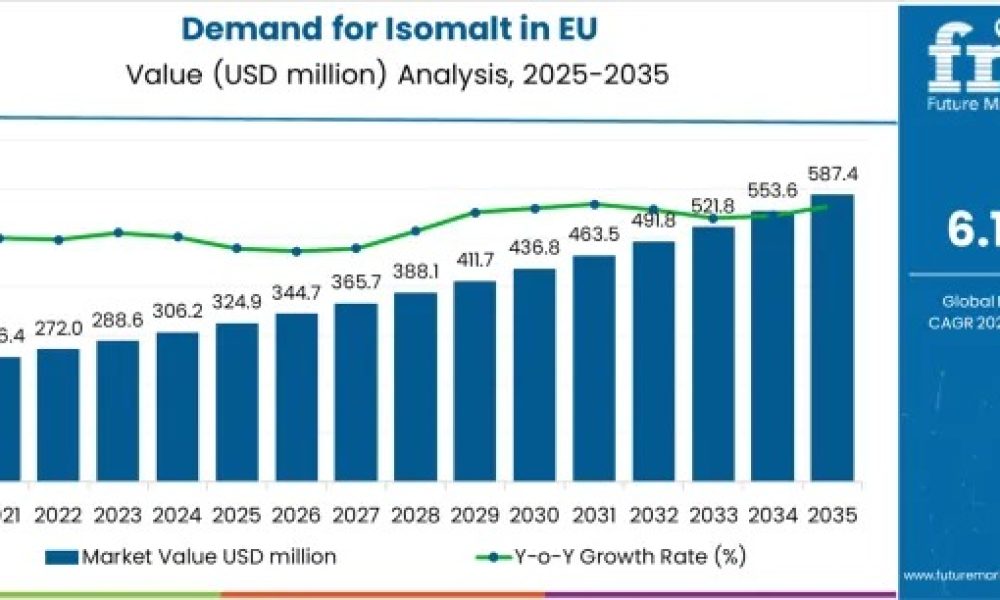
The EU isomalt market is entering a phase of sustained, structurally driven growth, supported by regulatory pressure on sugar reduction, rising health awareness, and expanding industrial applications. According to Future Market Insights (FMI), EU isomalt sales are projected to rise from USD 324.9 million in 2025 to approximately USD 587.4 million by 2035, registering an absolute increase of USD 262.3 million over the forecast period. This reflects total growth of 80.7% and a steady compound annual growth rate (CAGR) of 6.1% between 2025 and 2035, with the market expected to expand by nearly 1.8X in value.
This growth trajectory is being shaped by increasing consumer demand for sugar-free and reduced-calorie products, heightened awareness of dental health, a growing diabetic population across Europe, and rising adoption of isomalt in confectionery, pharmaceutical, and food manufacturing facilities. Isomalt’s unique ability to deliver sugar-like sweetness, functional performance, and health benefits positions it as a preferred polyol in modern reformulation strategies.
Get Exclusive Access To Data Tables, Market Sizing Dashboards, And Analyst Insights. Request Sample Report!
Between 2025 and 2030, EU isomalt demand is forecast to expand from USD 324.9 million to USD 436.8 million, generating USD 111.9 million in new value, equivalent to 42.7% of the decade’s total growth. This phase will be driven by accelerating sugar reduction initiatives, regulatory reformulation targets, and expanding availability of sugar-free confectionery, bakery, and pharmaceutical products. Manufacturers are increasingly incorporating isomalt to meet consumer expectations for healthier indulgence while maintaining taste, texture, and functionality.
From 2030 to 2035, sales are projected to increase further from USD 436.8 million to USD 587.4 million, adding USD 150.4 million and accounting for 57.3% of total forecast growth. This period will be defined by the expansion of sugar-free confectionery portfolios, deeper integration into functional and metabolic-health foods, and growing pharmaceutical use due to isomalt’s excellent compressibility for tablet manufacturing. Premium positioning based on its natural beet-sugar origin and clean-label appeal will further reinforce adoption.
Market Performance Snapshot
- EU Market Value (2025): USD 324.9 million
- Forecast Value (2035): USD 587.4 million
- Forecast CAGR (2025–2035): 6.1%
- Leading Product Type: Powder (70% share)
- Top Application: Confectionery (42%)
- Dominant Distribution Channel: Direct to Manufacturer (55%)
- Key Growth Countries: Germany, France, Italy
Why Demand for Isomalt Is Rising in the EU
Excessive sugar consumption remains a significant public health concern across Europe, prompting government-led sugar reduction policies, fiscal measures, and voluntary industry commitments. Consumers increasingly associate high sugar intake with obesity, diabetes, cardiovascular disease, and dental problems. Isomalt enables manufacturers to reduce calories by nearly 50% compared to sucrose while delivering non-cariogenic benefits that support dental health claims.
The expanding diabetic and pre-diabetic population further strengthens demand. Isomalt’s low glycemic index and minimal insulin response make it especially attractive for diabetic-friendly confectionery and specialty foods. At the same time, strong regulatory clarity from bodies such as EFSA, combined with scientific validation of isomalt’s safety and functional benefits, continues to encourage manufacturer adoption.
Segmental Insights Highlight Structural Strength
By product type, powder isomalt dominates with 70% share in 2025, supported by superior handling, storage stability, and suitability for automated industrial processing. Although syrup formats are gaining niche traction, powder remains the backbone of EU demand.
Confectionery applications account for 42% of total consumption, driven by sugar-free hard candies, chewing gum, medicated lozenges, and specialty products targeting health-conscious consumers. While its share gradually moderates as pharmaceutical uses grow faster, confectionery remains the largest application segment through 2035.
Direct-to-manufacturer distribution channels control 55% of sales, reflecting long-term supply contracts, technical collaboration, and quality assurance requirements among large food and pharmaceutical producers.
Country-Level Growth Patterns
Germany leads EU demand with a projected 6.5% CAGR, supported by its strong ingredient manufacturing base, advanced pharmaceutical sector, and established sugar-free confectionery brands. France and Italy follow closely with 6.3% and 6.2% CAGR, respectively, driven by expanding sugar-free categories and evolving consumer health awareness. The Netherlands benefits from food technology expertise and distribution hub status, while Spain shows steady progress as sugar-free categories mature.
Subscribe for Year-Round Insights → Stay ahead with quarterly and annual data updates.
Competitive Landscape
The EU isomalt market is moderately concentrated, led by specialized ingredient manufacturers with strong technical expertise. BENEO GmbH holds an estimated 24% share, followed by Cargill Inc. (10%) and Merck KGaA (8%), each leveraging production scale, regulatory expertise, and application support capabilities. Other players collectively account for nearly half of the market, reflecting opportunities for differentiation through organic certification, pharmaceutical-grade quality, and technical services.
About Future Market Insights (FMI)
Future Market Insights, Inc. (FMI) is an ESOMAR-certified, ISO 9001:2015 market research and consulting organization, trusted by Fortune 500 companies and global enterprises. With operations in the U.S., UK, India, and Dubai, FMI delivers data-backed insights and strategic intelligence across 30+ industries and more than 1,200 markets worldwide, enabling clients to make confident, future-ready decisions.



