
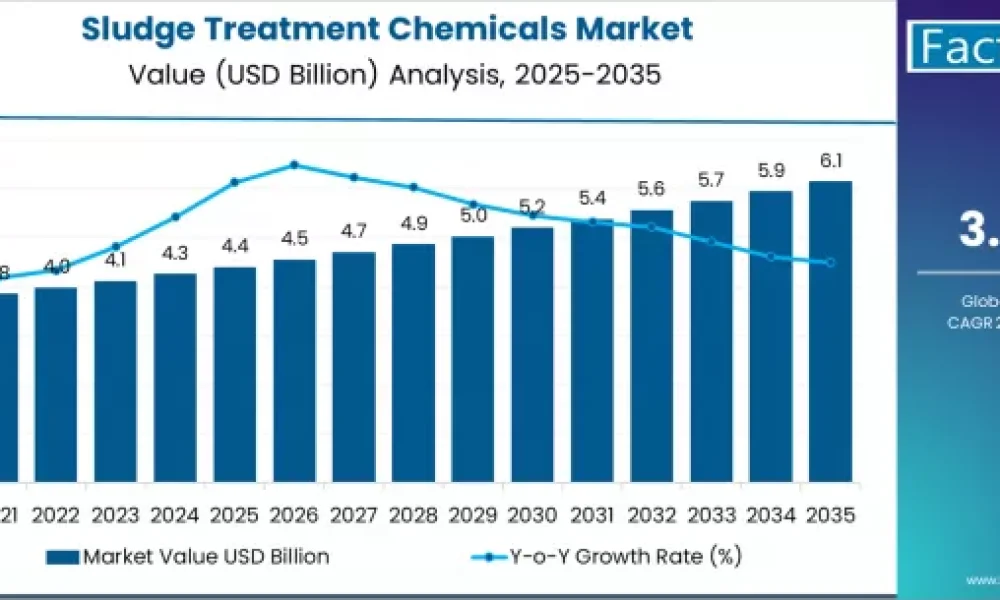
The global sludge treatment chemicals market is poised for significant expansion over the next decade as municipalities, industrial players, and wastewater management facilities increasingly adopt chemical solutions to enhance sludge dewatering, stabilization, and disposal. In 2026, the market is valued at USD 9.4 billion, and it is projected to reach USD 17.8 billion by 2036, reflecting an absolute increase of USD 8.4 billion over the forecast period. This growth corresponds to a compound annual growth rate (CAGR) of approximately 6.7% between 2026 and 2036, supported by expanding wastewater infrastructure, stringent environmental regulations, and rising emphasis on resource recovery from sludge.
Sludge treatment chemicals include a range of products such as coagulants, flocculants, conditioners, stabilizers, and odor control agents. These chemicals play a crucial role in facilitating efficient solid–liquid separation, reducing sludge volume, enhancing dewaterability, and controlling emissions, ultimately improving the performance and sustainability of wastewater and industrial waste treatment processes.
Quick Market Snapshot (2026–2036)
Market Value (2026): USD 9.4 billion
Market Forecast Value (2036): USD 17.8 billion
Market Forecast CAGR: 6.7%
Leading Chemical Type: Polymeric flocculants and coagulants
Key Applications: Municipal wastewater treatment, industrial effluent management, and biosolids processing
Key Growth Regions: Asia Pacific, North America, Europe
Primary Drivers: Rising wastewater generation, stringent discharge norms, investments in wastewater infrastructure, and focus on sludge minimization
To Access the Complete Data Tables & in-depth Insights, Request a Discount on this report: https://www.factmr.com/connectus/sample?flag=S&rep_id=7498
Market Overview
Sludge, a byproduct of wastewater treatment from municipal and industrial sources, poses significant challenges due to its high water content, organic load, and potential environmental impact. Effective sludge management is essential to comply with regulatory standards, minimize disposal costs, and reduce the environmental footprint of wastewater operations. Treatment chemicals serve as enablers for key processes such as coagulation, flocculation, stabilization, and dewatering, making them indispensable components of modern sludge treatment systems.
Among chemical types, polymeric flocculants and coagulants are expected to maintain strong demand due to their high efficiency in aggregating fine particles and enhancing solid separation. These polymers improve dewatering performance, reduce polymer consumption per unit of sludge processed, and support overall process cost optimization.
Key Demand Drivers
Expansion of Wastewater Infrastructure
Rapid urbanization, population growth, and industrialization are driving increased investments in wastewater collection and treatment facilities. Municipalities and industrial complexes are upgrading existing plants and building new infrastructure to manage rising volumes of sewage and process effluents. As a result, demand for sludge treatment chemicals is expanding in line with infrastructure development.
Stringent Environmental Regulations
Governments and regulatory authorities worldwide continue to enforce strict norms on wastewater discharge, sludge disposal, and reuse standards. These regulations mandate effective sludge treatment practices that reduce environmental contamination and protect public health. Compliance with such norms underpins steady adoption of advanced treatment chemicals that enhance process performance and regulatory compliance.
Focus on Resource Recovery and Sustainability
Sludge treatment is no longer limited to waste disposal; it has increasingly become a source for resource recovery. Technologies that extract energy, nutrients, and water from sludge are gaining traction. Chemical aids that improve dewatering, reduce organic load, and support anaerobic digestion are critical in this transition toward sustainable sludge management and circular economy objectives.
Industrial Wastewater Management Requirements
Industrial sectors such as pulp and paper, food and beverage, petrochemicals, textiles, and chemicals generate large volumes of wastewater and associated sludge with complex properties. Sludge treatment chemicals tailored to specific industrial effluents help meet effluent discharge standards, reduce treatment costs, and improve the operational efficiency of industrial wastewater plants.
Market Segmentation Insights
By Chemical Type
Polymeric Flocculants and Coagulants: Lead the market due to high performance in solid–liquid separation and dewatering enhancement
Inorganic Coagulants: Widely used for primary solid removal and pH adjustment
Conditioners and Stabilizers: Improve sludge handling, reduce odors, and enhance stabilization
Odor Control Agents: Important in biosolids storage and processing environments
Other Specialty Chemicals: Include nutrients, enzyme additives, and sludge drying agents
By Application
Municipal Wastewater Treatment: Largest application segment driven by expanding urban sewer systems and public infrastructure development
Industrial Effluent Treatment: Growing demand from manufacturing facilities and process industries with high wastewater load
Biosolids Management and Disposal: Increasing use in farms, land application sites, and renewable energy recovery systems
By End-User
Municipal Corporations and Water Utilities: Major consumers due to public service mandates
Industrial End Users: Including heavy manufacturing and process industries
Contract Waste Management Services: Outsourced sludge treatment providers that operate multiple facilities
Regional Demand Dynamics
Asia Pacific
Asia Pacific is expected to register the fastest growth rate through 2036, supported by rapid urbanization, government investments in sanitation and wastewater infrastructure, and heightened environmental awareness. Countries across the region continue to implement large-scale wastewater treatment projects and policy frameworks that encourage advanced sludge management practices.
North America
North America holds a significant market share thanks to well-established wastewater treatment infrastructure, stringent environmental regulations, and substantial funding for infrastructure upgrades. Technological adoption and process optimization investments further strengthen regional demand.
Europe
Europe’s mature regulatory environment, strong public investment in renewable utility projects, and emphasis on circular economy principles support steady adoption of sludge treatment chemicals. The region is also a leader in research and development for advanced treatment solutions.
Competitive Landscape Overview
The sludge treatment chemicals market is moderately competitive, featuring global chemical manufacturers, specialty treatment solution providers, and regional distributors. Companies are emphasizing product performance, environmental compliance, localized supply chains, and technical support to gain differentiation.
Innovation in chemical formulations, including biodegradable and low-impact polymers, eco-certified coagulants, and tailored additive blends for industrial effluent applications, is a key focus area. Strategic partnerships with municipal and industrial entities, along with sustainability-oriented product positioning, are shaping competitive dynamics.
Future Outlook
The sludge treatment chemicals market is expected to sustain robust growth through 2036 as global wastewater volumes continue to rise and treatment practices evolve toward efficiency and sustainability. Continued regulatory pressure, the need for cost-effective treatment solutions, and broader adoption of circular wastewater management frameworks will drive demand.
Emerging trends such as digital process monitoring, integrated chemical dosing systems, and customized treatment programs will further enhance the value proposition of sludge treatment chemicals, making them critical components of modern wastewater and environmental management strategies worldwide.
Have specific requirements or need assistance on report pricing or have a limited budget? Please contact [email protected]
About Fact.MR:
Fact.MR is a global market research and consulting firm, trusted by Fortune 500 companies and emerging businesses for reliable insights and strategic intelligence. With a presence across the U.S., UK, India, and Dubai, we deliver data-driven research and tailored consulting solutions across 30+ industries and 1,000+ markets. Backed by deep expertise and advanced analytics, Fact.MR helps organizations uncover opportunities, reduce risks, and make informed decisions for sustainable growth



