
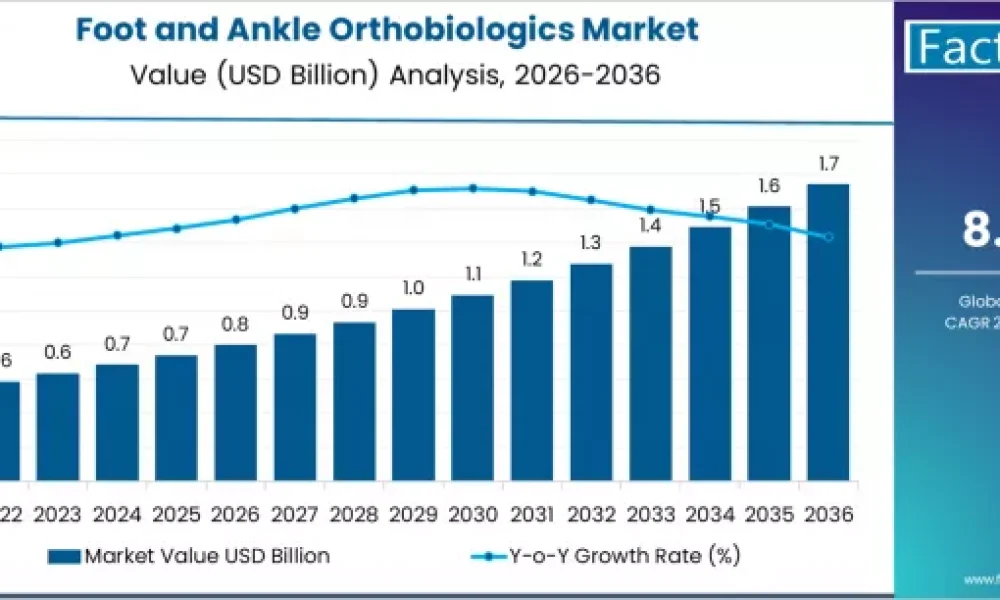
The global foot and ankle orthobiologics industry is entering a decade of accelerated growth, driven by rising surgical volumes, increasing sports-related injuries, and growing clinical adoption of regenerative therapies. The market is projected to expand from approximately USD 0.8 billion in 2026 to nearly USD 1.74 billion by 2036, registering a strong compound annual growth rate (CAGR) of 8.1% over the forecast period. This growth underscores the expanding role of orthobiologics in improving clinical outcomes for complex foot and ankle procedures.
Orthobiologics—encompassing bone graft substitutes, demineralized bone matrix (DBM), allografts, bone morphogenetic proteins (BMPs), and stem cell-based products—are increasingly preferred over traditional grafting techniques due to their ability to promote bone regeneration, enhance fusion rates, and reduce healing time. These advantages are particularly critical in foot and ankle surgeries, where limited blood supply and biomechanical stress can compromise recovery.
To access the complete data tables and in-depth insights, request a Discount On The Report here: https://www.factmr.com/connectus/sample?flag=S&rep_id=12834
Market Growth Drivers
A major growth catalyst is the rising prevalence of sports injuries and trauma cases, especially among younger and physically active populations. Foot and ankle injuries account for a significant share of orthopedic interventions globally, and orthobiologics are becoming integral in fracture repair, ligament reconstruction, and fusion procedures. Additionally, the global shift toward minimally invasive surgery has increased demand for biologic solutions that support faster healing and shorter hospital stays.
The aging global population is another key contributor. Degenerative conditions such as osteoarthritis, osteoporosis, and diabetic foot complications are increasing steadily, particularly in developed economies. Older patients often present with compromised bone quality, making orthobiologic solutions essential for improving surgical success rates and reducing revision procedures.
Product and End-Use Trends
By product type, biologics dominate the market, accounting for more than 63% of total revenue. Their strong clinical track record, versatility across procedures, and growing surgeon confidence have positioned them as the preferred option in foot and ankle reconstruction and fusion surgeries. Synthetic alternatives and next-generation regenerative platforms are gaining momentum but remain complementary to biologics in most clinical settings.
From an end-use perspective, hospitals account for over 63% of market demand, reflecting the complexity of foot and ankle surgeries and the need for advanced surgical infrastructure. Hospitals benefit from integrated surgical teams, access to advanced imaging, and higher patient throughput, making them the primary adopters of orthobiologic solutions. Specialty orthopedic clinics and ambulatory surgical centers are also increasing their uptake, particularly in elective and sports medicine procedures.
Regional Outlook
North America continues to lead the global market, supported by high procedural volumes, favorable reimbursement frameworks, and strong adoption of advanced orthopedic technologies. The United States alone is projected to grow at a CAGR of approximately 7.5%, driven by innovation, surgeon expertise, and established regulatory pathways.
Asia Pacific is expected to be the fastest-growing region, with countries such as India and China recording double-digit growth rates nearing 10% annually. Expanding healthcare infrastructure, rising awareness of regenerative medicine, and increasing access to orthopedic care are accelerating adoption. Urban centers across Asia are witnessing higher demand for advanced foot and ankle treatments, particularly in trauma and sports medicine.
Europe demonstrates steady growth, supported by structured healthcare systems and increasing emphasis on evidence-based regenerative therapies, especially in minimally invasive orthopedic surgery.
Competitive and Strategic Landscape
The market remains moderately consolidated, with approximately 30–60 active participants globally. Leading orthopedic companies continue to invest heavily in clinical research, surgeon education, and product innovation to strengthen their market positions. At the same time, emerging players are focusing on stem cell-based therapies, combination biologics, and point-of-care solutions to differentiate their offerings.
Strategic Implications
For industry stakeholders, sustained success will depend on continued R&D investment, expansion into high-growth emerging markets, and development of clinically validated, cost-effective solutions. Partnerships with hospitals, improved supply chain efficiency, and outcome-based evidence generation will be critical in supporting broader adoption and reimbursement.
Overall, the foot and ankle orthobiologics industry is set for long-term expansion through 2036, offering significant opportunities for innovation, market development, and strategic growth across global healthcare ecosystems.
Have a specific Requirements and Need Assistant on Report Pricing or Limited Budget please contact us – [email protected]
To View Related Report :
Foot Orthotic Insole Market https://www.factmr.com/report/4666/foot-orthotic-insoles-market
Foot & Ankle Trauma Market https://www.factmr.com/report/foot-ankle-trauma-market



