
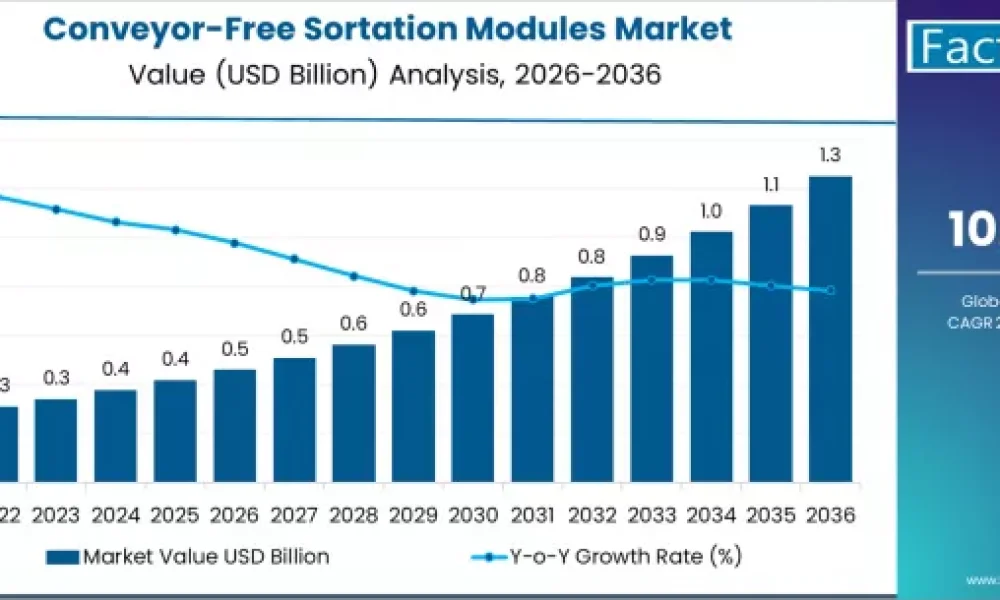
The global market for next-generation conveyor-free sortation modules is entering a decisive growth phase, supported by accelerating automation across logistics, e-commerce, and manufacturing operations. As supply chains evolve toward flexibility, speed, and resilience, conveyor-free sortation technologies are increasingly replacing traditional fixed conveyor systems. Between 2026 and 2036, the market is projected to more than double in value, expanding at a compound annual growth rate (CAGR) of approximately 10–11%, reflecting robust long-term demand for modular, intelligent material-handling solutions.
By 2026, global revenues for conveyor-free sortation modules are estimated at around USD 500 million. By 2036, revenues are forecast to reach approximately USD 1.3 billion, driven by rising order volumes, SKU proliferation, and the need for rapid fulfillment in omni-channel environments. Unlike conventional conveyor-based systems, conveyor-free modules offer scalability, reduced infrastructure costs, and the ability to adapt dynamically to changing operational requirements.
Innovation Catalysts Reshaping the Market
Technological innovation remains the primary catalyst for market expansion. Advanced artificial intelligence (AI) and machine vision systems are enabling real-time object recognition, adaptive routing, and higher sortation accuracy, even for irregularly shaped or mixed-size parcels. Autonomous mobile robots (AMRs) and swarm-based sortation architectures are increasingly deployed to improve throughput while minimizing manual intervention.
Another key trend is the development of modular and hybrid sortation architectures, which combine fixed robotic sortation cells with mobile robotic units. These systems allow facilities to scale capacity during peak demand periods without major infrastructure changes. As a result, operators can achieve higher asset utilization and faster return on investment (ROI), often within 24–36 months, compared to traditional conveyor installations.
Additionally, software-defined sortation platforms are gaining traction. These systems rely on advanced fleet-management software and data analytics to optimize routing, predict bottlenecks, and reduce downtime. The integration of warehouse management systems (WMS) and warehouse execution systems (WES) further enhances operational visibility and decision-making.
Regulatory Impact and Compliance Landscape
Regulatory frameworks are playing a growing role in shaping adoption. In developed markets, stricter workplace safety and ergonomics regulations are encouraging the deployment of conveyor-free systems that reduce repetitive manual labor and human-machine conflict zones. Collaborative robotics standards are accelerating certification and deployment of intelligent sortation modules designed to operate safely alongside human workers.
In parallel, government-led initiatives promoting industrial automation, smart manufacturing, and logistics modernization—particularly in Asia-Pacific regions—are boosting investments in advanced material-handling technologies. Incentives related to energy efficiency and reduced carbon footprints are also favoring conveyor-free systems, which typically consume less power and require fewer mechanical components than traditional conveyor lines.
Segmental and Regional Performance
From an application perspective, e-commerce and distribution centers represent the largest demand segment, accounting for an estimated over 50% of total market revenues by 2026. Rapid order fulfillment, same-day delivery expectations, and high return volumes are compelling retailers and third-party logistics providers to adopt flexible sortation solutions.
By system type, modular robotic sortation units dominate the market, holding an estimated around 60% share, due to their ease of deployment, scalability, and compatibility with both greenfield and brownfield warehouse environments.
Regionally, Asia-Pacific is expected to register the fastest growth, with annual growth rates exceeding 12% in some emerging economies, supported by expanding logistics infrastructure and manufacturing capacity. North America and Europe continue to show steady adoption, driven by retrofitting of existing facilities, labor shortages, and compliance with safety and automation standards.
Competitive Outlook and Future Trajectory
The competitive landscape is characterized by continuous innovation, strategic partnerships, and investments in AI-driven software platforms. Market participants are focusing on lowering total cost of ownership, improving system intelligence, and offering flexible deployment models, including service-based and subscription-driven solutions.
Looking ahead to 2036, conveyor-free sortation modules are expected to become a core component of next-generation warehouses and fulfillment centers. As supply chains prioritize agility, resilience, and data-driven operations, these systems will play a pivotal role in enabling faster, safer, and more sustainable logistics worldwide.
Have a specific Requirements and Need Assistant on Report Pricing or Limited Budget please contact us – [email protected]
To View Related Report :
Parcel Sortation Systems Market https://www.factmr.com/report/parcel-sortation-systems-market
Building Modules Market https://www.factmr.com/report/building-modules-market
Cut-Resistant High-Tenacity Blended Yarns Market https://www.factmr.com/report/cut-resistant-high-tenacity-blended-yarns-market
Beverage Packaging Equipment Market https://www.factmr.com/report/beverage-packaging-equipment-market



