
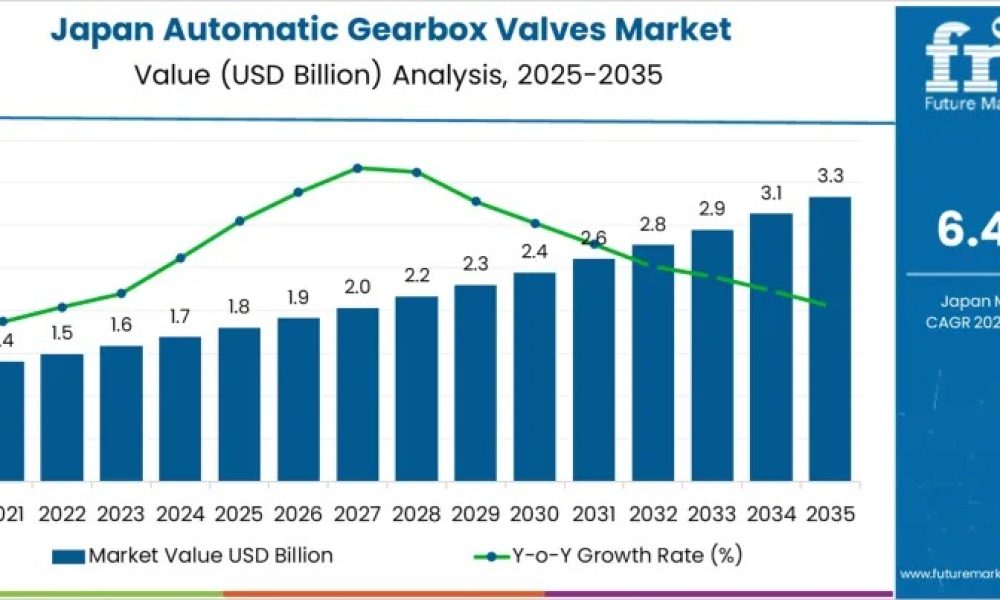
The automatic gearbox valves market in Japan is entering a sustained expansion phase, supported by stable domestic vehicle production, strong export-oriented manufacturing, and rising technical demands within modern transmission systems. In 2025, demand for automatic gearbox valves in Japan is valued at USD 1.8 billion and is forecast to reach USD 3.3 billion by 2035, growing at a compound annual growth rate (CAGR) of 6.4% over the forecast period.
Automatic gearbox valves are critical components within hydraulic and electro-hydraulic transmission systems, governing pressure modulation, torque regulation, and precise gear actuation. Their role is becoming increasingly central as Japanese automakers refine shift quality, fuel efficiency, and drivability across compact, mid-size, and hybrid vehicle platforms.
Stable Early Growth Anchored in Transmission Output
Between 2020 and 2025, market growth followed a disciplined and predictable trajectory, rising from approximately USD 1.3 billion to USD 1.8 billion. This period was characterized by steady year-on-year increments of around USD 0.1 billion, reflecting consistent automatic transmission penetration rather than cyclical volatility. Demand closely tracked OEM production schedules, underscoring the structural stability of gearbox valve consumption in Japan.
Unlike discretionary automotive components, gearbox valves are embedded deep within transmission architectures and are therefore insulated from short-term aftermarket swings. This stability is further reinforced by Japan’s long-standing preference for automatic and continuously variable transmissions in passenger vehicles.
Get access to comprehensive data tables and detailed market insights – request your sample report today!
Post-2030 Acceleration Linked to Hybrid Complexity
From 2025 onward, the market enters a higher-growth phase, with annual value additions approaching USD 0.2 billion after 2030. This acceleration is driven less by unit vehicle growth and more by increasing transmission complexity. Hybrid vehicles account for the largest installed base of automatic gearbox valves, as they require intricate coordination between electric motors and internal combustion engines.
Hybrid drivetrains rely heavily on advanced hydraulic control systems to manage torque blending, regenerative braking, and multi-speed gear transitions. As a result, valve density per gearbox increases, raising both component value and technical requirements. While battery electric vehicles reduce transmission diversity, Japan’s export-driven vehicle production and extended aftermarket servicing cycles continue to support steady demand for gearbox valves.
Automatic Transmissions and Passenger Vehicles Dominate Demand
Automatic transmissions represent 58% of total gearbox valve demand in Japan, reflecting their widespread adoption across passenger vehicles. Urban driving conditions in major metropolitan areas such as Tokyo, Yokohama, and Osaka favor automatic gearboxes due to frequent stop-and-go traffic, reinforcing long-term demand for precision hydraulic control components.
By vehicle type, passenger cars account for 62% of total demand, driven by consumer preferences for comfort, smooth shifting, and fuel efficiency. Continuous innovation in hybrid and fuel-efficient passenger vehicles further sustains valve demand, as these platforms integrate more sophisticated transmission control systems.
Manufacturing Precision and Design Innovation Shape the Market
Japanese gearbox valve suppliers are increasingly focused on technical differentiation rather than volume expansion. Competitive strategies center on miniaturized solenoids, tighter machining tolerances, and integrated electro-hydraulic control units. Valve bodies are evolving toward compact, lightweight aluminum housings with hardened steel internals, improving durability while supporting space-constrained transmission designs.
Automation in valve assembly, higher in-line inspection standards, and long-term platform supply agreements are becoming standard across OEM programs. These measures help suppliers manage cost pressures associated with precision machining, surface finishing, and heat treatment, while ensuring delivery reliability through extended vehicle production cycles.
Tailor Your Solution: Request Customization for Your Unique Needs!
Regional Growth Led by Kyushu and Kanto
Regional demand patterns reflect Japan’s automotive manufacturing geography. Kyushu & Okinawa lead market growth with an 8.0% CAGR, supported by expanding vehicle assembly operations and strong regional supply chains. Coastal operating conditions in this region also increase replacement demand for corrosion-resistant gearbox components.
The Kanto region follows with a 7.3% CAGR, driven by dense clusters of automotive OEMs and Tier-1 suppliers focused on advanced transmission systems for hybrid and fuel-efficient vehicles. Kinki and Chubu regions record CAGRs of 6.4% and 5.7%, respectively, supported by established industrial ecosystems and ongoing transmission innovation. Tohoku and the rest of Japan show moderate but stable growth, underpinned by fleet maintenance and replacement demand.
Competitive Landscape Anchored by Global and Domestic Leaders
The competitive environment is shaped by a mix of global transmission specialists and domestic precision manufacturers. Key players include BorgWarner, Atsumitec, Avex, Hikari Seiko, and Bosch GmbH. These companies leverage long-standing relationships with Japanese automakers, combining global engineering expertise with localized manufacturing and customization.
Competition increasingly centers on durability, contamination resistance, sensor integration, and compatibility with low-viscosity transmission fluids used in next-generation gearboxes. Suppliers that can align advanced valve design with Japan’s rigorous quality standards and long platform lifecycles are best positioned to capture sustained growth through 2035.
Outlook: Technically Driven Growth with Low Volatility
Overall, the Japan automatic gearbox valves market presents a profile of technically driven expansion with low downside volatility. Growth is underpinned by predictable transmission output, rising hybrid complexity, and continuous refinement of automatic gearbox performance. While electrification introduces long-term structural shifts, hybrid dominance and export-oriented production ensure that automatic gearbox valves remain a critical and resilient component category within Japan’s automotive ecosystem.
As transmission architectures evolve toward higher efficiency and tighter control, gearbox valves will continue to gain strategic importance—supporting a decade of measured, high-confidence growth for suppliers aligned with Japan’s advanced mobility roadmap.
Why Choose FMI: Empowering Decisions that Drive Real-World Outcomes: https://www.futuremarketinsights.com/why-fmi
About Future Market Insights (FMI)
Future Market Insights, Inc. (FMI) is an ESOMAR-certified, ISO 9001:2015 market research and consulting organization, trusted by Fortune 500 clients and global enterprises. With operations in the U.S., UK, India, and Dubai, FMI provides data-backed insights and strategic intelligence across 30+ industries and 1200 markets worldwide.



