
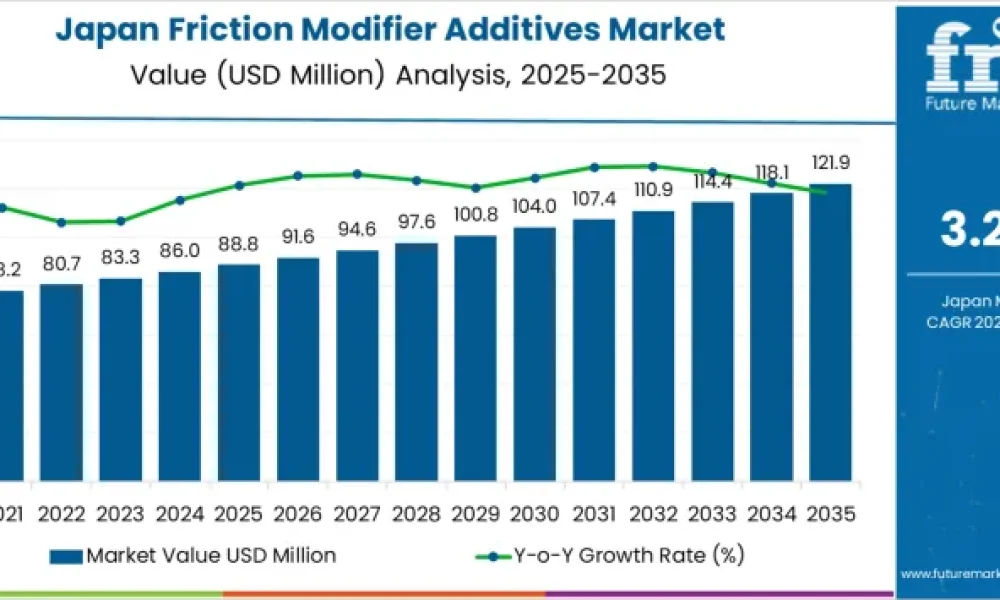
The Japan friction modifier additives market is entering a decisive growth phase, projected to expand from an estimated US$ 780 million in 2024 to nearly US$ 1.2 billion by 2034, registering a steady compound annual growth rate of approximately 4.3% over the forecast period. This growth is fueled by Japan’s automotive efficiency mandates, rising electric vehicle adoption, and increasing demand for advanced lubricants that enhance fuel economy, reduce emissions, and extend engine life.
As Japan strengthens its position as a global leader in sustainable mobility and industrial efficiency, friction modifier additives are becoming indispensable components across automotive lubricants, industrial oils, and emerging EV drivetrain systems.
Key Market Insights at a Glance
Friction modifier additives play a critical role in reducing surface friction and wear, directly contributing to lower energy losses and improved mechanical performance. In Japan, stricter fuel economy standards and carbon neutrality targets for 2050 are accelerating adoption across passenger vehicles, commercial fleets, and high-precision industrial machinery. OEMs and lubricant formulators are increasingly prioritizing additives that deliver measurable efficiency gains without compromising durability.
Segment Overview
Organic friction modifiers currently dominate the Japanese market due to their superior compatibility with modern engine oils and environmentally favorable profiles. Molybdenum-based additives continue to see strong uptake in high-performance and heavy-duty applications, particularly in commercial vehicles and industrial equipment. The passenger vehicle segment remains the largest end-use category, while electric and hybrid vehicles are emerging as high-growth application areas as Japan’s electrification roadmap advances.
Regional Overview
Japan’s friction modifier additives market benefits from a highly integrated automotive and manufacturing ecosystem. Major industrial hubs such as Kanto, Chubu, and Kansai account for the majority of consumption, supported by dense clusters of OEMs, lubricant blenders, and chemical manufacturers. The country’s emphasis on precision engineering and long-term asset reliability further reinforces consistent demand across regions.
Competitive Landscape
The competitive environment is characterized by strong technological differentiation and long-term supplier relationships with automotive OEMs. Leading players focus on formulation innovation, performance validation, and regulatory compliance. Strategic collaborations with lubricant manufacturers and investments in R&D facilities within Japan are strengthening market positioning and accelerating time-to-market for next-generation additives.
To access the complete data tables and in-depth insights, request a sample report here
Market Outlook: Powering the Next Decade
Looking ahead, the Japan friction modifier additives market is set to benefit from the convergence of sustainability, electrification, and performance optimization. Advanced additive solutions designed for low-viscosity lubricants, hybrid powertrains, and EV gear systems are expected to unlock new revenue streams. Digital formulation tools and AI-driven testing are further enhancing product efficiency, reducing development cycles, and improving customization for OEM requirements.
Key Players of Sustainable Label Industry
Prominent companies shaping the Japan friction modifier additives landscape include BASF SE, Lubrizol Corporation, Afton Chemical, Infineum International, Croda International, Vanderbilt Chemicals, and LANXESS AG. These players continue to invest in sustainable chemistry, low-ash formulations, and bio-based alternatives to align with Japan’s environmental objectives.
Recent Strategic Developments
Recent years have seen increased investment in local production capabilities, long-term supply agreements with Japanese automakers, and the introduction of friction modifiers optimized for hybrid and electric drivetrains. Several manufacturers have also expanded their portfolios to include environmentally friendly additives that comply with evolving regulatory frameworks while delivering superior performance.
With efficiency, sustainability, and innovation at its core, the Japan friction modifier additives market is well-positioned to power the nation’s next decade of mobility and industrial advancement.
Have a specific Requirements and Need Assistant on Report Pricing or Limited Budget please contact us – [email protected]
About Future Market Insights (FMI)
Future Market Insights, Inc. (FMI) is an ESOMAR-certified, ISO 9001:2015 market research and consulting organization, trusted by Fortune 500 clients and global enterprises. With operations in the U.S., UK, India, and Dubai, FMI provides data-backed insights and strategic intelligence across 30+ industries and 1200 markets worldwide.
Why Choose FMI: https://www.futuremarketinsights.com/why-fmi



