
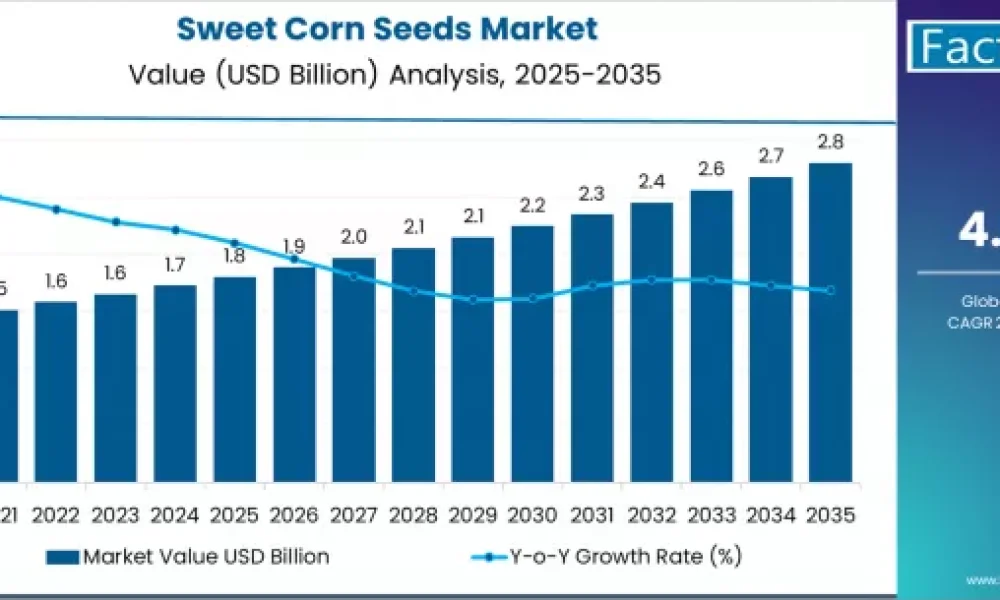
The global sweet corn seeds market is poised to enter a significant growth phase over the next decade, driven by rising food demand, accelerating adoption of advanced agricultural technologies, and expanding applications across both conventional and sustainable farming systems. The market is expected to expand from an estimated USD 1.8 billion in 2025 to approximately USD 2.8 billion by 2035, reflecting a steady compound annual growth rate (CAGR) of around 4.5 % over the forecast period.
This growth trajectory underscores the evolving role of seed genetics, crop optimization, and precision agriculture in shaping the future of sweet corn cultivation worldwide.
Market Dynamics: Demand Drivers and Growth Catalysts
The sweet corn seeds market is benefiting from multiple converging drivers that support both short‑term acceleration and long‑term expansion. At the core of this growth narrative are global food security challenges and population expansion, which have heightened demand for high-yielding and resilient crop varieties. With the global population expected to continue rising in the coming decade, the need for more productive and reliable seed solutions has never been more critical — particularly in staple food crops like corn.
Among the primary demand drivers:
Food Consumption and Nutrition Trends: Sweet corn remains a key component of human diets across many regions. Increasing consumer preference for quality produce, including fresh and processed sweet corn products, is fueling demand. Food applications are currently the largest end-use segment, accounting for more than half (approx. 54 %) of total market consumption.
Agricultural Modernization: The rising adoption of mechanized farming systems, GPS-enabled precision agriculture, and data-driven crop management platforms is boosting the uptake of advanced hybrid seeds. These technologies enable farmers to optimize planting, fertilization, and yield outcomes with greater efficiency.
Climate and Environmental Pressures: Variable weather patterns and increasing incidences of drought and heat stress have created urgency for seeds that can withstand environmental challenges. Climate-adaptive and drought-tolerant seed variants are becoming essential in many regions, enhancing resilience and reducing crop risk.
Hybrid Seed Preference: Hybrid varieties dominate the market with a commanding share of around 64 %, largely due to their superior yield potential, uniformity, and agricultural performance. These characteristics make hybrid seeds the preferred choice for commercial growers focused on maximizing output per hectare.
To access the complete data tables and in-depth insights, request a Discount On The Report here: https://www.factmr.com/connectus/sample?flag=S&rep_id=399
Technology & Innovation: Shaping the Future
The coming decade will see a deepening integration of seed genetics with precision and digital agriculture technologies — an evolution that is redefining seed value propositions beyond traditional performance metrics.
Key innovation trends in the market include:
Advanced Breeding Techniques: Seed developers are leveraging marker-assisted selection, genomic improvements, and trait stacking to enhance yield, stress tolerance, and disease resistance. This science-driven approach is central to delivering next-generation sweet corn seeds.
Climate-Resilient Genetics: As climate pressures mount globally, breeding programs are increasingly prioritizing traits that enable crops to thrive under abiotic stress — a critical differentiator in both developed and emerging markets.
Integration with Agritech Platforms: Precision agriculture tools — including variable rate planting, soil mapping, and predictive analytics — are being integrated with seed selection to enhance decision-making and optimize outcomes. Digital seed catalogs, AI-guided advisory services, and mobile apps are also improving farmer access and adoption.
Organic and Specialty Seeds: The rise of organic farming and non-GMO preferences among conscious consumers has stimulated demand for open-pollinated and specialty sweet corn seeds. These varieties appeal to growers targeting premium, sustainable, and eco-focused market segments.
Segment Insights & Market Structure
A clear segmentation of the sweet corn seeds market highlights diverse growth pockets and specialized demand:
By Trait Type:
Hybrid Seeds: Command a majority share (≈64 %) due to their higher yield and uniform crop characteristics.
Open-Pollinated Seeds: Account for the remaining share and cater primarily to organic, sustainable, and specialty farming operations.
By End Use:
Food Applications: Lead the market with significant share, reflecting strong demand from fresh markets, processed foods, and vegetable supply chains.
Fodder/Feed: Represent a robust segment driven by livestock and dairy farming growth.
Industrial Uses: Include biofuel, starch, and specialty processing applications.
Distribution Channels:
Agri-Retailers: Dominant channels providing direct access to farmers with advisory support.
Cooperatives & Digital Platforms: Emerging channels that widen market reach and strengthen farmer engagement.
Geographic Outlook: Regional Growth Leaders
The sweet corn seed market is shaped by geographic dynamics, with certain regions poised to lead growth due to advanced agriculture systems and progressive seed adoption.
North America: Particularly the United States, leads global growth with a strong emphasis on innovation, technology adoption, and extensive farming infrastructure. The U.S. market is characterized by high hybrid seed utilization and robust supply networks.
Western Europe: Countries like Germany, France, and the UK demonstrate steady demand backed by sustainable agriculture practices, specialty food markets, and regulatory support for advanced crop genetics.
East Asia: Nations including Japan and South Korea are leveraging precision agriculture and climate-adapted seed technologies to enhance productivity and resilience under diverse environmental conditions.
Emerging Markets: Mexico and other developing economies are rapidly modernizing their agriculture sectors, offering fertile ground for sweet corn seed adoption through improved access and localized seed development.
Competitive Landscape & Strategic Imperatives
The global sweet corn seeds market remains moderately consolidated, with multinational agribusinesses dominating the competitive landscape. These players continue to invest significantly in R&D, trait innovation, and global distribution networks to maintain leadership and expand market share.
To succeed in this evolving environment, industry stakeholders are prioritizing:
Integrated seed solutions that combine genetics with agronomic guidance.
Climate-ready portfolios that address regional stress factors.
Farmer education and extension services to improve adoption rates.
Sustainability-oriented offerings that align with organic and non-GMO consumer trends.
Challenges & Market Restraints
Despite robust growth prospects, the sweet corn seeds market faces challenges that must be navigated carefully. High cost barriers associated with premium hybrid seeds can limit adoption among smallholder farmers, especially in cost-sensitive emerging markets. In addition, regulatory complexities surrounding genetically modified organisms (GMOs) and local seed policies continue to influence market penetration strategies and product approvals in certain regions.
Strategic Outlook: 2026‑2036
As the market advances toward 2036, sweet corn seeds are expected to transition from commodity genetics to integrated crop optimization systems — defined by data analytics, climate resilience, and enhanced performance attributes. Market growth will increasingly align with global efforts to ensure food security, sustainable agriculture, and efficient resource utilization.
For investors, agribusiness stakeholders, and policymakers alike, the message is clear: innovation in seeds is foundational to future agricultural productivity and resilience — and the sweet corn seeds market sits at an intersection of opportunity, technology, and global food systems transformation.
Have a specific Requirements and Need Assistant on Report Pricing or Limited Budget please contact us – [email protected]
To View Related Report :
USA Sweet Corn Seeds Industry Analysis https://www.factmr.com/report/usa-sweet-corn-seeds-industry-analysis
Sweet Potato Flour Market https://www.factmr.com/report/sweet-potato-flour-market
Sweet Protein Extracts Market https://www.factmr.com/report/sweet-protein-extracts-market
Sweet Potato Fries Market https://www.factmr.com/report/sweet-potato-fries-market



