
The 2025 edition of Bienalsur, a sweeping international contemporary art project, has touched down in over 70 cities across five continents, with its Italian chapter presenting a powerful critique of anthropocentrism. Curated by Benedetta Casini, the overarching theme “Invocation” features multiple visual arts exhibits, including the profound installation “Devenir animal” (To Become Animal) at the Fabbrica del Vapore in Milan. This ambitious collection of works by a diverse group of international artists seeks to dismantle the conventional human perspective, proposing a radical shift in how we perceive and interact with other species. The exhibit operates not as a mere collection of animal-themed art, but as a deliberate philosophical provocation that reinterprets the boundaries between man and beast, challenging the very notion of human exceptionalism that has dominated Western thought since the Enlightenment.
This edition of Bienalsur, which has expanded its reach to 140 venues worldwide, leverages its global platform to initiate a dialogue that is both culturally specific to its locations and universally relevant to the growing ecological and ethical crises. The Italian segment, particularly the Milan exhibition, is framed as a crucial interrogation of established hierarchies. Casini’s curatorial project reflects a growing academic and artistic movement that questions the dominion humans have exerted over the natural world, urging a re-evaluation of shared biological existence. The artists—Marta Roberti (ITA), Lia Chaia (BRA), Elena Mazzi (ITA), Bruna Esposito (ITA), Gaia De Megni (ITA), Helena Hladilová (CZE/ITA), Valentina Furian (ITA), Bekhbaatar Enkhtur (MNG/ITA), Jonathas de Andrade (BRA), Calixto Ramirez (MEX), Michela de Mattei (ITA), Allora & Calzadilla (USA/CUB) and Carla Grunauer (ARG)—hail from various continents, ensuring the critique is multinational and multifaceted.
Philosophical Underpinnings of a Shifted Perspective
The curatorial framework for “Devenir animal” draws heavily on contemporary philosophical and anthropological thought. Casini explicitly cites the Amerindian perspectivism theorized by Eduardo Viveiros de Castro, a concept central to the exhibition’s intellectual foundation. This perspective posits that every living being perceives itself as “human” (in its own context) and perceives others as “animals” or “predators.” As Casini articulated, if we see the jaguar as an animal, the jaguar, in its own ontological framework, views us as another species within its experiential realm, perhaps even as potential prey. The exhibit seeks to compel the human spectator to momentarily adopt this non-human gaze, moving beyond rational, human-centric models of interaction. The artists collectively explore processes of mutation and hybridization with animal species, either by inverting the visual perspective or by problematizing the deep-seated power dynamic inherent in humanity’s desire to domesticate and control the animal kingdom. Casini notes that the works either encourage the viewer to look at the world as if they were an animal, striving to break free from the rational, human-centered outlook, or they analyze the relationship of power and the deep-seated desire to domesticate the other.
The Inversion of Sight: Who is Watching Whom?
The exhibit immediately sets its challenging tone with the Italian artist Bruna Esposito’s series of photographs, Eye. Upon entering the gallery space, the viewer encounters enlarged images of the eyes of dead fish. Esposito manipulates the images to render the fish pupils uncannily similar to those of humans. This visual strategy is explained by Casini as an inversion of the gaze: fish, unlike humans, do not have eyelids, meaning they continue to “observe” even after death. This work flips the customary script where humans gaze into aquariums or the sea to study other life forms. Instead, the viewer is confronted by the silent, perpetual stare of the deceased subject, making the human the object of observation and initiating the process of surrendering the privileged perspective. As Casini notes, this work was deliberately chosen to open the show because it reverses the common power dynamic of looking: “We are the ones being looked at.”
Gaia De Megni’s installation, featuring two perfect spheres engraved with the unsettling line, “The night I don’t know if it’s sky or sea,” introduces a cognitive dissonance rooted in animal perception. These spheres, made of stones from Italy’s Liguria region, quote the Genoese poet Edoardo Firpo, whose verses describe the Heron’s difficulty in distinguishing the horizon at night. The bird, characteristic of the Ligurian coast, struggles because the black sky reflects perfectly on the sea, complicating its hunt for food. The poem paints a poignant scene: sailors must throw bread near the shore to attract fish to the surface, aiding the Heron which waits, thinking, “At night, I don’t know if it’s sky or sea.” De Megni’s work forces the viewer to inhabit a sensory world where the fundamental visual boundaries that humans take for granted—the line between air and water, between cosmos and liquid—dissolve, illustrating the precariousness and distinct nature of non-human reality.
Embodying the Other: Metamorphosis and Mortality
Several artists explore the visceral act of physical transformation and integration with animal forms, blurring the lines of morphology. Elena Mazzi’s photographs and sculptures from the series Becoming with and unbecoming with incorporate whale skeletons into the artist’s own body, suggesting a literal, if temporary, metamorphosis. By using the skeletal structure, Mazzi engages with the deepest, most permanent biological trace of the non-human. Similarly, Carla Grunauer’s drawing presents a figure, initially human, whose vertebrae are depicted in a state of mutation, visibly shifting away from the hominid form. This focus on osseous and dermal shifts continues with Calixto Ramírez, whose photo features a hand covered in serpent skin, directly invoking the possibility of an ongoing, evolutionary mutation and the primal allure of sloughing off the human condition. Lia Chaia contributes to this exploration with self-portraits alongside false animals, using tender interaction with the inanimate to explore the human need for connection and projection onto the animal form, whether real or fabricated.
Other works explore the fusion of forms metaphorically. Marta Roberti’s drawing depicts two sisters and a snake in a process of fusion, a classical image of transformation and wisdom, while Helena Hladilová creates a complex sculpture—part tortoise, part hand, part spider—ascending a wall, embodying a grotesque yet organic hybridity. These pieces collectively suggest that the boundary of the human body is neither fixed nor sacrosanct, but porous and subject to the logic of the non-human organism.
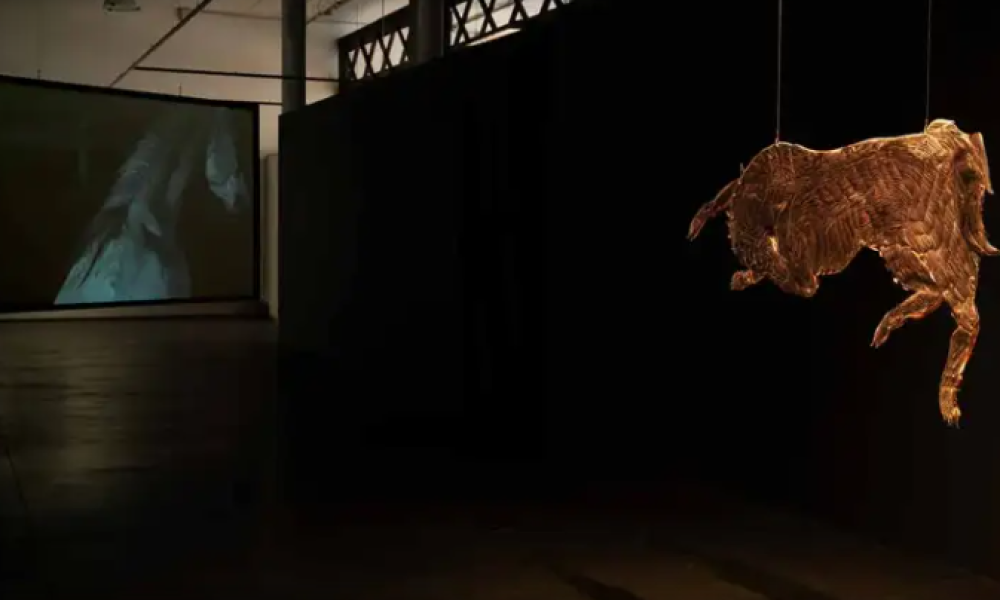
Mongolian artist Bekhbaatar Enkhtur’s sculptures, crafted from copper and beeswax, further this exploration through the lens of myth and legend. His organic, zoomorphic forms—wolves, birds, dragons, and horses—emerge from Mongolian narratives. His work argues that transformation is the essential condition of existence, where form and meaning change over time, but the underlying essence persists, tying human identity to the primordial spirit of the animal world. His sculptures stand before Valentina Furian’s installation, which creates a participative experience where the viewer can momentarily become a centaur. A hanging screen projects images of a white horse; a person standing behind the film completes the mythological figure, their human legs becoming the horse’s lower half. This ingenious setup allows the viewer an embodied, performative engagement with hybridity, moving beyond passive observation into active participation in the “becoming animal.”
The Persistence of the Extinct and the Limits of Communication
The human tendency to deny extinction and project desire onto the absent is documented in Michela de Mattei’s work. She presents a series of photos treated like “scratch cards,” documenting alleged sightings of the Tasmanian tiger (thylacine), an animal officially declared extinct in 1936 due to hunting and habitat destruction following British colonization. De Mattei explores the collective human will to believe, showing how denial operates as a potent mechanism against the finality of loss. These persistent community sightings underscore the enduring imaginative presence of a vanished species, a refusal to accept the ecological impact of human activity. The artist materializes these “fugitive presences,” exploring the human mechanisms of desire and projection, and the psychological denial of extinction as a concept.
Perhaps the most potent critique of human communication is delivered in The Great Silence by the renowned artistic duo Allora & Calzadilla. This film is set at the now-deactivated Arecibo Radio Telescope in Puerto Rico, a monumental symbol of humanity’s search for extraterrestrial life. This technological behemoth shares its landscape with the last remaining population of the critically endangered white-crowned Amazon parrot. The film, using a science fiction narrative written by Ted Chiang and presented as subtitles, gives voice to the parrot itself. The bird employs the concept of vocal learning—a skill shared by humans, parrots, and some other species—to deliver a damning indictment of humanity’s priorities. The parrot questions why humans are so determined to establish dialogue with beings light-years away while making no serious effort to communicate with the other, intelligent life forms they share the planet with. The film foregrounds the “great silence” not in the cosmos, but in our terrestrial indifference, criticizing the technological arrogance that prioritizes the abstract possibility of distant life over the concrete reality of life currently facing extinction on Earth.
Empathy and Ritual: A New Relationship with Prey
The Milan exhibit culminates with Jonathas de Andrade’s haunting film, O Peixe (The Fish). Shot in 16mm with the aesthetic of classic ethnographic documentaries, the film records a ritual among fishermen on the Brazilian northeast coast. After catching a fish, the fishermen hold their dying prey against their chests, caressing the animal’s body in a prolonged, sensual embrace that lasts until its final breath. This powerful, uncomfortable documentation of a final, tender contact with a creature about to be consumed challenges the typical sterile relationship of predator to prey. It proposes a form of empathetic ritual, a recognition of shared mortality and physical presence that complicates the simple act of taking life. The fishermen’s actions are presented without explanation, forcing the viewer to grapple with a profound, almost erotic display of interspecies connection at the moment of death. This work, alongside the entire collection, pushes the audience toward a fundamental reconsideration of the human position in the world’s complex ecosystem, echoing the core curatorial goal of abandoning the anthropocentric viewpoint. The Bienalsur exhibit, through its provocative array of media, does not simply show animals; it demands that the viewer confront the limitations of being human and the ethical responsibility that comes with being the dominant terrestrial species. The work collectively serves as a sophisticated call to awareness, suggesting that true progress lies not in mastery over nature, but in the acknowledgment of mutual existence and dependency.



